
Tag: Finance and economics
Ukraine’s conflict with Russia is also financial

IN THE tense, uncertain days of late 2013, when Ukrainians filled Kiev’s Independence Square in protest at their government’s turn towards Russia, the then president, Viktor Yanukovych, grabbed a lifeline. To bolster his resolve in resisting the demands of pro-EU protesters, Russia lent Ukraine $3bn in the form of a bond. Mr Yanukovych was subsequently ousted anyway. Russia and Ukraine went to war. The money was never paid back.
So Russia took legal action against Ukraine. The bond was issued under English law, and a hearing began this week in London. Those on the Ukrainian side say the country has no case to answer. In 2015 a group of creditors agreed to a debt restructuring on favourable terms: Russia refused to take part. And Russia itself made it much harder for Ukraine to repay the bond by annexing Crimea and stoking war in the Donbass. Moreover, it has fiddled with gas supplies to the country and slapped on trade sanctions. In 2013-15 Ukraine’s GDP dropped by 15%. The purchasing power of ordinary folk has fallen far more. In 2013 eight hryvni bought one American dollar; it now takes more than 25.
It is not clear, however,…Continue reading
Tokyo’s showy tuna auctions do not augur economic growth

KIYOSHI KIMURA does not like to lose. For the past six years he has outbid all comers for the first bluefin tuna of the year sold by Tokyo’s famed Tsukiji fish market. Last week Mr Kimura, who owns a chain of sushi shops, paid ¥74.2m ($642,000) to win the first fish. That nets out to some $3,000 per kilogram.
Folk wisdom has it that high tuna-auction prices signal future economic buoyancy. Mr Kimura has said that he pays the exorbitant prices to “encourage Japan”. But that rationale seems fishy.
After a rival Hong Kong bidder baited him, Mr Kimura paid three times as much for the Tsukiji tuna in 2013 as in the previous year—a record-high ¥155.4m. GDP growth did not replicate that rise, however, sinking from 1.7% to 1.4%. In fact, Japan’s economic fortunes and Tokyo’s season-opening tuna prices seem to float rather erratically (see chart). A deep dive by The Economist suggests that tuna prices explain only 6% of the fluctuation in GDP. The correlation is a red herring.
Environmentalists, meanwhile, are gutted. Bluefin tuna are endangered; stocks have plunged by 97% from their peak, according to one estimate. The…Continue reading
Our Big Mac index of global currencies reflects the dollar’s strength
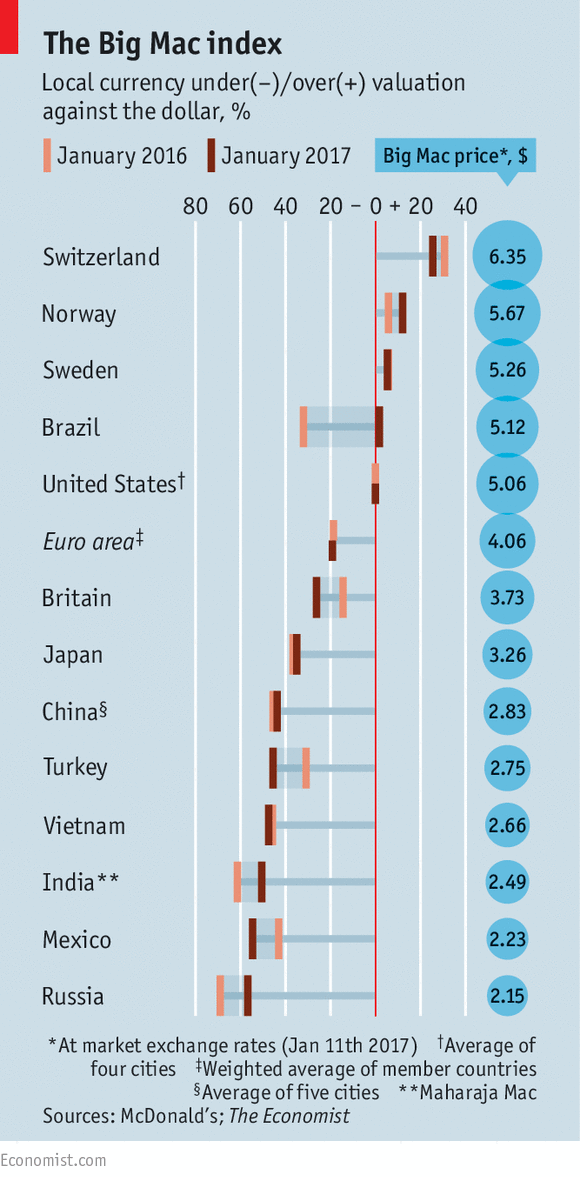
IT IS perhaps not surprising that the worst-performing major currency in the world this year is the Turkish lira. Many emerging-market currencies have taken a battering since the election in November of Donald Trump raised expectations of faster monetary tightening in America and sent the dollar soaring. But the lira has many other troubles to contend with, too: terrorist bombings, an economic slowdown, alarm over plans by the president, Recep Tayyip Erdogan, to strengthen his powers, and a central bank reluctant to raise interest rates to defend the currency. It has plunged to record lows. According to the Big Mac index, our patty-powered currency guide, it is now undervalued by 45.7% against the dollar.
The Big Mac index is built on the idea of purchasing-power parity, the theory that in the long run currencies will converge until the same amount of money buys the same amount of goods and services in every country. A Big Mac currently costs $5.06 in America but just 10.75 lira ($2.75) in Turkey, implying that the lira is undervalued.
However, other currencies are even cheaper. In Big Mac terms, the Mexican peso is…Continue reading
China’s reputation for low-cost manufacturing under attack

WHEN China was gripped by political turmoil in the 1960s and 1970s, Cao Dewang cut his teeth as an entrepreneur. Mao’s chaotic rule forced him out of school and he took to the street, a scrappy teenager selling fruit and cigarettes. Looking back, Mr Cao has said that it was actually a good time to do business: the government was too busy waging ideological campaigns to enforce its regulations. Mr Cao went on to become a billionaire, as China’s biggest manufacturer of automotive glass. Last month he sparked controversy by complaining that life was tough for businesses in China. There are, he said, far too many regulations—especially taxes and fees. These days the government is much more effective in enforcing them.
Mr Cao hit a nerve with his claim that it was more costly to run a business in China than in America. He should know. His company, Fuyao Glass, bought an old General Motors factory in Ohio in 2014 and announced plans to invest $200m there. Mr Cao claimed that the overall tax on manufacturers is 35% higher in China than in America. Once China’s higher land and energy costs are factored in, the advantages of its lower labour costs…Continue reading
Singapore tries to become a fintech hub

IN AN era when architectural masterpieces curve and bloom (Zaha Hadid), or shimmy and fold (Frank Gehry), designers of central-bank buildings remain reassuringly fond of right angles. The Monetary Authority of Singapore (MAS), the city-state’s central bank and financial regulator, is housed in a boxy tower just south of the central business district. But tucked into one corner is a room called “LookingGlass@MAS” that desperately wants to be Silicon Valley: witness the scruffily dressed young men, whiteboards on wheels covered in buzzwords and the kitchen along one wall.
This is the MAS’s fintech lab, where Singapore is trying to put its own twist on the technologies disrupting the financial sector. A report from Citigroup published in 2016 warned that as fintech lets customers do more online and cuts into banks’ lending and payments activities, European and American banks could lose almost 2m jobs in the next ten years. Similar fears stalk Singapore, home to more than 200 banks, and dependent on finance for 12.6% of GDP.
In London, Berlin and San Francisco, many fintech innovators are betting against the big banks. Singapore,…Continue reading
How fintech firms are helping to revolutionise supply-chain finance
 Still waiting for the invoice approval
GROWING up on a sugar-cane farm in Australia, Lex Greensill had a front-seat view of the strains suppliers suffer as they wait to be paid. After harvesting his crops, Mr Greensill’s father had to wait a year or more to receive payment. Across industries, buyers are eager to conserve their cash. Delaying payment is one way to do it: among the most important for some, such as big retailers, says Mr Greensill. Many buyers expect their suppliers to accept payment months after delivery. Even so, many still pay late—47% of suppliers surveyed by Taulia, a fintech firm, said they had this problem. In 2011 Mr Greensill founded Greensill Capital, one of a cluster of new fintech firms overhauling how supply chains are financed.
The details vary but their basic approach is to take advantage of buyers’ low credit risk to pay suppliers’ invoices promptly. The buyer—a large supermarket chain, say—approves a supplier’s invoice and transmits it to the fintech lender. (The lender can raise money in different ways: Greensill raises funds in the capital markets.) The lender pays the supplier on…Continue reading
Inflation is on the way back in the rich world, and that is good news

IT WAS telling that Germany, a country with a phobia of rising prices, in the first week of 2017 reported a jump in inflation. Its headline rate rose from 0.8% to 1.7% in December. After two years of unusually low price pressures, inflation across the rich world is set to revive this year. Much of this is because of the oil price, which fell below $30 a barrel in the early months of 2016 but has recently risen above $50 (see chart). Underlying inflation, too, seems poised to drift up. That is good news. The story for 2017 is not of inflation running too hot but rather of a welcome easing of fears of deflation.
To understand why, consider the three big drivers of inflation in the rich world: the price of imports, capacity pressures in the domestic economy and the public’s expectations. Start with imported inflation. A year ago, global goods prices were falling because of a slide in aggregate demand and a seemingly endless glut of basic commodities and manufactures. China’s economy wobbled. Emerging markets in general were in a funk; two of the largest, Brazil and Russia, were deep in recession.
Things look perkier now. Emerging markets…Continue reading
Argentina is admitted to a widely tracked bond index

EMERGING markets have not been the same without Argentina, a country that embodies the promise and peril, the romance and the rockiness of the asset class. In 1988 it was one of the ten original members of the most popular emerging-market equity index, introduced by MSCI. In the late 1990s it was also the biggest member of the benchmark-bond indices compiled by JPMorgan Chase. But once it defaulted at the end of 2001, Argentina was exiled from global debt markets. And after it subsequently imposed capital controls on “hot money”, its shares suffered a similar banishment, ejected from MSCI’s index in 2009. It became a remote “frontier market”, like countries such as Bangladesh.
Since Mauricio Macri succeeded Cristina Fernández de Kirchner as president at the end of 2015, Argentina has been finding its way back from the financial periphery. It has floated its currency and lifted capital controls, recently abolishing a remaining requirement that foreign investors keep their money in the country for at least 120 days. In April the government sold $16.5bn of dollar bonds to international investors in a single day (a record for an…Continue reading
Marine Le Pen’s nerve-jangling plans to revive the French franc

HOW do you solve a problem like Marine? Ms Le Pen, leader of France’s far-right National Front, has indicated that she hopes to reintroduce a national currency if she is elected president in May. In a recent speech, she suggested that government bonds would be redenominated in francs instead of euros.
The proposal was dressed up in technicalities. The franc would be revived as a “parallel” currency for official transactions and used alongside the euro in a version of the systems (the snake and the exchange-rate mechanism) that existed in the 1970s and 1980s. Such schemes tied European currencies together but were subject to regular crises, with France periodically devaluing the franc.
Investors would pretty quickly see through the façade. There is not much point in bringing back a national currency unless you want the right to devalue it. And there is not much point in redenominating government bonds in francs unless you want to pay creditors back less than they expected. (This might technically count as a default, according to Moody’s, a rating agency; it depends on the exact circumstances.) If that happened, it…Continue reading
To be relevant, economists need to take politics into account

EVERY January more than 10,000 economists meet for the annual conference of the American Economic Association (AEA). This year, the shindig was in balmy Chicago, a stone’s throw from its second-tallest building, the name TRUMP stamped in extra-large letters across its base. Most papers had been written months in advance; few sessions tackled the electoral earthquake in November. Yet there was no mistaking the renewed sense, following its failure to foresee the 2007-08 financial crisis, of an academic field in a crisis of its own. The election was seen as a defeat for liberalisation and globalisation, and hence for an economics profession that had championed them. If economists wish to remain relevant and useful, the modest hand-wringing at this year’s meetings will need to yield to much deeper self-reflection.
Their theories had always shown that globalisation would produce losers as well as winners. But too many economists worried that emphasising these costs might undermine support for liberal policies. A “circle the wagons” approach to criticism of globalisation weakened the case for mitigating policies that might have protected it from a…Continue reading