
Tag: Finance and economics
Sub-national currencies struggle to survive
 Five Bowies make a Winston
TUCKED away in a corner of Brixton, in south London, a rainbow-coloured ATM dispenses cash, looking for all the world like any other. But the notes it spews out are not pounds sterling. They are Brixton pounds (B£). Not to be mistaken for silly Monopoly money, the Brixton pound can actually be spent, legally: the currency, which has a fixed one-for-one exchange rate with sterling, is accepted at over 150 local shops and businesses. It can even be used to pay local taxes.
Launched in 2009, this is one of many such initiatives. Local currencies have been adopted in other towns and cities in Britain, such as Bristol, Exeter and Totnes. Elsewhere, examples include the eusko, used in the French Basques; BerkShares, used in western Massachusetts; and the Ithaca Hour, in Ithaca, New York. Barcelona plans an experiment in 2017.
Such schemes aim to boost spending at local retailers and suppliers, by encouraging the recirculation of money within a community. Because the currency is worthless outside its defined geographic area, holders spend it in the neighbourhood, thus creating a “local…Continue reading
The state steps in to rescue Monte dei Paschi di Siena

FOR months, a bail-out had seemed likely; for weeks, unavoidable. On December 23rd it became fact. Monte dei Paschi di Siena, Italy’s third-largest bank and Europe’s most troubled, announced it had requested state help. The European Central Bank (ECB), Monte dei Paschi’s supervisor, had given it until the end of the year to find €5bn ($5.2bn) in equity, but the bank’s attempts to raise the money from the private sector failed. Paolo Gentiloni, Italy’s new prime minister, said that “today represents a turning-point [for the bank] and a reassurance for its depositors and its future”.
That is the hope. The Tuscan lender’s problems have been rumbling for years. In 2007 it ill-advisedly bought Antonveneta, another Italian bank, from Spain’s Santander for €9bn in cash; more tales of mismanagement have emerged since. Monte dei Paschi has already had two state bail-outs, and raised €8bn from share issues in 2014 and 2015. Its gross non-performing loans amount to one-third of its book. In this summer’s European stress tests, it ranked 51st of 51 institutions. In the past year its stockmarket value has fallen by 88%, to a piddling…Continue reading
Germany’s biggest lender reaches a settlement with America’s Department of Justice

WELL, it might have been worse. Early on December 23rd Deutsche Bank announced that it had reached a settlement “in principle” with America’s Department of Justice (DoJ), over claims that it had mis-sold residential mortgage-backed securities (RMBSs) in 2005-07, in the run-up to the financial crisis. Deutsche says the agreement is worth $7.2bn—a far cry from the $14bn that the DoJ demanded in September, sending Deutsche’s share price reeling. Credit Suisse said that it too had struck a deal, worth $5.3bn. However, the DoJ is suing Barclays, with which it had also been negotiating, and two of its bankers. Barclays says it will fight the complaint.
Deutsche, Germany’s biggest bank, has always insisted that it would not pay anything like as much as the DoJ had asked for. Although $7.2bn is more than analysts had expected, investors will probably see the deal as good news: Deutsche will fork out only—“only”—$3.1bn in cash and pay the rest as “consumer relief”, such as changes to borrowers’ loans, which will be spread over five years. On the morning of the announcement the bank’s shares were trading 3-4% up.
Such…Continue reading
Japanese banks grapple with ultra-low interest rates

BANKS the world over are wrestling with low interest rates. Nowhere have they grappled for longer than in Japan. Although the Bank of Japan (BoJ) introduced negative rates only in January, almost 20 months after the European Central Bank, its rates have been ultra-low for years: they first hit zero in 1999. In its long battle against deflation, it pioneered “quantitative easing”—buying vast amounts of government bonds—which depresses longer-term rates and thus banks’ lending margins. Since September the BoJ has also aimed to keep the ten-year bond yield at around nought, while holding its deposit rate at -0.1%.
Banks have had some relief lately: since Donald Trump’s election in November, the yield curve has steepened slightly—and share prices have leapt—as American interest rates have risen and the yen has tumbled. But on December 20th the BoJ kept policy on hold.
For Japan’s biggest lenders, negative rates are “an irritant, not a catastrophe”, says Brian Waterhouse of CLSA, a broker. Every tenth of a percentage point below zero, he estimates, shaves 5% from the earnings of the three “megabanks”: Mitsubishi UFJ…Continue reading
What not to expect in 2017

IF 2016 was a year of shocks, what will the next 12 months bring? It is time for the annual tradition (dating all the way back to 2015) when this column tries to predict the surprises of the coming year.
By definition, a surprise is something the consensus does not expect. A regular survey of global fund managers by Bank of America Merrill Lynch (BAML) points to what most people believe. Following the election of Donald Trump, investors are expecting above-trend economic growth, higher inflation and stronger profits. They have invested heavily in equities and have a much lower-than-normal exposure to bonds.
So it is not too difficult to see how the first surprise might play out. Expectations for the effectiveness of Mr Trump’s fiscal policies are extraordinarily high. But it takes time for such policies to be implemented, and they may be diluted by Congress along the way (especially on public spending). Indeed, it may well be that demography and sluggish productivity make it very hard to push economic growth up to the 3-4% hoped for by the new administration. Neither fiscal nor monetary stimulus has done much to lift Japan out of its torpor,…Continue reading


Thomas Schelling, economist and nuclear strategist, died on December 13th, aged 95

WITHIN half an hour of waking up on October 10th 2005, Thomas Schelling received four phone calls. The first was from the secretary of the Nobel Committee, with news that he and Robert Aumann had jointly won that year’s prize for economics. During the fourth call, when asked how winning felt, he answered: “Well, it feels busy.” He was nothing if not truthful. He also confessed to feeling confused about which bit of his work had won the prize.
It might have been his work on addiction—flicked off like ash from his own struggles with smoking. Economists must understand, he wrote, the man who swears “never again to risk orphaning his children with lung cancer”, yet is scouring the streets three hours later for an open shop selling cigarettes. Mr Schelling’s work laid (largely unacknowledged) foundations for future behavioural economists. In his thinking, addicts have two selves, one keen for healthy lungs and another craving a smoke. Self-control strategies involve drawing battle lines between them.
The prize could also have been for his work on segregation, showing how mild individual preferences could lead to extreme group…Continue reading
European insurers and the curse of low interest rates

INSURANCE is banking’s boring cousin: it lacks the glamour, the sky-high bonuses and the ever-present whiff of danger. So European stress tests for insurers, whose results were due to be published on December 15th after The Economist went to press, have attracted far less attention than those for banks in July. Yet insurance also faces a grave threat, from prolonged low interest rates.
Insurers invest overwhelmingly in bonds, so low interest rates make their lives difficult. The last time the European Insurance and Occupational Pensions Authority (EIOPA) conducted an insurance stress test, in 2014, a quarter of participants scored poorly: they would not have met their capital requirements in the test’s long low-interest-rate scenario. The proportion jumped to 44% in an alternative scenario involving an asset-price shock. The new results are unlikely to be better. Each year of low interest rates worsens the problem. Higher-yielding bonds mature and insurers end up with ever more newer ones with low, or even negative, interest rates.
Insurers are focused on the problem. One strategy is to outsource more to external…Continue reading
A cheaper currency does not always boost economic growth
IN SEPTEMBER 2010 Brazil’s then-finance minister, Guido Mantega, gave warning that an “international currency war” had broken out. His beef was that in places where it was difficult to drum up domestic spending, the authorities had instead sought to weaken their currencies to make their exports cheaper and imports dearer. The dollar had recently fallen, for instance, because the Federal Reserve was expected to begin a second round of quantitative easing. The losers in this battle were those emerging markets, like Brazil, whose currencies had soared. Its currency, the real, was then trading at around 1.7 to the dollar.
These days a dollar buys 3.4 reais, but no one in Brazil or in other emerging markets with devalued currencies is declaring a belated victory. A cheap currency has not proved to be much of a boon. Indeed new research from Jonathan Kearns and Nikhil Patel, of the Bank for International Settlements (BIS), a forum for central banks, finds that at times a rising currency can be a stimulant and a falling currency a depressant. They looked at a sample of 44 economies, half of them emerging markets, to gauge the effect of changes in the exchange rate on exports and imports (the trade channel) and also on the price and availability of credit (the financial channel).
They found a negative relationship between changes in GDP and currency shifts…Continue reading
Do fiscal rules work in emerging markets?
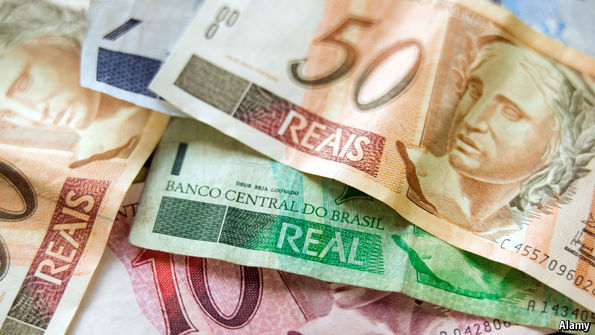
FROM its headquarters in Brasília, a sterile, technocratic city, Brazil’s federal government doles out money for health, education, generous pensions and artistic awards, among other things. Over the past two decades, this spending has grown by more than 185% in real terms. Over the next 20 years, its growth will be zero.
That, at least, is the intention of a constitutional amendment passed this week by Brazil’s Senate. The measure, which allows federal spending (excluding interest payments and transfers to states and municipalities) to grow no faster than inflation, is an unusually ambitious example of a fiscal rule: a quantitative limit on budget-making, which lasts beyond a single year and perhaps beyond a single government.
The best known, and least loved, fiscal rule is the euro area’s stability and growth pact. But such rules are also now common among emerging economies. According to the IMF’s latest count, 56 developing countries in 2014 had rules of some kind, including 15, like Brazil, that impose limits on the growth of public spending.
The reasons so many emerging-market governments choose to limit their fiscal…Continue reading