
Tag: Finance and economics
Venezuela’s lunatic experiment in demonetisation
 Bum notes
ANYTHING India does, Venezuela can do worse. Last month, in a dramatic effort to curb corruption, India’s government cancelled all its high-denomination banknotes without warning. Since 98% of transactions in India are done in cash, commerce seized up. It is a huge mess, but India will after a while print enough replacement notes. And it has a plausible plan to help its many poor people join the cashless digital economy.
Not so Venezuela. President Nicolás Maduro says that the constant shortages of more or less everything in Venezuela are caused by evil speculators. (They are actually caused by his price controls.) Mr Maduro claims that “mafias” in Colombia are stockpiling lorryloads of bolívars, the Venezuelan currency, and sneaking across the border to buy up price-controlled goods. Given Venezuela’s soaring inflation, this seems improbable. “The idea that anybody would want to hoard a currency that has lost 60% of its value in the past two months is absurd,” says David Smilde of the Washington Office on Latin America, a think-tank.
Nonetheless, on December 11th Mr Maduro announced that the…Continue reading
An early salvo in a trade war between America and China?
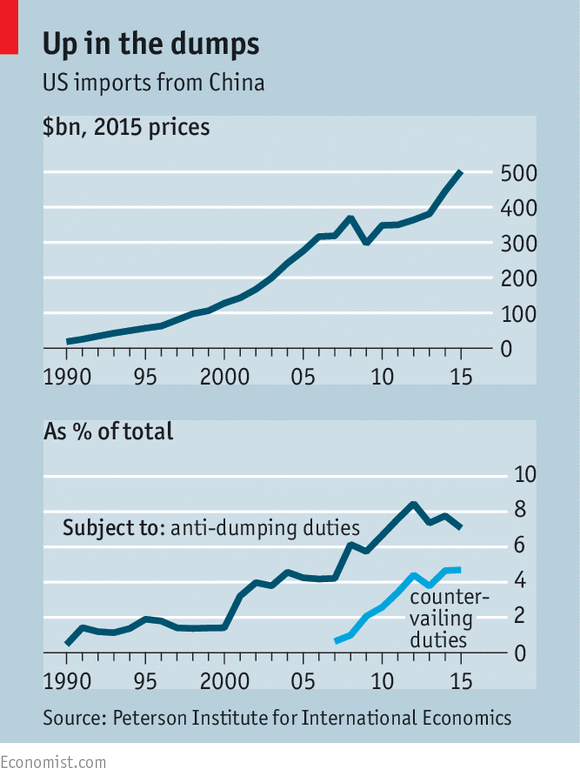
ANNIVERSARIES should be happier than that on December 11th, marking China’s 15 years as a member of the World Trade Organisation (WTO). On that day, China expected to be unshackled from its legal label as a “non-market economy” and attain “market-economy status”. In the event, America and the European Union refused to give it the nod. On December 12th the Chinese reacted: see you in court.
The fight will focus on the wording in the original accession agreement. The Americans and the Chinese are both confident of winning. Legal experts are divided. The WTO does not provide a clear definition of a “market economy”. And clumsy legal drafting does not help.
The meat of the row is over the method WTO members use to protect their industries against cheap Chinese imports. Alleging that Chinese companies enjoy subsidised credit, energy and raw materials, America and the EU slap anti-dumping duties on 7% (see chart) and 5% respectively of their Chinese imports. The agreement welcoming China into the WTO explicitly gave other members licence to treat it as a non-market economy until December 11th 2016….Continue reading
The Asian Development Bank tries to evolve

JUST outside the Asian Development Bank (ADB) headquarters, a barefoot girl in a tattered yellow shirt stretches out her hand as a few of its employees walk past. One gives her change—not exactly a textbook approach to development lending but a natural-enough impulse. “It reminds you of what you’re doing every day,” he says as he reaches into his wallet.
It is also a small reminder of what sets the ADB apart from its China-led challenger, the Asian Infrastructure Investment Bank (AIIB). Since its formal launch in 2015, the AIIB has garnered much more attention than the ADB. But the ADB is still much bigger, with a presence throughout Asia’s poorest areas and a focus on all aspects of development, from education to anti-corruption projects, not just infrastructure.
It also has an impressive track record. December 19th will mark the ADB’s 50th anniversary. It funds projects and provides policy advice from Georgia in the west to the Cook Islands in the east. It had a hand, albeit a small one, in the economic miracle Asia has witnessed in its lifetime. It has never suffered a default on the $250bn that it has doled out over the years…Continue reading
Italy’s biggest bank unveils a recapitalisation plan

THIS is no time to be timid. Or so Jean-Pierre Mustier seems to think. On December 13th, after five months in the job, the chief executive of UniCredit presented his plan for Italy’s biggest bank. He didn’t hold back. UniCredit is shedding €17.7bn worth ($18.8bn) of bad loans, taking a one-off provision of €8.1bn. It will save €1.7bn a year by 2019, cutting 6,500 jobs on top of 7,500 previously announced to shrink its workforce by 14%. And in a rights issue next year it will raise €13bn—just €2bn less than its market value before the announcement. The markets lapped it up: the shares gained 16%, before retreating the next day.
Mr Mustier had already been busy. The previous day UniCredit sold Pioneer, its asset-management arm, to France’s Amundi (though it will still distribute Pioneer’s products). It recently unloaded its stake in Bank Pekao, in Poland, as well as 30% of Fineco, an Italian online bank of which it will retain control. The bad-debt write-down, restructuring costs and other bits and bobs will partially offset the gains from these sales and the rights issue. But the boss expects UniCredit’s ratio of…Continue reading
The financial markets in an era of deglobalisation

FOR more than two decades after the early 1980s, it seemed as if the financial markets were moving in only one direction. More and more money was flowing across borders; capital markets were becoming increasingly integrated.
Since the 2008 financial crisis this particular aspect of globalisation has stalled, and even partly retreated. The reversal is illustrated by the triennial survey of foreign-exchange markets, conducted by the Bank for International Settlements (BIS). Daily turnover in April was $5.1trn, down from $5.4trn in April 2013.
That is still a huge number compared with the turn of the century, when daily turnover was around the $1trn mark. But it is a sign that markets are getting a little less frenetic; spot (or instant) currency trading has fallen by 19% in three years.
Other data from the BIS confirm the trend. Cross-border banking claims peaked in the first quarter of 2008 at $34.6trn. By the second quarter of 2010, they had dropped to $27.9trn, and they have never recovered their pre-crisis levels. In the second quarter of this year (the most recent data), claims were $28.3trn. Part of this may be a…Continue reading
Place-based economic policies as a response to populism

HOW do you solve a problem like Ohio? Over the course of a generation America’s once-thriving industrial heartland has withered. Economic stress has contributed to rising rates of drug addiction and falling life-expectancy. Frustrated, Ohioans and other Midwesterners pushed Donald Trump to victory in November. That has focused attention on the plight of declining industrial areas in the rich world. Yet orthodox economics has few answers to the problem of regional inequality.
Economists used to think the best policy was often merely to wait. From 1880 to 1980 the incomes of poorer and richer American states tended to converge, at a rate of nearly 2% per year, according to research by Peter Ganong and Daniel Shoag of Harvard University. That pattern has since broken down (see chart). Yet the shift of resources and the movement of people from declining places toward thriving ones remains an important part of the process of economic growth. In theory, the gains should be big enough to compensate those harmed by the shift, leaving everyone better off. “Governments should not try to rescue failing towns,” The…Continue reading
Republican plans to cut corporate taxes may have unpleasant side-effects

SINCE Donald Trump won America’s presidential election investors have salivated over the prospect of lower taxes. Mr Trump has promised to cut corporation tax, a levy on firms’ profits, from 35% to 15%. Republicans remain in charge of both houses of Congress; Paul Ryan, the speaker of the House of Representatives, wants to cut the levy to 20%. The coming reforms, though, are about more than just lower rates. Republicans want to overhaul business taxes completely. Unfortunately, this task is far from straightforward.
America’s corporate-tax rate, which reaches 39.6% once state and local levies are included, is the highest in the rich world. But a panoply of deductions and credits keeps firms’ bills down. These include huge distortions, such as a deduction for debt-interest payments, as well as smaller scratchings of pork like special treatment for NASCAR racetracks. After all the deductions are doled out, corporate-tax revenues are roughly in line with the average in the rest of the G7, according to economists at Goldman Sachs.
Still, a high tax rate and a narrow tax base is a glaringly inefficient combination. Politicians of all…Continue reading
Winners and losers from the Trump stockmarket rally
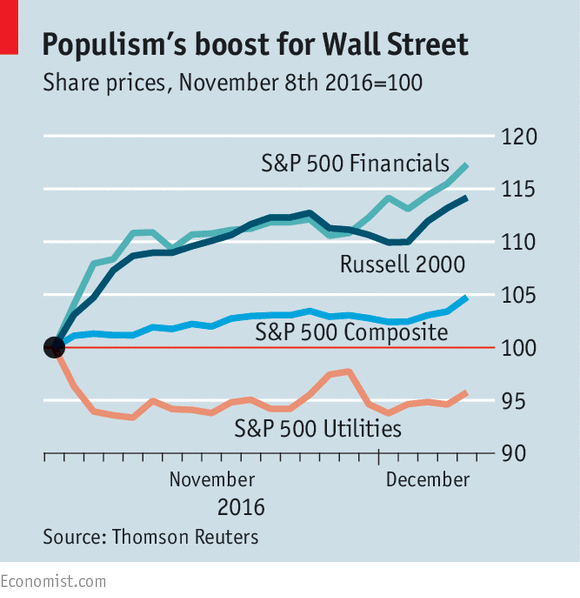
SELL on the rumour, buy on the news runs one version of a hoary stockmarket adage. And it certainly applied to last month’s presidential election. Before the poll, many investors were concerned about the risk that Donald Trump might become the 45th president. But as soon as the result was confirmed, they piled into shares. American equity mutual funds enjoyed four consecutive weeks of inflows, the longest streak since 2014, according to EPFR Global, a data provider.
One driver of the rally was Mr Trump’s planned fiscal stimulus. Investors believe this will lead to bigger deficits; hence the rise in bond yields since the election. But they also hope it will boost the American economy. That may explain why the Russell 2000 index of smaller companies, which tend to have a domestic focus, has outperformed the S&P 500 since the election (see chart). If this goes on, such stocks may become known as the Trumpettes.
Another factor was the planned cut in corporate-tax rates. The official American corporate income-tax rate is 35% (rising to 39% when state taxes are added). Standard & Poor’s, a ratings agency, reckons that the effective rate paid…Continue reading
Italian banks after the referendum

THE first casualty was Matteo Renzi’s hold on office. As he had promised, Italy’s prime minister resigned on December 7th, three days after voters rejected his proposals to overhaul the constitution. The second is likely to be a planned private-sector recapitalisation of Banca Monte dei Paschi di Siena, the country’s third-biggest bank and the world’s oldest. As The Economist went to press, the scheme’s chances looked slim. A government rescue was reportedly being prepared.
Monte dei Paschi has been in trouble for years. It has already had two state bail-outs and frittered away €8bn ($10bn) raised in share sales in 2014 and 2015. Its stockmarket value has dwindled to €600m, having fallen by 85% this year (see chart). Its non-performing loans (NPLs), even after provisions, are 21.5% of its total; the gross figure is 35.5%. In July it fell ignominiously short in European stress tests, ranking 51st of 51 lenders. The European Central Bank, its supervisor, asked it to raise more capital by the end of the year. This week the bank asked for more time.
Pre-empting the test results, Monte dei…Continue reading
The Federal Reserve prepares to raise interest rates again

AMERICA’S central bank tries to be predictable. When in December 2015 it raised interest rates for the first time since 2006, nobody was much surprised. The central bank had telegraphed its intentions to a tee. Similarly, if the overwhelming consensus in financial markets is to be believed, on December 14th—almost exactly a year later—rates will rise again, to a target range of 0.5-0.75%. Donald Trump’s tweets and phone calls may upend trade, fiscal and foreign policy in a matter of minutes, but Janet Yellen, the Federal Reserve’s chairwoman (pictured), is tweaking monetary policy at only a cautious annual pace.
Yet in another sense, the Fed has confounded predictions—at least, those it made itself. A year ago the median rate-setter foresaw four rate rises in 2016. None has happened yet. This might seem like a straightforward reaction to events. At the start of the year, stockmarkets sagged on worries about Chinese growth. Then, in June, Britain voted to leave the European Union, sending markets spinning again for a while. But the delay also resulted from a gradual acceptance by Fed officials that low rates have become a longer-lasting…Continue reading