
Tag: Finance and economics
The dollar’s strength is a problem for the world

WHEN economic historians look back on the years following the global financial crisis, they might ponder the exact moment at which the boom in offshore dollar-lending reached its zenith. Was it September 2012, when Zambia issued its debut Eurobond (dollar-denominated bond), at a yield of 5.4%, and received $12bn of orders? Perhaps it was a year later, when investors gobbled up an $850m Eurobond issue by a state-backed tuna-fishing venture in Mozambique. In between Petrobras, Brazil’s state oil company, was able to issue $11bn of ten-year bonds in May 2013, a record for an emerging-market firm, at a generously low yield of 4.35%.
Investors had reason to regret those purchases even before the dollar’s latest surge. Between November 9th, when Donald Trump won the presidential election in America, and the Thanksgiving holiday, the dollar rose by 3% against a basket of rich-world currencies. Such a jump in so short a time is rare. The dollar-borrowing binge during these years helps explain why the greenback bounced so sharply.
By the end of last year, governments and businesses outside America had racked up $9.7trn of debts denominated in…Continue reading
What Donald Trump’s election means for government-bond markets

THE death of the long bull market in bonds has been called many times in recent years. Such a consummation is devoutly wished for by those who think the global economy will never get back to health until short- and long-term interest rates return to more normal levels.
Following the election of Donald Trump as American president, the funeral rites are being read again. The yield on the ten-year Treasury bond jumped from 1.73% (while the votes were being counted) to 2.36% at one stage; the yield on the two-year bond rose from 0.78% to 1.12%. (Bond prices fall as yields rise.)
The rationale for the shift is the belief that Mr Trump will push through a fiscal stimulus, in the form of tax cuts and infrastructure spending. Not only will that boost the American economy but it will allow the Federal Reserve to return monetary policy to more “normal” levels by pushing up rates from the current 0.5%. It could also lead to higher inflation in the medium term. Forecasts for American inflation in the early 2020s can be derived from the bond market. In July, they pointed to 1.4%; now they imply 2.1%. All three factors—faster…Continue reading
The dire consequences of India’s demonetisation initiative

SUPPOSE that one day the government of a large and fast-growing economy became convinced that its highest priority was to purge the country of black-economy millionaires hoarding piles of illicit cash. Seeking popular approval, it sent the printing presses into overdrive, hoping to inflate away the value of these secret piles of wealth. It worked: rising prices struck a blow against the undeserving rich, and by egging on others to deposit their money in banks (where it could at least earn interest), the shadow economy shrank. The government could plough the newly created money into tax breaks and public-works schemes.
Critics, rightly, would stand aghast. Inflation would affect everyone who held cash, law-abiding or not. Much of the wealth of those enriched by the black economy would be insulated, because lots of their lucre is held not in cash but in property, gold or jewellery. Such heavy-handed measures could undermine the credibility of important government institutions. Fear that they might be used again in future could weaken confidence in the currency as a store of value—paving the way for some broader institutional failure, like hyperinflation….Continue reading
India grapples with the effects of withdrawing 86% of cash in circulation
 A short, sharp liquidity shock
A NEW strain of trickle-down economics has been spawned by the decision, on November 8th, to withdraw the bulk of India’s banknotes by the end of this year. As holders of now-useless 500-and 1,000-rupee ($15) notes rushed to deposit them or part-exchange them for new notes, an e-commerce site offered helpers, at 90 rupees an hour, to queue outside banks in order to save the well-off the bother.
Elsewhere, a chronic shortage of banknotes in a cash-dominated economy has left most trades depressed. Seven out of ten kiranas (family-owned grocers) have suffered a decline in business, according to a survey by Nielsen, a consultancy. Supply chains, in which wholesalers and truckers deal mostly in cash, have fractured. Some 20-40% less farm produce reached markets in the days after the reform. City folk admit to hoarding the 100-rupee note, the largest of the old notes to remain legal tender. Taxi drivers refuse to break the new 2,000-rupee note. Road-tolls have been suspended until at least November 24th, to prevent queues. Beggars have disappeared from parts of Delhi; no one has…Continue reading
American bankers look forward to a bonfire of financial rules

BEFORE the presidential election, Wall Street dreaded Donald Trump as a dangerous, unpredictable and disruptive, if improbable, president. Since his victory, fear has turned to hope. Stockmarkets are at record highs and shares in financial institutions have been among the best performers. Mr Trump, it turns out, looks to big finance like good news.
Partly this reflects Mr Trump’s change of tack. He campaigned as the leader of a rustbelt revolt against the besuited, pampered elites. As president-elect, he seems less of an outsider. Among the rumoured names he has been mulling as his choice for treasury secretary are Jamie Dimon, boss of JPMorgan Chase, and Steven Mnuchin, a 17-year veteran of Goldman Sachs. Wall Street’s access to the corridors of power seems likely to be unimpaired.
But the euphoria mostly reflects the finance industry’s excitement at one of the more achievable of Mr Trump’s campaign promises: to cut red tape. In a YouTube video this week outlining his priorities, he announced a new rule: for every new regulation, two old ones must be eliminated. No industry in America feels as browbeaten by regulators as does…Continue reading
British mutual-fund fees are too high

BANKS tend to grab the headlines when it comes to financial scandals and systemic risk. But many people have a lot more money squirrelled away with the asset-management industry, in the form of pensions and lifetime savings, than they do in their bank accounts. A new report* from one of Britain’s regulators, the Financial Conduct Authority (FCA), suggests that the industry is not doing a great job at looking after investors’ interests.
The British fund-management industry is huge, with some 1,840 firms managing around £6.9trn ($8.6trn) of assets. With the ten biggest fund managers representing only around 47% of the market, competition ought to be pretty intense. But the FCA report finds that fees in the actively managed sector (ie, funds that try to beat the market by picking the best stocks) have barely shifted in the past ten years. Operating margins across a sample of 16 fund-management firms have averaged 34-39% in recent years, one of the highest of any industry. Profits that heady smack more of an oligopoly than of a cut-throat battle for business.
There is one part of the market where fees have come down—passive, or tracker, funds…Continue reading
Malaysia’s central bank tries to stem a slide in the ringgit
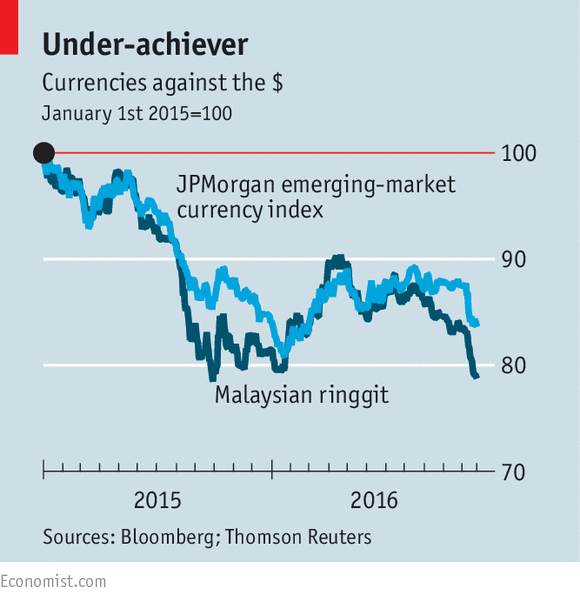
“THERE is no new policy on capital flows. There is no proxy capital control either,” insisted Muhammad Ibrahim, governor of Malaysia’s central bank, in a dinner speech on November 18th. This echoed a similar central-bank promise 15 months ago. For those hoping to bring money in and out of Malaysia, the commitments are reassuring. The frequency with which they need reiterating is less so.
It is no secret that the central bank is worried about the sharp drop in Malaysia’s exchange rate. Like other emerging-market currencies, the ringgit has suffered from China’s slowdown in the past two years and Donald Trump’s upset victory on November 8th. But, like Malaysia’s politics, beset by lurid tales of financial malfeasance, the currency has been unusually skittish (see chart).
Mr Muhammad blames what he calls “the arbitrary and unpredictable devices of the offshore markets”. Whereas China has been keen to “internationalise” the yuan, Malaysia’s central bank has an equally determined policy of “non-internationalisation”. It prohibits the trading of ringgit assets outside of its…Continue reading
The global bond-market rally tests Japan’s ability to keep yields down

HARUHIKO KURODA is not a man to be put off by an unexpected setback. On November 17th the governor of the Bank of Japan (BoJ) gave his defiant take on the implications for Japanese monetary policy of the global market gyrations that have followed the surprise election of Donald Trump. Interest rates, he noted, have risen in America. “But that doesn’t mean that we have to automatically allow Japanese interest rates to increase in tandem.”
A sell-off triggered by Mr Trump’s win wiped more than $1.2trn off the value of the world’s bond markets as investors bet that his administration will stoke America’s economic engines and drive up inflation. Bond yields rose sharply around the world as investors sold assets to buy dollar-denominated ones. In Japan the yen weakened and the yield on ten-year government bonds (JGBs) crept above zero for the first time in nearly two months. Since he was appointed by Shinzo Abe, the prime minister, in March 2013 as custodian of the monetary wing of “Abenomics”, Mr Kuroda has been fighting to end years of debilitating deflation. Keeping bond yields down is an important part of that…Continue reading
A showdown looms over bank-capital rules
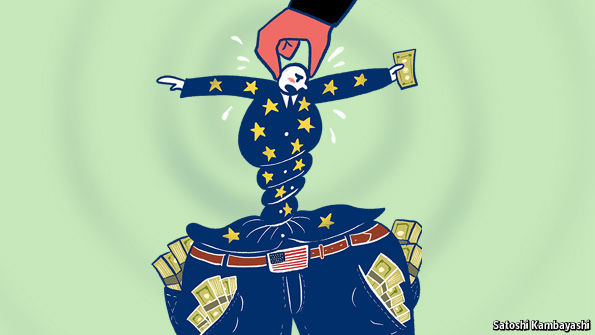
THEY lack the magic of “Harry Potter” and provoke even less laughter than “Police Academy”, but the sequels keep coming. In Santiago on November 28th and 29th the committee of central bankers and supervisors from nearly 30 countries that draws up global bank-capital standards is due to thrash out revisions to Basel 3, the version agreed on after the financial crisis of 2008. European (and some Asian) bankers and officials fear additional capital requirements are coming; Americans are all for the changes. Stand by for a standoff in Chile.
Spurred by Basel 3, banks have stuffed billions into capital cushions that the crisis showed to be woefully thin. Between mid-2011 and the end of last year, 91 leading lenders bolstered their common equity by €1.4trn ($1.5trn), or 65%, according to the Bank for International Settlements (BIS), which provides the Basel committee’s secretariat. The ratio of equity to risk-weighted assets, an important regulatory gauge, climbed from 7.1% to 11.8%. Although Basel 3 need not be fully honoured until 2019, most banks are far above the minimum of 4.5% (additional buffers, some at national level, raise the actual floor…Continue reading
Economists are prone to fads, and the latest is machine learning
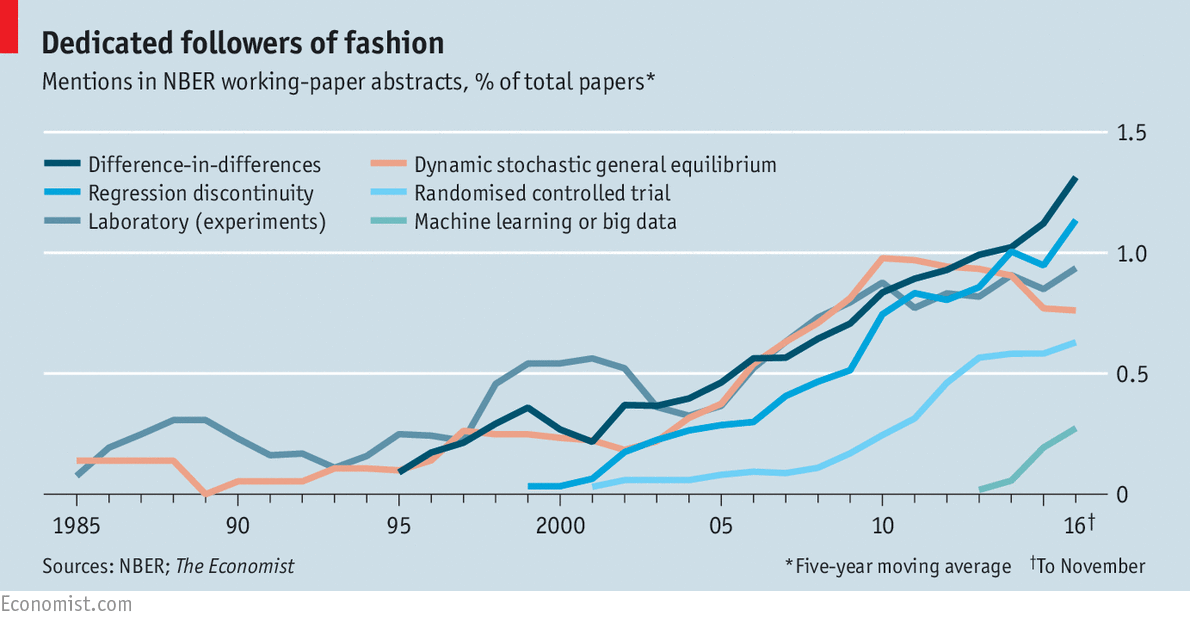
WHAT is the collective noun for a group of economists? Options include a gloom, a regression or even an assumption. In January, when PhD students jostle for jobs at the annual meeting of the American Economic Association, a “market” might seem the mot juste. Or perhaps, judging by the tendency of those writing economic papers to follow the latest fashion, a “herd” would be best. This year the hot technique is machine learning, using big data; Imran Rasul, an economics professor at University College, London, is expecting to read a pile of papers using this voguish technique.
Economists are prone to methodological crazes. Mr Rasul recalls past paper-piles using the regression-discontinuity technique, which compared similar people either side of a sharp cut-off to gauge a policy’s effect. An analysis by The Economist of the key words in working-paper abstracts published by the National Bureau of Economic Research, a think-tank (see chart), shows tides of enthusiasm for laboratory experiments, randomised control trials (RCTs) and the difference-in-differences approach (ie, comparing trends…Continue reading