
Tag: Finance and economics
A Dallas public pension fund suffers a run
 The mayor and Dallas’s finest
BANK runs, with depositors queuing round the block to get their cash, are a familiar occurrence in history. A run on a pension fund is virtually unprecedented. But that is what is happening in Dallas, where policemen and firefighters are pulling money out of their city’s chronically underfunded plan, and Mike Rawlings, the mayor, is suing to stop them.
At the start of the year the fire and police pension fund had $2.8bn in assets. Since then nearly $600m has been withdrawn from the plan, of which almost $500m has been taken out since August 13th. That is an alarming acceleration; in 2015 total withdrawals were just $81m.
Even at the start of 2016, the plan was just 45% funded, and was expected to become insolvent within 15 years. When some workers take out their money, they get the full value of their benefits; leaving a smaller pot to be shared among the remaining members. (The city estimates that the funded ratio has fallen to 36% after the withdrawals.) As in a bank run, it seems rational to withdraw your money if you worry that all the benefits won’t be paid.
The crisis…Continue reading
An epic legal battle with big implications for litigation funding

FOUNDED by former African American slaves, the west African country of Liberia has produced an insurance case that has bounced between the courts of several countries for a quarter of a century, condemning the claimants and their opponent to a generation of legal bondage. At long last, the saga might just be drawing towards a conclusion. It may also leave a legacy: to shift the calculus when third-party litigation funders assess the risks they face.
In the early 1990s, Liberia’s biggest importer, Lebanese-owned AJA, sued Cigna, an American insurer, in the federal court in Philadelphia for refusing to pay out over property damage incurred during Liberia’s civil war. AJA won, but a district-court judge overturned the verdict with a “judgment notwithstanding the verdict”—a rare device that can be employed when a jury is deemed to have deviated far from the law (in this case by failing to acknowledge a war-risk exclusion). The judge’s move was upheld by a higher appeal court.
Livid, AJA applied to Liberian courts and in 1998 won a judgment for $66.5m (now worth double that with interest). Cigna counter-sued, and in 2001 won an…Continue reading
Economic integration and the “four freedoms”

“WHAT’S the model? Have cake and eat it.” So read handwritten notes, snapped in the hands of an official of Britain’s ruling Conservative Party, as she left a meeting in Downing Street on Brexit strategy in late November. Britons seem keen to pick and choose from a menu of ties with Europe—in particular, to retain access to the single market while gaining more control over migration. Angela Merkel, the chancellor of Germany, is unwavering. In a speech in Berlin on December 6th she reiterated that Europe’s “four freedoms” are inseparable and inviolable. Countries hoping to share in the free movement of goods, services and capital must accept the free movement of labour as well.
The European project was meant above all to be a process of economic integration (intended, in the words of the Schuman declaration in 1950, “to make war [within Europe] not merely unthinkable but materially impossible”). Dissatisfaction with the EU often boils down to the suspicion that its original mission of economic integration has morphed into a misguided push for political union. Which one of these agendas does the free movement of people…Continue reading
The European Central Bank’s quantitative-easing options

THE response of bond, stock and currency markets to the result of Italy’s referendum, and the resignation of its prime minister, Matteo Renzi, was a jaw-breaking yawn. The euro fell a bit against the dollar, and then rallied. The yield on Italy’s ten-year bonds ticked up a few basis points and then fell to 1.89%. The markets had expected a No vote and priced it in, is one view. The calm probably also owed much to a belief that the European Central Bank (ECB) would act to stem any panic.
As The Economist went to press, the ECB’s governing council was widely expected to extend its monthly purchases of government and other bonds (“quantitative easing”, or QE) beyond March 2017. These purchases (which began at a monthly rate of €60bn and then increased to €80bn), plus the ECB’s myriad schemes to provide long-term liquidity to banks, have worked like a charm. Financing costs in the euro zone’s periphery have converged on those of core countries (see chart). All governments, apart from Greece, can borrow in bond markets at tolerable rates. A nagging worry is that the ECB cannot keep up this support…Continue reading
Insurers grapple with cyber-attacks that spill over into physical damage

AS HACKERS wreak havoc with depressing regularity, the insurance industry finds itself forced to contemplate a whole new set of risks. They range from the theft of millions of credit-card numbers from American retailers to the disabling of the power grid, as happened in Ukraine last December. The dedicated “cyber-insurance” policies that companies offer against data breaches have become relatively routine. But the risks they insure under other policies are also affected by cyber-risks—and they are still struggling to understand this so-called “silent” cyber-exposure.
Insurance that protects firms who suffer data breaches has been on offer for around 15 years. It is much harder to put a precise value on, for example, stolen health records than on a property or car. Insurers sidestep the problem by covering only the direct costs that a company incurs from a hack. Typically, these include hiring a specialised forensics firm to work out exactly what was stolen, notifying affected customers (which 47 American states currently require), short-term business interruption and fines.
The industry will be shaken up by new EU data-protection…Continue reading
Africa’s stock exchanges meet but size holds them back
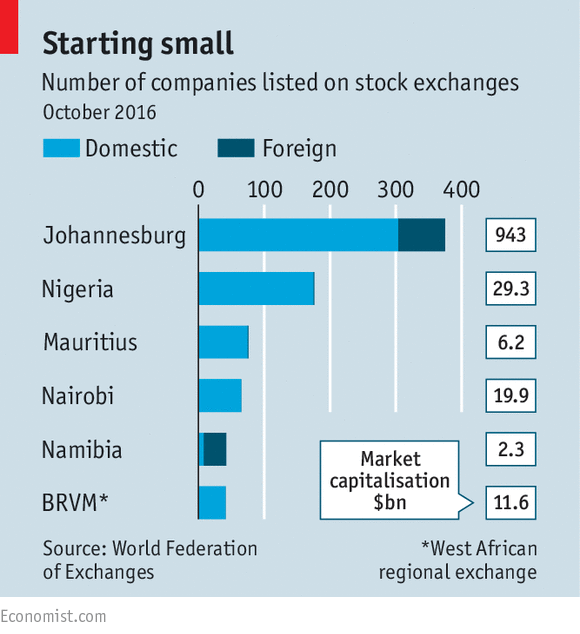
AS THE trading bell rings, a handful of brokers, in crisp scarlet jackets, gather around a whiteboard at the Rwanda Stock Exchange in Kigali. There are only seven listed companies, and it takes just a couple of minutes to write up the day’s bids. But Celestin Rwabukumba, its chief executive, is excited for the future. “If it works elsewhere, then why not here?” he asks.
Why not indeed? Johannesburg, with a market capitalisation of nearly $1trn, is in a league of its own. But sub-Saharan Africa has many small exchanges, lots of them created in the 1990s to help privatise state enterprises. Most struggle to attract new issues. Seven of the eight domestic listings on the Uganda Securities Exchange came from government divestments. Older exchanges, in Kenya and Nigeria, are dominated by big firms: a third of Nigeria’s market is the Dangote Group, a conglomerate with interests from cement to salt.
Stock-exchange leaders were in Kigali this week for the annual conference of the African Securities Exchanges Association. Much of the talk was about coaxing smaller, family-owned businesses to list. But many owners are loth…Continue reading
Sell-side share analysis is wrong
“SELL-SIDE” analysts, whose firms make money from trading and investment banking, are notoriously bullish. As one joke goes, stock analysts rated Enron as a “can’t miss” until it got into trouble, at which point it was lowered to a “sure thing”. Only when the company filed for bankruptcy did a few bold analysts dare to downgrade it to a “hot buy”.
Economic research shows that there is some truth to the ribbing. The latest figures from FactSet, a financial-data provider, show that 49% of firms in the S&P 500 index of leading companies are currently rated as “buy”, 45% are rated as “hold”, and just 6% are rated as “sell”. In the past year, 30% of S&P 500 companies yielded negative returns.

Profits forecasts made more than a few months ahead have a dismal record of inaccuracy. According to Morgan Stanley, a bank, forecasts for American firms’ total annual earnings per share made in the first half of the year had to be revised down in 34 of the past 40 years. Studying their forecasts over time reveals a predictable pattern (see chart 1).
In theory, a diligent share analyst should do his own…Continue reading
Revising bank-capital standards
A STEEP climb awaited the Basel Committee on Banking Supervision in Santiago on November 28th and 29th. The central bankers and regulators hoped to agree on revisions to Basel 3, the post-crisis version of bank-capital standards. On November 30th Stefan Ingves, the group’s chairman and head of Sweden’s central bank, said that “the contours of an agreement are now clear”. But the climbers are still short of the summit.
The committee had proposed restricting the use of banks’ internal models for calculating risk-weighted assets—which in turn help determine how much capital banks must have at hand. Models varied too much, it said; low risk-weights were flattering some banks’ ratios. But European bankers and officials had complained for months that the proposals would penalise banks that have lots of (low-risk) corporate loans or mortgages (eg, in Germany or Sweden). They sniffed an American plot: American banks, holding fewer such assets, would be untouched.
Mr Ingves gave few details, but said that the new set-up would “largely retain” internal models, though with minimum values for important parameters (such as the probability of default). A “standardised” approach will replace alternatives based on banks’ models for estimating operational risk (big fines, say, or cyber-security breaches).
Not surprisingly, the thorniest topic…Continue reading
The yuan’s weakness is a dilemma for China’s central bank

YUAN forecasters have had it easy for the past decade. But for a few isolated days, China’s currency has been a one-way bet for years on end, whether appreciating against the dollar, pegged to it or, more recently, depreciating. The pace at which it has risen and fallen has also been predictable: the central bank always made it gradual. So Guan Qingyou, of Minsheng Securities, thought himself on solid ground when he predicted in early November that the yuan would stay above 6.82 per dollar for the rest of the year. Less than a week later he was proved wrong: the yuan fell to an eight-year low. Mr Guan published an apology: the art of knowing the yuan’s future with any precision, he conceded, had become rather tricky.
Most analysts, investors and companies believe that the Chinese currency has further to fall against the dollar, but can only guess as to how far and how quickly. Their uncertainty reflects a new reality. The government, long able to exercise tremendous control over the yuan, has started to lose its grip. A new exchange-rate mechanism, introduced last year, has made the currency more flexible but also more responsive to…Continue reading
OPEC reaches a deal to cut production

EXACTLY two years after Saudi Arabia coaxed its fellow OPEC members into letting market forces set the oil price, it has performed a nifty half-pirouette. On November 30th it led members of the oil producers’ cartel in a pledge to remove 1.2m barrels a day (b/d) from global oil production, if non-OPEC countries such as Russia chip in with a further 600,000 b/d. That would amount to almost 2% of global production, far more than markets expected. It showed that OPEC is not dead yet.
The size of the proposed cut, the first since 2008, caused a surge in Brent oil prices to above $50 a barrel. Some speculators think it may mark the beginning of the end of a two-year glut in the world’s oil markets, during which prices have fallen by half and producers such as Venezuela have come close to collapse. As long as prices continue to recover, Saudi Arabia can probably shrug off the fact that its previous strategy damaged OPEC at least as badly as non-members, and that this week’s deal gave more breathing space to its arch-rival Iran than it would have liked.
The rally’s continuation, however, depends on non-OPEC members such as Russia reliably committing…Continue reading