
Tag: Finance and economics
Awards
Awards: Tom Easton, our American finance editor, was named journalist of the year by the CFA Society of the UK in a ceremony on January 11th. The Economist was named publication of the year.
China’s currency upsets forecasts by beginning the new year stronger

THE omens for the Chinese yuan seemed bad heading into 2017. The capital account looked as porous as ever, making a mockery of the government’s attempts to fix the leaks. The new year, when residents received fresh allowances for buying foreign currency, was due to bring even more pressure. The mighty dollar would be a magnet for Chinese investors as it strengthened still further in the run-up to Donald Trump’s inauguration. Analysts braced for a stampede for the exits from China. The yuan had fallen sharply at the beginning of 2016, catching them by surprise. This time, they were ready.
Instead, the yuan began the year as one of the world’s star performers. This was particularly so in the offshore market, where foreigners trade it most freely. It gained 2.5% against the dollar over two days in the first week of 2017, its biggest two-day increase since 2010, when trading began in Hong Kong, its main offshore hub. Within China itself, price increases were more subdued, but the yuan still climbed to a one-month high.
The high economic costs of India’s demonetisation

MOST economists might hazard a guess that voiding the bulk of a country’s currency overnight would dent its immediate growth prospects. On November 8th India took this abstruse thought experiment into the real world, scrapping two banknotes which made up 86% of all rupees in circulation. Predictably, the economy appears indeed to have been hobbled by the sudden “demonetisation”. Evidence of the measure’s costs is mounting, while the benefits look ever more uncertain.
At least the new year has brought a semblance of monetary normality. For seven weeks queues had snaked around banks, the main way for Indians to exchange their old notes for new ones or deposit them in their accounts. That is over, largely because the window to exchange money closed on December 30th. The number of fresh notes that can be withdrawn from ATMs or bank counters is still curtailed, but the acute cash shortage is abating, at least in big cities.
As data trickle through, so is evidence of the economic price paid for demonetisation. Consumers, companies and investors all wobbled in late 2016. Fast-moving consumer goods, usually a reliable growth sector, retrenched…Continue reading
Supervisors put off finalising reforms to bank-capital rules

SOME banks find existing capital requirements too taxing. To no one’s surprise, on December 23rd Monte dei Paschi di Siena, at present Italy’s fourth-biggest bank, asked the Italian state for help, having failed to raise from the private sector €5bn ($5.2bn) in capital demanded by the European Central Bank before the year’s end. Three days later Monte dei Paschi said that the ECB had redone its sums—and concluded that the stricken lender faced an even bigger shortfall, of €8.8bn.
Plenty of other European banks—in far better nick than poor old Monte dei Paschi, which is overloaded with bad loans—are grumbling that they too may eventually have to find more capital. They have spent years plumping up cushions that the financial crisis showed to be worryingly thin, but fear that proposed adjustments to Basel 3, the latest global standards, will require more. The Basel Committee on Banking Supervision, which draws up the standards, had hoped to agree on the revisions by the end of 2016. It’s not there yet: on January 3rd an imminent meeting of central-bank governors and supervisors, to approve the changes, was postponed.
The…Continue reading
2016 may have been an economic as well as political turning-point
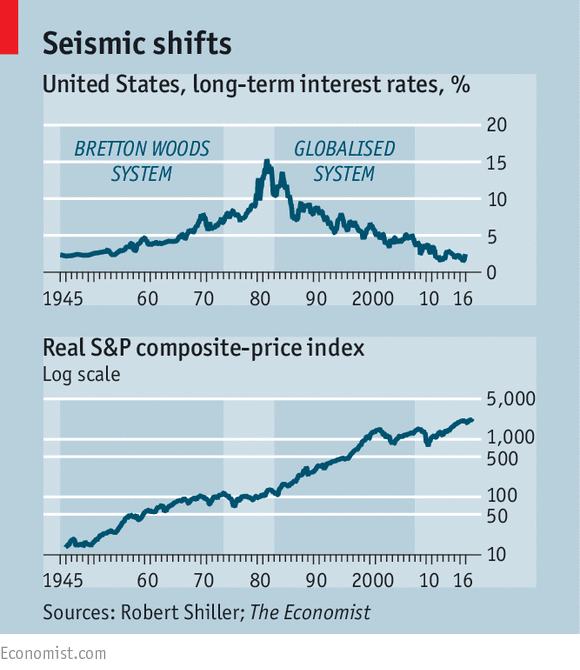
THANKS to Brexit and the election of Donald Trump, 2016 is widely viewed as a political turning-point. But it may also come to be seen as an economic turning-point, marking the third big change of direction since the second world war.
The post-war period from 1945 to 1973 was the era of the Bretton Woods system of fixed exchange rates and capital controls. It was a time of rapid economic growth in the rich world as countries rebuilt themselves after the war and as the technological innovations of the first half of the 20th century—cars, televisions, and so on—came into widespread use. High taxes reduced inequality; fiscal policy was used to control the economic cycle. It all came crashing down in the early 1970s as the fixed-currency system collapsed, and an oil embargo imposed by Arab producers ushered in stagflation (ie, high unemployment combined with inflation).
By the early 1980s, a new system had emerged. Currencies floated, capital controls were abolished, the financial sector was liberalised, industry was privatised and tax rates on higher incomes were cut. In this system inequality widened again (although…Continue reading
“Open outcry” is in retreat but futures and options trading-volumes surge
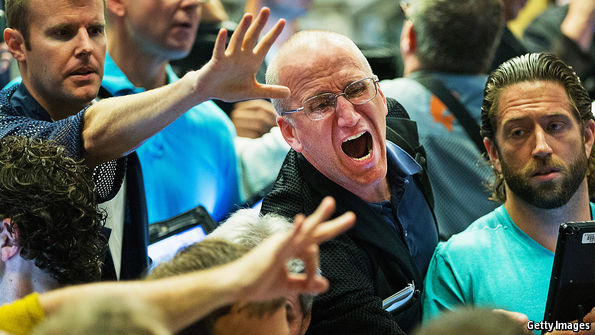 Nothing to outcry about
AS A new trading year began this week in the art-deco tower that houses the Chicago Board of Trade, big men were clustered around pits dealing in futures and options tied to various commodities. Their approach dates back to the building’s opening in 1930, and was once familiar in cities throughout America. But after decades of attrition, on December 30th the CME Group (named after the Chicago Mercantile Exchange) closed the “open outcry” trading pits that it operated in New York. In America, Chicago’s hue and cry has become unique.
Even this exchange is a shadow of its former self. There are now nine pits, down from 32 in 2007. A once teeming trading floor was closed in 2015. Most activity in the contracts still traded in the pits is electronic. No one in the surviving CME pits in Chicago seems worried by the New York closures. But they have a symbolic impact. The markets have long been a colourful, fractious component of America’s financial architecture.
They have always lured the ambitious. Two alumni of New York’s commodity markets have joined the Trump administration. Gary…Continue reading
Anthony Atkinson, a British economist and expert on inequality, died on January 1st
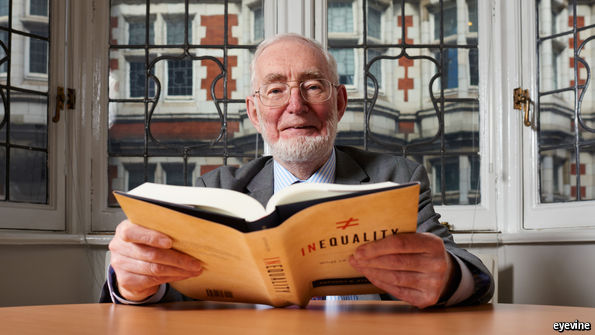
“TIME is of the essence,” wrote Sir Anthony Atkinson, a British economist, in a report on measuring global poverty, published in July 2016. His sense of urgency may have been influenced by another constraint. In 2014 Sir Anthony had been diagnosed with incurable cancer. Some might have paused; he sped up. He chaired the World Bank commission that produced the poverty report, and wrote a book, “Inequality: What Can Be Done?”, in just three months. On January 1st, his time ran out.
In his lifetime, he was tipped for a Nobel prize. On his death, fellow economists rushed to describe him as “one of the all-time greats” and emphasised his extraordinary “decency, humanity and integrity”. The two were linked. For him, economics was about improving people’s lives.
A six-month stint volunteering as a nurse in a hospital in deprived inner-city Hamburg was an early influence. He saw poverty, and went on to spend his life combating it. He fought his battles gently—shying away from the adversarial style he experienced as a student at Cambridge—but with rigorous precision and an unfailing sense of social justice.
When stars die, insurers count the cost
 Carrie trade
THE death of Carrie Fisher, a much-loved actor in the “Star Wars” movies, left a hole in the force for fans. It may also burn a hole in the pockets of underwriters, syndicated under Lloyds of London. They may have to fork out as much as $50m to meet Disney’s claim for its loss. The studio, which owns the sci-fi saga, had wisely taken out so-called contractual-protection insurance (CPI) in case death thwarted a contractual obligation: in Ms Fisher’s case to film and promote future “Star Wars” episodes.
Contrary to the headlines, 2016 was not an especially lethal year to be a celebrity. Like the rest of us, they do die. But unlike most of us, their employers can be left with astronomic bills. When Paul Walker, an actor in “The Fast and the Furious”, a series of action movies, died in 2013 while filming the seventh instalment, Universal Pictures had to spend considerable effort (and dollars) to make his on-screen persona live on. This included hiring body-doubles and digitally inserting Mr Walker into the movie with hundreds of computer-generated images.
Most workers are easier to…Continue reading
“Impact investing” inches from niche to mainstream

WHEN investors gathered in Amsterdam in late 2016 for perhaps the largest annual conference on “impact investing”, the mood was upbeat. The concept of investing in assets that offer measurable social or environmental benefits as well as financial returns has come a long way from its modest roots in the early 2000s. Panellists at the conference included, among others, representatives of two of the world’s largest pension funds, TIAA of America and PGGM of the Netherlands, and of the asset-management arm of AXA, a French insurance behemoth. A niche product is inching into the mainstream.
In the past two years BlackRock, the world’s biggest asset manager, launched a new division called “Impact”; Goldman Sachs, an investment bank, acquired an impact-investment firm, Imprint Capital; and two American private-equity firms, Bain Capital and TPG, launched impact funds. The main driver of all this activity is investor demand. Deborah Winshel, boss of BlackRock Impact, points to the transfer of wealth to women and the young, whose investment goals, she says, transcend mere financial returns. Among institutions, sources of demand have…Continue reading
The “WTO option” for Brexit is far from straightforward

THE two sides of the Brexit debate do not agree on much, but they agree on this: if Britain fails to reach a trade deal with the EU it will have to revert to the “WTO option”. This involves trading only under rules set by the World Trade Organisation. The Leave camp is happy with this idea; Remainers less so. But the awkward truth is that the WTO option is not much of a fallback. Becoming an independent WTO member will be tortuous.
It is puzzling that Brexiteers, whose campaign was summed up as “Vote Leave, take back control”, seem happy with the WTO option. The WTO is truly global, with only a handful of countries outside it (zealous as they are about sovereignty, Brexiteers do not want to join the ranks of Turkmenistan and Nauru). But forsaking one unelected, unaccountable bureaucracy in Brussels for another housed in a leafy district of Geneva seems perverse. WTO members are at the mercy of its “dispute-settlement” regime, which allows other countries to enforce penalties.
Inconsistency has its upside. Membership of the WTO appears to be good for trade. Most economists believe Britain’s overall trade will suffer if Britain…Continue reading