
Tag: Finance and economics
Lost in transition

AIR-CONDITIONING doesn’t feel like much of a luxury in parts of India, but the taxman begs to differ. Cooled restaurants are deemed posher. Their patrons are liable to additional taxes the unventilated masses do not bear. Luckily for sweat-prone diners there is a catch: the tax only applies to the service and not the food, so only part of the tab incurs the extra levy. In their wisdom, India’s bureaucrats once decided that 60% of a restaurant’s offering is food, and so air-conditioning triggers a service tax payable on just 40% of the bill.
Indirect taxation in India often seems the product of a micromanaging bureaucracy run amok. The result of combined taxes levied by its 29 states, union territories and the central government is that the same products in different regions, or different products in the same region, are taxed at different rates. This makes it difficult to trade between states. Tariffs are enforced by internal borders at which lorries languish for hours. It also distorts the economy in favour of goods and services taxed at lower rates (usually as a result of energetic lobbying). The agreement in August to subsume all manner of…Continue reading
Plan v market
 Lin-Keynes is on the left
IT IS not quite Keynes-Hayek, but Lin-Zhang is a marvel in its own right. Perhaps the most famous debate in the history of economics was that between John Maynard Keynes and Friedrich Hayek—a clash over the benefits and perils of government intervention that exploded in the 1930s and still reverberates today. It has echoed around Chinese lecture halls in recent months. Justin Lin, a former chief economist of the World Bank, who leans to Keynesian faith in public spending, has squared off against Zhang Weiying, a self-professed Hayekian who doubts bureaucrats can ever beat the free market.
Like their predecessors, Mr Lin and Mr Zhang have been sparring over two decades. And whereas Keynes and Hayek were down the road from each other (respectively, in Cambridge and London), the Chinese professors are now only a few paces apart, both at the prestigious Peking University. Their latest debate has been one of their fiercest, becoming a talking point for the domestic press, other academics and even officials.
At issue is one of the big questions facing China’s economy: does industrial policy…Continue reading
Turning off the tap

EUROPE has yet to produce a rival to Silicon Valley, but London’s “Silicon Roundabout” by Old Street station is closest. As a funding hub, the city’s venture-capital industry tends to attract more money than rivals in Berlin, Munich or Paris. And more venture capital is invested in Britain, relative to its GDP, than in any other big European economy. Britain’s vote to leave the European Union threatens this lead. Besides unknown risks, there is a prosaic worry: the most important backer of such firms is the European Investment Fund (EIF), an EU institution, whose mandate includes “fostering EU objectives”.
As the biggest investor in European venture funds, the EIF supplied almost a fifth of all commitments last year, with Britain, France and Germany the main recipients. It is also among the largest and earliest investors in any fund. For every pound it pumped into Britain in 2015, the EIF reckons it mobilised another four of private capital. Venture-capital managers debate the extent to which the EIF spurs private investment, but generally accept it is a linchpin of the industry. Nenad Marovac, of DN Capital, a technology…Continue reading
Net debt, big returns

AS DONALD TRUMP sees it, America’s trade deficit is a sign of economic weakness, proof that lousy trade deals have sent production overseas. But Uncle Sam does not just import goods from the rest of the world and send nothing in return (though that would be a lucrative arrangement). Rather, the net inflow of goods is matched by a net outflow of stocks, bonds and other financial assets.
That makes America a debtor. In theory the interest and dividends paid to foreigners should chip away at national wealth in future. Since 1989 foreigners have owned more assets in America than Americans have owned overseas; in the jargon, the net international investment position (NIIP) has been negative. But America is an unusual borrower. For almost all of that time, it has received more income on its overseas investments than it has paid out to foreigners. This is strange: it is akin to someone’s savings earning more than enough interest to service his far bigger debts.
This contrast is getting starker (see chart). In recent years the NIIP has tumbled to -44% of GDP, the lowest since 1976, when the data begin. Yet net primary income—the…Continue reading
A turning-point?

EVERYONE wants to spot the moment when markets change trend. By riding one of the great bull markets—the rally in equities from 1982 onwards, for example—or avoiding a crippling bear market like that of 2007-08, fortunes can be made, or saved. The key lies in spotting the turning-point.
Commentators see several potential turning-points in today’s markets. The first is in government bonds. The ten-year American Treasury bond yield bottomed at 1.37% on July 7th and has since risen to 1.80%. The ten-year German bond yield reached a low of -0.18% on around the same date and has since edged back into positive territory, at 0.13%. British bond yields of the same maturity have shown an even sharper shift, rising from 0.61% to 1.17% thanks to worries about the economic impact of Brexit.
These yields are still very low by historical standards. But there has been a revival of talk that the long downward march of bond yields (and upward march of bond prices) dating back to 1982 may at last have reached an end.
A second turning-point may already have occurred, earlier in the year. Risky assets seem to have recovered in unison,…Continue reading
Apps and downsides

DURING a recent ride with Uber, this passenger received a surprising word of thanks for talking softly. To complete the job, the driver needed to follow the route provided by Uber, read out turn-by-turn by his phone; noise from the back seat drowned out the critical instructions. The control Uber exercises over its drivers, whom it calls “independent contractors”, is increasingly a point of dispute. Two were recently judged to be entitled to some employment benefits—such as a minimum wage and holiday pay—by a tribunal in London sceptical of the degree of independence they actually enjoy. In fact, the drivers sit within a grey area in employment law; rules regarding firms’ obligations to their workers will need to adjust in response.
More than the profitability of Uber is at stake. According to a recent report by the McKinsey Global Institute, 162m people in America and Europe, or more than 20% of the working-age population, work outside normal employment. Nearly half rely on such work for their primary income. Sensible changes to work rules to take account of the rise in gig work could make life better for millions of workers; bad ones could mean…Continue reading
Permian hyperbole

ON THE outskirts of this west Texan city, on top of one of America’s most prolific oilfields, sit 230 square miles (600 square km) of scrubland owned by one family for more than a century. David Fasken, a Canadian lawyer, paid about $1.50 an acre ($3.70 a hectare) back in 1913, hoping to make a fortune out of cattle. But the land lacked sufficient groundwater. Before he died some years later, he swore it was the worst deal he had ever done.
Today the farm, still owned by a few Fasken heirs, is valued in the billions. Oil-rich land in the Permian Basin, a 250m-year-old sea of oil lying up to 12,000 feet (3.7km) underground, has changed hands this year for an average of more than $25,000 an acre. On October 31st Occidental Petroleum (Oxy), a large American oil company, said it had paid $2bn in cash for 59,000 acres in the Permian. Amid a flurry of such deals, Bernstein, a research firm, predicts prices will go as high as $100,000 an acre. The nicknames range from “Saudi America” to “Texarabia”.
But Tommy Taylor, head of oil at Fasken Oil and Ranch, smells a rat. He has worked on the Permian, where oil was first struck in the…Continue reading
Seeking asylum—and jobs
 Unskilled, unemployed and unhappy
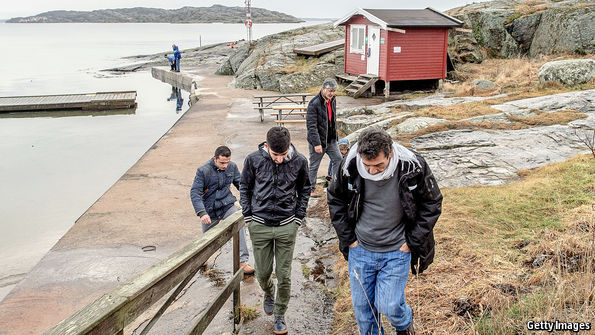
WHEN Ameen first arrived from Aleppo, he was thrilled to have made it to Sweden. Speaking as he takes a break from a protest near parliament, he says he thought there would be plenty of jobs. But none was available. Now that the government has made it harder for family members to join the refugees, some have taken to Stockholm’s cobbled streets. The rules on asylum-seeking in Europe mean refugees like him have to stay in their country of arrival. “If we could leave, many of us would,” he says.
A big reason refugees cause alarm across Europe is the fear that they will steal jobs. But a more serious problem may be their joblessness. France, Germany and Norway all have big employment gaps between native- and foreign-born workers. But the gap is widest in the Netherlands and Sweden—and these figures do not yet include the 163,000 asylum-seekers who arrived in Sweden last year (see chart).
 Continue reading
Wind and solar advance in the power war against coal
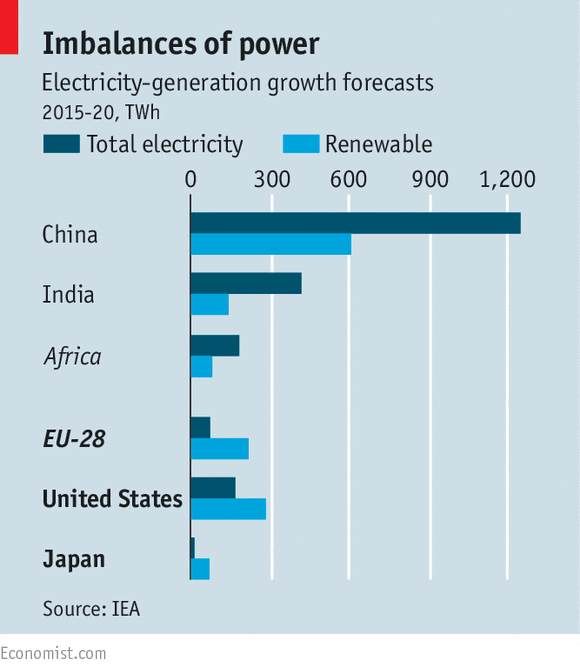
THE battle between clean energy and dirty coal has entered a new phase. The International Energy Agency (IEA), an industry forecaster, this week reported that in 2015 for the first time renewable energy passed coal as the world’s biggest source of power-generating capacity.
The IEA, whose projections for wind and solar energy have in the past been criticised as too low, accepted that renewables are transforming electricity markets. Last year 500,000 solar panels were installed every day around the world. In China alone, home to a whopping 40% of the 153 gigawatts (GW) of global growth in renewable-energy installations, two wind turbines were erected every hour. Based on existing policies, it forecasts that from 2015-21, 825GW of new renewable capacity will be added globally, 13% more than it projected just last year.
All those new wind and solar plants will not generate electricity all the time. Unlike coal, which burns around the clock, renewables are intermittent. But the IEA expects the share of renewables in total power generation to rise to almost 28% from 21%. Government policies to curb global warming and reduce air…Continue reading
Steel trap

BESIDES being dirty and dangerous, making steel in China has been a good way to burn through money over the past few years. But in recent months, the fires from the country’s blast-furnaces have started to emit the warm glow of profits. Steel prices have risen by nearly 50% this year. Production, which fell in 2015 for the first time in decades, is also up. Smelters are set for a strong recovery after losing $10bn last year. And it is not just the steelmakers who will be pleased. Asia’s central bankers can also take some comfort in the rising prices: they suggest that the threat of deflation might be receding.
Once seen in Asia as a peculiarly Japanese phenomenon, deflation spread throughout the region’s factories in the past half-decade. The prices that consumers see in shops have on the whole continued to increase, albeit more gently than before. But the prices that companies charge for goods as they leave their factories’ gates have dipped lower and lower. Virtually all big Asian economies, including South Korea, India, the Philippines, Taiwan and Thailand, have experienced prolonged bouts of falling producer…Continue reading