
Tag: FINANCE
Sovereign-bond issuers shrug off downgrades
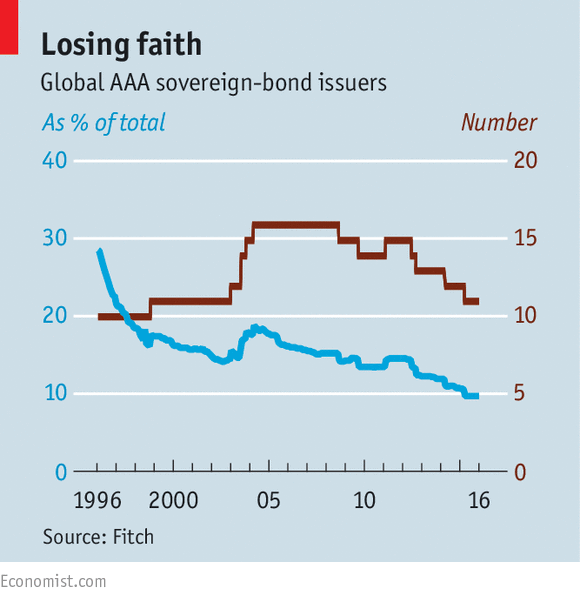
ONCE upon a time, countries jealously guarded their credit ratings. Before the 2010 British election, George Osborne, soon to be the chancellor of the exchequer, emphasised the importance of cutting the budget deficit in order to maintain the country’s top AAA rating.
But despite the spending cuts and the tax increases he imposed, Britain was downgraded in 2013. There are only 11 countries with AAA status, according to Fitch, a rating agency, down from 16 in 2009. By value, only 40% of global sovereign debt has the highest rating, down from 48% a decade ago.
There has been an even more dramatic downward trend in corporate debt ratings. There were 99 AAA-rated American corporations in 1992, according to S&P Global, another ratings group; now there are just two. That trend is linked to the tax deductibility of interest: in terms of tax efficiency, it has made sense to increase the amount of debt, and reduce the equity, on the balance-sheet.
Clearly, at the sovereign level, the deterioration has been driven by the global financial crisis, which dented both economic growth and tax revenue. But with bond yields very…Continue reading
A settlement ends Hank Greenberg’s epic lawsuit

A SETTLEMENT to be signed in front of a New York judge as The Economist went to press on February 16th marked the end of years of attritional legal warfare. It was less clear who had won: the state of New York or Maurice (Hank) Greenberg, the now 91-year-old former chief executive of AIG, once the world’s largest insurer, but saved by a government bail-out in 2008.
Eric Schneiderman, New York’s attorney-general, had seemed in little doubt when he issued a surprise statement on February 10th. Hank Greenberg had admitted “to initiating, participating and approving two fraudulent transactions…that fundamentally misrepresented AIG’s finances.” He had agreed to pay a $9m fine.
Mr Greenberg, however, saw things differently. Within hours of Mr Schneiderman’s statement, his attorney, David Boies, issued a response, accusing the state of being false and misleading and noting that Mr Greenberg’s own carefully negotiated statement had no “reference to any accounting being fraudulent” or suggested that Mr Greenberg was aware of any fraud.
By February 13th Mr Greenberg was on the offensive. In a press…Continue reading
Spain’s banking clean-up

ALMOST five years have passed since the near-collapse of Bankia, one of Spain’s biggest lenders, forced the country into a European banking bail-out. But inquiries into what went wrong continue—and widen. This week, for the first time, the investigations embroiled Spain’s financial regulators, including a former governor of the central bank, the Bank of Spain, Miguel Angel Fernández Ordóñez.
On February 13th the national court indicted Mr Fernández Ordóñez and seven other senior regulators, ordering a criminal investigation but without specifying any charges. The court is questioning why they allowed Bankia to sell shares in an initial public offering in 2011, less than a year before Bankia’s portfolio of bad mortgage loans forced the government to seize control of it. It said there was evidence the regulators had “full and thorough knowledge” of Bankia’s plight. After its nationalisation, it went on to report a €19.2bn ($24.7bn) loss for 2012, the largest in Spanish corporate history.
The investigation comes as several bankers are already awaiting sentencing for mismanagement and fraud. Most prominent…Continue reading
The European Union’s delicate political economy

GREECE’S marathon crisis is at least instructive. Past flare-ups have illustrated a textbook’s worth of economic principles. The latest episode—a dispute over the sustainability of Greece’s mammoth debt—provides a lesson in political economy. The beleaguered economy itself is not at the centre of the disagreement; rather it is the European Commission and the IMF and others that are at loggerheads, squabbling over projections of Greek growth. This sort of institutional wrangling is not incidental to the process of European integration; it has historically been a crucial ingredient, helping defang the continent’s tricky interstate relations. But as Greece’s latest turn in the spotlight demonstrates, the role of Europe’s institutions has changed during the euro-area crisis. Paradoxically, they themselves have become part of the existential threat facing the European project.
Like European identity itself, the role of “institutions” can seem vague, amorphous and of overstated importance. Yet institution-building has been one of the most consequential aspects of European integration. Economists view institutions as the solutions to social…Continue reading
China tightens monetary policy (discreetly)

IF ASKED before the start of 2017 to bet on which important central bank would be the first to raise interest rates this year, the safe choice would have been the Federal Reserve. Some gamblers, relishing the long odds, might have gone for the Bank of England or even taken a flutter on the European Central Bank. All these guesses would have been wrong. The first to budge this year? The People’s Bank of China.
On February 3rd the Chinese central bank raised a series of short-term rates. The decision received scant attention. The increases were, after all, small: one-tenth of a percentage point for the main rates. It also seemed quite technical, primarily affecting liquidity tools that lenders can tap if short of cash. And there was no fanfare: the central bank did not publish an explanation.
But China’s move is important for two reasons. First, it highlights the government’s dilemma in managing the economy. Growth is expected to slow from last year’s pace of 6.7%, and recent surveys suggest that momentum is already ebbing. Sentiment is fragile: investment by private companies last year increased at its slowest pace in more than a…Continue reading
Remaking American financial regulation

AT FIRST blush, there is little to be excited about. The eighth executive order of Donald Trump’s infant presidency, signed on February 3rd, lists seven “core principles” for regulating America’s financial system. These include the prevention of bail-outs by taxpayers; advancing the American interest in international negotiations; and tidying the unruly thatch of federal regulation. The treasury secretary and regulators must report by early June on how well existing laws fit the bill. “There is little in the actual executive order that the Obama administration would have disagreed with,” says Doug Elliott of Oliver Wyman, a consulting firm.
And yet. Although the edict does not mention the Dodd-Frank act of 2010, which redefined financial regulation after the crisis of 2008, it is chiefly aimed at that law. (Another presidential memorandum paves the way to aborting a rule tightening financial advisers’ obligations to Americans saving for retirement.) Many banks, especially smaller ones, loathe the 848-page act and its reams of ensuing rules. According to Davis Polk, a law firm, 111 of its 390 “rule-making requirements” have not yet…Continue reading
Explaining euro-zone market jitters
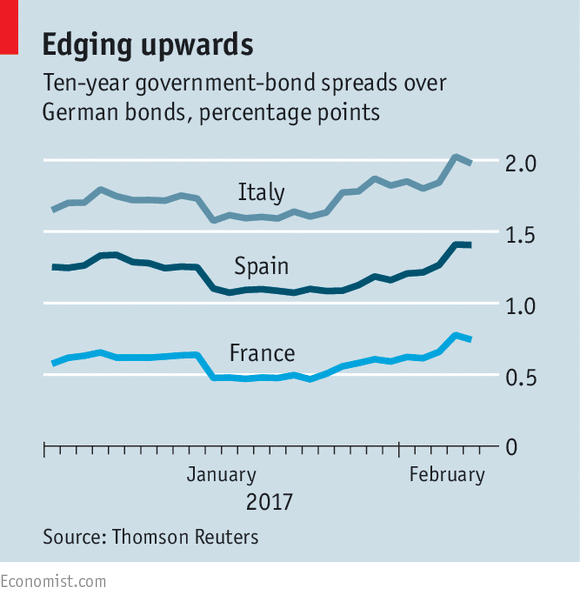
IT was not an ideal way to mark a silver jubilee. The 25th anniversary of the signing of the Maastricht treaty, which gave life to the idea of a single European currency, fell on February 7th, the same day that the IMF published its annual health-check on the Greek economy. It said most (but not all) of its board favoured more debt relief to get Greece’s public finances in order—an idea quickly trashed by euro-zone officials.
A day earlier the spread between ten-year government bonds in France and Germany had reached its widest level in four years. The proximate cause seemed to be a growing concern about political risks to the euro. François Fillon, once the front-runner in the race for the French presidency, is embroiled in a scandal and losing ground. A fear is that his fall from grace might boost support for Marine Le Pen, leader of the National Front, who wants France to leave the euro and the EU.
Shorter odds on a Le Pen victory would certainly justify a higher risk premium on French bonds. Yet there is more to the latest bout of euro-area bond jitters than a sharper focus on politics. After all, bond markets…Continue reading
Big data, financial services and privacy

DONALD TRUMP’s health-insurance premiums could soon go up, and not just because of his love of burritos. Data-crunchers have found a link between the negativity of someone’s tweets and his risk of dying of heart disease. The education levels of your Facebook friends or the activity on your phone can help reveal how likely you are to repay a loan. Money-managers are rummaging ever more curiously through customers’ digital lives.
This is all part of an “intensifying data arms-race in finance”, says Magda Ramada Sarasola from Willis Towers Watson, a consultancy, which claims that no industry used more big data last year. Banks and insurers used to rely only on what customers and credit agencies told them, but today websites and mobile-banking apps let them get much more close and personal. Less conventional sources are also popular. Social-media profiles, web-browsing, loyalty cards and phone-location trackers can all help. In a trial, FICO, America’s main credit-scorer, found that the words someone uses in his Facebook status could help predict his creditworthiness (tip: avoid “wasted”). Even facial expressions and tone of voice are being…Continue reading
Donald Trump and the dollar standard

TRUMPISM is in part an expression of American exhaustion at bearing burdens it first took up 70 years ago. Donald Trump has moaned less about the dollar than about shirking NATO allies or cheating trade partners. Yet the dollar standard is one of the most vulnerable pillars of global stability. And the world is far from ready for America to ditch its global financial role.
Unlike other aspects of American hegemony, the dollar has grown more important as the world has globalised, not less. In the Bretton Woods system devised for the post-war world, Western economies fixed their exchange rates to the dollar, which was in turn pegged to the price of gold. After the fracturing of this system under the inflationary pressures of the 1970s, the dollar became more central than ever. As economies opened their capital markets in the 1980s and 1990s, global capital flows surged. Yet most governments sought exchange-rate stability amid the sloshing tides of money. They managed their exchange rates using massive piles of foreign-exchange reserves (see chart). Global reserves have grown from under $1trn in the 1980s to more than $10trn…Continue reading
How to measure North Korea’s economy
 An area of darkness
FACTS about the North Korean economy are not so much alternative as non-existent. The country has never published a statistical yearbook. If it did, no one would believe it. Nicholas Eberstadt of the American Enterprise Institute, a think-tank, calls analysis of its economy “essentially pre-quantitative”.
The most-cited estimate of the size of the economy comes from South Korea’s central bank. Its methodology is opaque but is based, at least in part, on the South Korean intelligence agency’s estimates of the North’s physical output, which is then translated to South Korean prices. But it is hard to estimate market valuations for goods that are not traded on the market, and physical goods make up only a fraction of overall economic output. Another technique is to “mirror” statistics from the country’s trading partners. But most North Korean trade is with China, where statistics are unreliable.
The advent of satellite imaging has helped, providing researchers with better estimates of manufacturing output, coal production and urbanisation. Yet another strategy is to work out…Continue reading