
Tag: FINANCE
Warren Buffett extends his dominance of retroactive reinsurance
IT IS a niche market, but a big one, and it is increasingly dominated by Warren Buffett’s Berkshire Hathaway. On January 20th its reinsurance subsidiary, National Indemnity Company (NICO), agreed with American International Group (AIG), a big insurer, to acquire excess losses on old insurance policies. In one of the largest such “retroactive reinsurance” deals ever announced, NICO will be on the hook for four-fifths of all losses above $25bn, up to $20bn, in exchange for a payment of $9.8bn now. The deal comes just a few weeks after a similar deal giving up to $1.5bn of coverage to Hartford, another American insurance giant.
For much of the 15 years since the term retroactive reinsurance came into use, Berkshire, through NICO, has been at the forefront. The structure allows insurers to rid themselves of so-called “long-tail” exposures, ie, claims that may come in years or decades after policies were written. Often, they cover long-term environmental risks like pollution, or asbestos-related disease, where workers may fall ill many years after exposure. In the largest previous deal in 2006 NICO provided reinsurance coverage worth $7bn for…Continue reading
America, China and the risk of a trade war
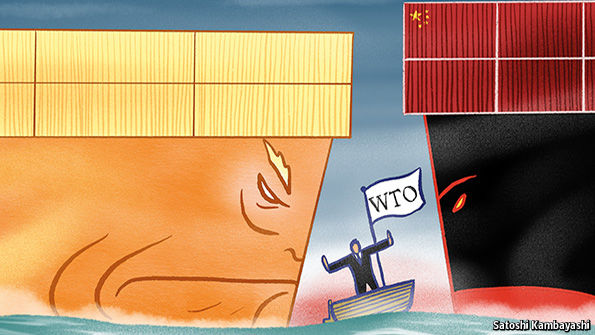
DONALD TRUMP’S quest to protect American workers from cheating foreigners has begun. But in his first flurry of policy tweets and executive orders, China, his favourite bogeyman, was conspicuously absent. On the campaign trail he deplored China’s currency manipulation, accused it of flouting global trade rules and threatened a 45% tariff on its exports, all to cheering crowds. Now, the world is waiting to see how much of this he meant.
The promise to label China a currency manipulator has not been repeated. An optimistic interpretation is that Mr Trump has realised that the promise was based on an “alternative” fact. China is no longer squashing its currency to gain a competitive edge, but is instead propping it up. A pessimistic one is that Steven Mnuchin, his treasury secretary, who would do the labelling, is not yet confirmed by the Senate.
Mr Trump certainly has the power to wreak trade havoc. A big blanket tariff would slice through supply chains, hurt American consumers and fly in the face of the global system of trade rules overseen by the World Trade Organisation (WTO). But, rather than blow up the world’s trading system, Mr Trump…Continue reading
Visas as aid
 Better in America
TWO years ago, Jon Hegeman, a farmer from Alabama, was struggling to expand his business. He could offer unglamorous but steady work. Potting plants and shifting them to a greenhouse paid $10.59 an hour. He couldn’t find workers; he even tried recruiting from a youth-detention programme.
Mr Hegeman stumbled on a solution when he met Sarah Williamson, of Protect the People (PTP), a charity for people affected by humanitarian disasters. With the International Organisation for Migration, PTP was trying a novel way of helping Haiti after its devastating earthquake in 2010: by taking Haitians to work temporarily in America. The idea appealed to Mr Hegeman, born to missionary parents on the same island (but in the Dominican Republic). With the agencies’ help, eight workers arrived in September 2015.
A new study by Michael Clemens and Hannah Postel of the Centre for Global Development compares those Haitians who secured visas through the project with unsuccessful applicants left behind. The benefits were mind-boggling: the temporary migrants earned a monthly income 1,400% higher than those back in…Continue reading
A fintech startup tries to shake up American student loans

IN AN old factory building in lower Manhattan a fintech startup is seeking answers to a question that has tormented teachers and students for decades: what is the value of a given course, teacher or institution? Climb Credit, with just two dozen employees, provides student loans. The programmes it finances bring returns far higher than can be expected from even highly rated universities.
Climb does not claim to nurture billionaires, nor to care much about any of the intangible benefits of education. Rather, it focuses on sharp, quantifiable increases in earnings. The average size of its loans is $10,000 and it normally finances programmes of less than a year. The subjects range from coding to web design, from underwater welding to programming robots for carmakers (which has the highest rate of return). Some students have scant formal education; others advanced degrees. The rate of return they get is calculated as the uplift in earnings after the course of study, minus its cost (which includes that of servicing the loan, and takes account of the absence of earnings during the course).
Climb’s results so far are hardly conclusive. It has…Continue reading
Financial markets diverge as central banks start to turn off the taps
INVESTORS are learning to let go of Daddy’s hand. Monetary policy has been very supportive of asset markets over the past eight years but the direction of policy is tilting slowly.
The Federal Reserve has increased rates twice already and is expected to push through another three increases this year. The Bank of England has indicated that the next move in rates could be up or down, but that the former looks more likely, especially as inflation is on the rise. The European Central Bank is scheduled to reduce the amount of bond purchases it makes after the end of March. Only the Bank of Japan seems committed to keeping the monetary taps on “full”.
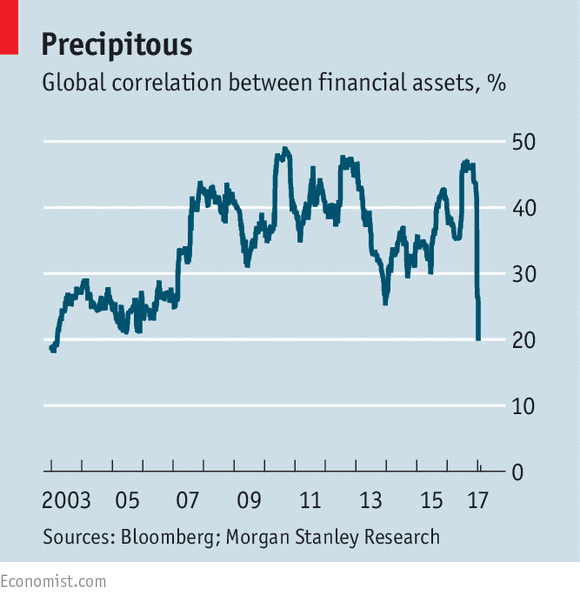
The market impact is already visible. Morgan Stanley says there has been a “crash” in the tendency for assets to correlate with each other in recent months (see chart). Its measure incorporates correlations between different markets (equities and corporate bonds, for example), and between different regions.
The recent fall in correlations takes the measure back to where it was in the run-up to the 2007-08 financial crisis. During and after the crisis, correlations rose…Continue reading
Winners and losers in a China-America trade war
ECONOMIC Armageddon became a bit more likely when Donald Trump took office on January 20th, given his threats to impose a 45% tariff on Chinese imports. “No one will emerge as a winner in a trade war,” Xi Jinping, China’s president, intoned just days earlier. He was not quite right. In any catastrophe, a few survive; some even thrive.

Tariffs that high would serve as a tax on American shoppers buying phones, computers and clothes (see chart). They might not dent their wallets too much—a study found that in 2010 goods and services from China made up less than 3% of consumer spending. Poorer Americans would be hit harder, however, as they spend a higher share of their income on tradable goods.
American importers would suffer from a tariff. Importers of electronics and clothing enjoy higher retail and wholesale margins than other importers. A tariff would eat into them. Their competitors, relying on domestic suppliers, could benefit and raise prices.
A squeeze on trade between America and China would be painful but not catastrophic for China’s economy. It has weaned itself off export-led growth. Analysts from…Continue reading
Brexit poses a threat to Ireland’s aircraft-leasing business

THE glass office blocks of Dublin’s docklands still stand proud; the banks that built them no longer do. The financial crisis of 2008 took down Ireland’s six biggest lenders. Within five years Dublin slid from being rated by Z/Yen, a London-based business think-tank, as the world’s tenth-best financial centre to its 70th. Britain’s readiness to leave Europe’s single market has since sparked hopes Dublin’s fortunes could be revived. An English-speaking base from which to keep doing business inside the EU may appeal to London’s bankers. But worries are growing that the impact will not be all good for Dublin.
To see why, look at aircraft finance, perhaps the city’s most successful industry. The topic of Brexit dominated the chatter at the world’s two biggest air-finance conferences, both held in Dublin this month. Drawing more than 4,500 airline bigwigs, lessors and bankers, such gatherings are usually preoccupied by issues such as aeroplane prices and the aviation cycle. This year geopolitics predominated. “In Ireland we’re surrounded by Trump to the west and Brexit to the east,” one industry veteran sighed in…Continue reading
The definition of “maximum employment” needs updating
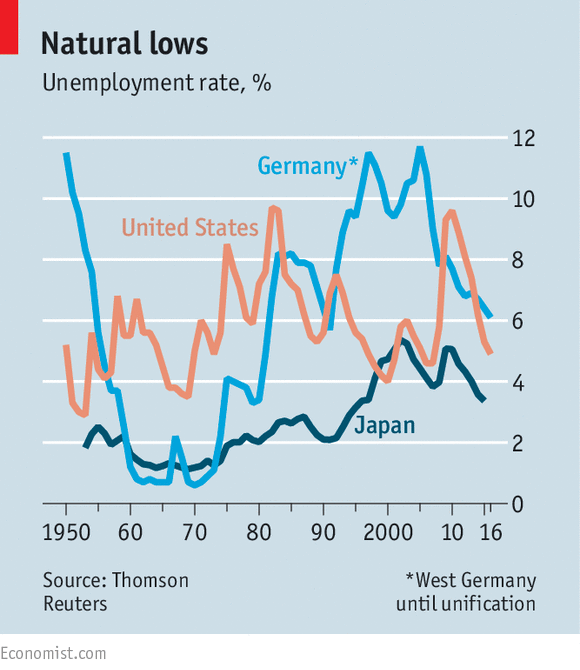
“IT IS fair to say the economy is near maximum employment,” said Janet Yellen, chairman of the Federal Reserve, in recent comments preparing markets for rate rises to come. But “maximum employment”, like pornography, is in the eye of the beholder. American adults, of whom only about 69% have a job, seem less than maximally employed. In previous eras, governments of countries scarred by economic hardship set themselves the goal of “full” employment. Today, the target is termed “maximum”. But it is the same concept. It needs a bit of updating.
Ms Yellen has a particular definition of maximum employment in mind, built on the economic experience of the past half-century. In the 1960s and 1970s a consensus (or, at least, what passes for one in macroeconomics) emerged that government efforts to boost demand could push unemployment only so low. Below that “natural rate”, it would soon start climbing again and inflation would accelerate. So now central bankers take a guess at the natural rate and at how quickly unemployment that is “too low” will spark inflation. Maximum employment, in their view, is the sweet spot: the…Continue reading
Are eight men as wealthy as half the world’s population?

EVERY ten minutes, black Volkswagen shuttle vans ferry delegates from their hotels in Davos, Switzerland, to this year’s World Economic Forum, held from January 17th to 20th. If you could squeeze the world’s eight richest men into one of these vans, they might feel cramped. But they could comfort themselves with an extraordinary statistic: according to Oxfam, a charity, they own as much wealth ($426bn) as half the world’s population combined ($409bn).
To make this striking calculation, the charity draws on data from Forbes magazine, which lists the wealth of the billionaires, and Credit Suisse, which estimates the smaller holdings of everyone else, thanks to painstaking work by three scholars of wealth, Anthony Shorrocks, Jim Davies and Rodrigo Lluberas.
Pedants can nonetheless criticise Oxfam’s headline-grabbing comparison for its handling of debt, the dollar, labour and data. The world’s least wealthy include over 420m adults whose debts exceed their assets, leaving them with negative net worth. Most of this net debt is owed by people in high-income countries. There are, for example, over 21m Americans…Continue reading
Regulatory settlements raise questions about America’s financial markets

THIS week, Credit Suisse and Deutsche Bank became the latest banking giants to finalise multi-billion dollar settlements with American authorities over misdeeds in the mortgage market in the run-up to the financial crisis. But other, less publicised settlements have hissed out of the waning Obama administration like a series of slow punctures: with Moody’s, a leading credit-rating agency; with Citadel Securities, a critical component of America’s equity-trading system; and with the Port Authority of New York and New Jersey. High-profile defendants all, but the most striking characteristic of the deals is how gently their tyres were let down.
The Moody’s deal, about high ratings accorded securities that crashed during the crisis, was announced late on January 13th, the Friday before a holiday weekend. The other cases were resolved almost as discreetly. Admittedly the amounts involved were comparatively small (Moody’s will pay $864m, Citadel $23m, and the Port Authority a mere $400,000). But the cases were bigger than the numbers suggest.
The Moody’s settlement will inflame suspicions that Wall Street is infested with conflicts…Continue reading