
Tag: FINANCE
Indonesia, one of five “fragile” emerging markets, looks stronger now

IN RECENT weeks signs have appeared in the poky arrivals hall at Soekarno-Hatta airport in Jakarta, Indonesia’s capital, exhorting visitors to shun the dollar in the name of national sovereignty. “Use rupiah for all transactions in Indonesia!” travellers are told, as they wait, interminably, at the luggage carousels. That reflects old suspicions of foreign interference in the economy, South-East Asia’s largest, coupled with newer concerns about the currency’s vulnerability to capital flight.
In 2013, when the Federal Reserve’s “tapering” of its asset purchases led to a 21% slide in the rupiah against the dollar, Indonesia was seen as one of the “fragile five” emerging markets. Of late, anxieties have resurfaced. On December 14th the Fed raised interest rates for the first time in a year. More rises are expected this year. Higher yields in advanced economies draw capital from emerging markets, putting pressure on their currencies. The rupiah fell by 3.7% against the dollar in November, the steepest monthly decline for more than a year, as part of a wider sell-off of emerging-market currencies.
This partly explains why…Continue reading
Italy presents the European Union’s new bank-rescue rules with their first big test
ANOTHER blow to national pride: on January 13th DBRS, a Canadian rating agency, downgraded Italy’s sovereign debt, stripping the country of its last A rating. Government bond-yields rose; so will the cost of funding for Italian banks. Erik Nielsen, chief economist of UniCredit, Italy’s biggest lender, calls the extra €5bn ($5.3bn) or so banks will have to put up as collateral for their loans from the European Central Bank (ECB) “immaterial”. Still, it is a burden they could do without.
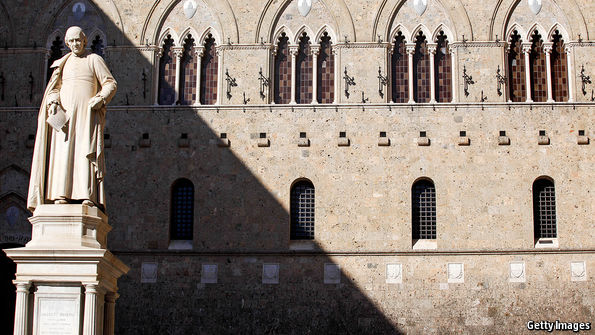
Weighing heaviest on bankers’ minds is a planned state rescue of Monte dei Paschi di Siena, now Italy’s fourth-largest lender. A private recapitalisation scheme collapsed in December, prompting it to seek government help. Days earlier, anticipating the plan’s demise, the state had created a €20bn fund to support ailing banks.
Next month Monte dei Paschi’s chief executive, Marco Morelli, will present a new business plan. On January 18th he confirmed to a Senate committee that 500 branches and 2,450 jobs will go within three years. Soon the bank is expected to issue a state-backed bond, for perhaps €1.5bn, to shore up liquidity; it…Continue reading
The repair job at Cyprus’s biggest lender

THE banking woes of Italy, the euro area’s third-biggest member, pale next to those that, four years ago, plagued Cyprus, its second-smallest. Now there is cause for cautious optimism. This month Bank of Cyprus, the biggest local lender, finished repaying €11.4bn ($12.2bn) of emergency liquidity assistance from the country’s central bank. It followed that by returning to the bond markets, raising €250m in a sale of unsecured notes, albeit with a stiff 9.25% coupon.
Even better, on January 19th Bank of Cyprus listed on the London Stock Exchange. This, says John Hourican, the chief executive, fulfils a promise to investors in 2014, when the bank raised €1bn of equity, to list on “a liquid, index-driven European exchange”. It is quitting the Athens bourse, now that it “no longer has any business of significance in Greece.” (Its listing in Nicosia remains.) It has also rid itself of operations in Romania, Russia, Serbia and Ukraine. Although its return on equity is still meagre, just 2.7% in the third quarter, its ratio of equity to risk-weighted assets, a key gauge of strength, is respectable enough, at…Continue reading
Industrial policies mean cosseting losers as well as picking winners

EQUITY markets have shrugged off the Brexit and Trump votes. Indices in London and New York have reached new highs. But individual stocks and industries have had the odd wobble, not least when they have been the subject of a hostile tweet from the incoming president. “You’ve been fired at” may turn out to be a dominant meme of the next four years.
Indeed, what seems to be emerging on both sides of the Atlantic is a new version of industrial policy, in which Brexit negotiations, tax laws and trade talks are used as a way to favour some industries and punish others. And that ought to be cause for real investor concern.
The standard criticism of industrial policy is that it is all about “picking winners”. But the real problem is that it is more about protecting the position of established corporations—cosseting losers, in other words.
Which companies are most likely to get protected? The obvious answer is incumbent groups that possess lobbying clout. Many companies have expressed concern about Brexit, but it is to Nissan, a Japanese car giant, that the British government has made an undisclosed commitment. Startups are unlikely…Continue reading
How the City of London hopes to navigate a hard Brexit

THERESA MAY’S speech on January 17th set Britain definitively on a path to a “hard” Brexit, in which it will leave not just the EU but the European single market. This was not what the City of London wanted to hear. The prime minister did at least pick out finance, along with carmaking, as an industry for which “elements of current single-market arrangements” might remain in place as part of a future trade deal. The City is holding out hope that a bespoke deal built on the existing legal concept of “equivalence” could still accord it a fair degree of access to Europe.
“Passporting”, which allows financial firms in one EU member state automatically to serve customers in the other 27 without setting up local operations, was always going to be difficult after Brexit. Outside the single market, says Damian Carolan of Allen & Overy, a law firm, the “passport as we know it is dead.” Already, two big banks, HSBC and UBS, this week each confirmed plans to move 1,000 jobs from London.
Financial companies all have to firm up their contingency plans. For the City, these focus on so-called “equivalence” provisions, allowing third-country financial…Continue reading
Republican tax-reform plans face many hurdles, including Donald Trump

AMONG other things, the start of Donald Trump’s presidency this week heralds a collision between campaigning rhetoric and legislative and economic reality. What follows will be a learning experience for all, it is fair to say. Though not perhaps the most consequential of the looming reality checks, the outcome of a brewing debate over a proposed border-adjusted tax plan could prove a taste of things to come. As Mr Trump and his Congress work to make policy, there are many ways for things to go awry.
Both Mr Trump and congressional Republicans are keen to cut taxes on corporations. America’s inefficient corporate-tax system has remarkably high rates but leaks like a sieve, yielding a pitiful tax take (see chart). As a solution, Mr Trump favours a large cut in the corporate-tax rate, from 35% to 15%, and a chance for companies to repatriate foreign profits at a tax rate of 10%. Paul Ryan, Speaker of the House of Representatives and chief Republican policy wonk, has something very different in mind.
At present American firms are assessed for tax on their global income. This encourages multinationals either to use clever…Continue reading
Tokyo’s showy tuna auctions do not augur economic growth

KIYOSHI KIMURA does not like to lose. For the past six years he has outbid all comers for the first bluefin tuna of the year sold by Tokyo’s famed Tsukiji fish market. Last week Mr Kimura, who owns a chain of sushi shops, paid ¥74.2m ($642,000) to win the first fish. That nets out to some $3,000 per kilogram.
Folk wisdom has it that high tuna-auction prices signal future economic buoyancy. Mr Kimura has said that he pays the exorbitant prices to “encourage Japan”. But that rationale seems fishy.
After a rival Hong Kong bidder baited him, Mr Kimura paid three times as much for the Tsukiji tuna in 2013 as in the previous year—a record-high ¥155.4m. GDP growth did not replicate that rise, however, sinking from 1.7% to 1.4%. In fact, Japan’s economic fortunes and Tokyo’s season-opening tuna prices seem to float rather erratically (see chart). A deep dive by The Economist suggests that tuna prices explain only 6% of the fluctuation in GDP. The correlation is a red herring.
Environmentalists, meanwhile, are gutted. Bluefin tuna are endangered; stocks have plunged by 97% from their peak, according to one estimate. The…Continue reading
Our Big Mac index of global currencies reflects the dollar’s strength
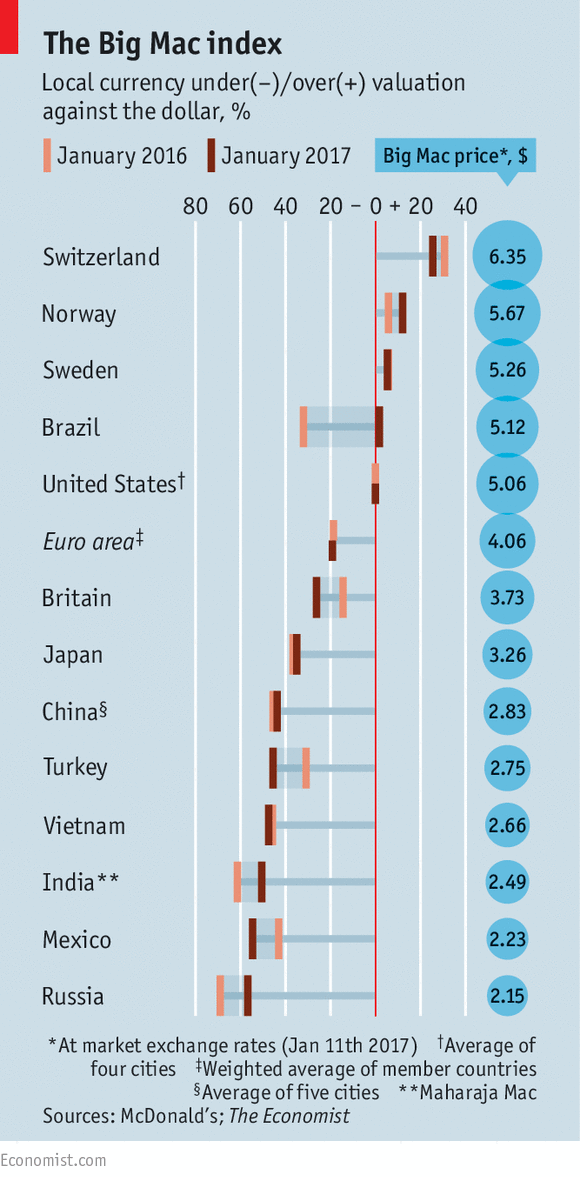
IT IS perhaps not surprising that the worst-performing major currency in the world this year is the Turkish lira. Many emerging-market currencies have taken a battering since the election in November of Donald Trump raised expectations of faster monetary tightening in America and sent the dollar soaring. But the lira has many other troubles to contend with, too: terrorist bombings, an economic slowdown, alarm over plans by the president, Recep Tayyip Erdogan, to strengthen his powers, and a central bank reluctant to raise interest rates to defend the currency. It has plunged to record lows. According to the Big Mac index, our patty-powered currency guide, it is now undervalued by 45.7% against the dollar.
The Big Mac index is built on the idea of purchasing-power parity, the theory that in the long run currencies will converge until the same amount of money buys the same amount of goods and services in every country. A Big Mac currently costs $5.06 in America but just 10.75 lira ($2.75) in Turkey, implying that the lira is undervalued.
However, other currencies are even cheaper. In Big Mac terms, the Mexican peso is…Continue reading
China’s reputation for low-cost manufacturing under attack

WHEN China was gripped by political turmoil in the 1960s and 1970s, Cao Dewang cut his teeth as an entrepreneur. Mao’s chaotic rule forced him out of school and he took to the street, a scrappy teenager selling fruit and cigarettes. Looking back, Mr Cao has said that it was actually a good time to do business: the government was too busy waging ideological campaigns to enforce its regulations. Mr Cao went on to become a billionaire, as China’s biggest manufacturer of automotive glass. Last month he sparked controversy by complaining that life was tough for businesses in China. There are, he said, far too many regulations—especially taxes and fees. These days the government is much more effective in enforcing them.
Mr Cao hit a nerve with his claim that it was more costly to run a business in China than in America. He should know. His company, Fuyao Glass, bought an old General Motors factory in Ohio in 2014 and announced plans to invest $200m there. Mr Cao claimed that the overall tax on manufacturers is 35% higher in China than in America. Once China’s higher land and energy costs are factored in, the advantages of its lower labour costs…Continue reading
Singapore tries to become a fintech hub

IN AN era when architectural masterpieces curve and bloom (Zaha Hadid), or shimmy and fold (Frank Gehry), designers of central-bank buildings remain reassuringly fond of right angles. The Monetary Authority of Singapore (MAS), the city-state’s central bank and financial regulator, is housed in a boxy tower just south of the central business district. But tucked into one corner is a room called “LookingGlass@MAS” that desperately wants to be Silicon Valley: witness the scruffily dressed young men, whiteboards on wheels covered in buzzwords and the kitchen along one wall.
This is the MAS’s fintech lab, where Singapore is trying to put its own twist on the technologies disrupting the financial sector. A report from Citigroup published in 2016 warned that as fintech lets customers do more online and cuts into banks’ lending and payments activities, European and American banks could lose almost 2m jobs in the next ten years. Similar fears stalk Singapore, home to more than 200 banks, and dependent on finance for 12.6% of GDP.
In London, Berlin and San Francisco, many fintech innovators are betting against the big banks. Singapore,…Continue reading