
Tag: FINANCE
How fintech firms are helping to revolutionise supply-chain finance
 Still waiting for the invoice approval
GROWING up on a sugar-cane farm in Australia, Lex Greensill had a front-seat view of the strains suppliers suffer as they wait to be paid. After harvesting his crops, Mr Greensill’s father had to wait a year or more to receive payment. Across industries, buyers are eager to conserve their cash. Delaying payment is one way to do it: among the most important for some, such as big retailers, says Mr Greensill. Many buyers expect their suppliers to accept payment months after delivery. Even so, many still pay late—47% of suppliers surveyed by Taulia, a fintech firm, said they had this problem. In 2011 Mr Greensill founded Greensill Capital, one of a cluster of new fintech firms overhauling how supply chains are financed.
The details vary but their basic approach is to take advantage of buyers’ low credit risk to pay suppliers’ invoices promptly. The buyer—a large supermarket chain, say—approves a supplier’s invoice and transmits it to the fintech lender. (The lender can raise money in different ways: Greensill raises funds in the capital markets.) The lender pays the supplier on…Continue reading
Inflation is on the way back in the rich world, and that is good news

IT WAS telling that Germany, a country with a phobia of rising prices, in the first week of 2017 reported a jump in inflation. Its headline rate rose from 0.8% to 1.7% in December. After two years of unusually low price pressures, inflation across the rich world is set to revive this year. Much of this is because of the oil price, which fell below $30 a barrel in the early months of 2016 but has recently risen above $50 (see chart). Underlying inflation, too, seems poised to drift up. That is good news. The story for 2017 is not of inflation running too hot but rather of a welcome easing of fears of deflation.
To understand why, consider the three big drivers of inflation in the rich world: the price of imports, capacity pressures in the domestic economy and the public’s expectations. Start with imported inflation. A year ago, global goods prices were falling because of a slide in aggregate demand and a seemingly endless glut of basic commodities and manufactures. China’s economy wobbled. Emerging markets in general were in a funk; two of the largest, Brazil and Russia, were deep in recession.
Things look perkier now. Emerging markets…Continue reading
Argentina is admitted to a widely tracked bond index

EMERGING markets have not been the same without Argentina, a country that embodies the promise and peril, the romance and the rockiness of the asset class. In 1988 it was one of the ten original members of the most popular emerging-market equity index, introduced by MSCI. In the late 1990s it was also the biggest member of the benchmark-bond indices compiled by JPMorgan Chase. But once it defaulted at the end of 2001, Argentina was exiled from global debt markets. And after it subsequently imposed capital controls on “hot money”, its shares suffered a similar banishment, ejected from MSCI’s index in 2009. It became a remote “frontier market”, like countries such as Bangladesh.
Since Mauricio Macri succeeded Cristina Fernández de Kirchner as president at the end of 2015, Argentina has been finding its way back from the financial periphery. It has floated its currency and lifted capital controls, recently abolishing a remaining requirement that foreign investors keep their money in the country for at least 120 days. In April the government sold $16.5bn of dollar bonds to international investors in a single day (a record for an…Continue reading
Marine Le Pen’s nerve-jangling plans to revive the French franc

HOW do you solve a problem like Marine? Ms Le Pen, leader of France’s far-right National Front, has indicated that she hopes to reintroduce a national currency if she is elected president in May. In a recent speech, she suggested that government bonds would be redenominated in francs instead of euros.
The proposal was dressed up in technicalities. The franc would be revived as a “parallel” currency for official transactions and used alongside the euro in a version of the systems (the snake and the exchange-rate mechanism) that existed in the 1970s and 1980s. Such schemes tied European currencies together but were subject to regular crises, with France periodically devaluing the franc.
Investors would pretty quickly see through the façade. There is not much point in bringing back a national currency unless you want the right to devalue it. And there is not much point in redenominating government bonds in francs unless you want to pay creditors back less than they expected. (This might technically count as a default, according to Moody’s, a rating agency; it depends on the exact circumstances.) If that happened, it…Continue reading
To be relevant, economists need to take politics into account

EVERY January more than 10,000 economists meet for the annual conference of the American Economic Association (AEA). This year, the shindig was in balmy Chicago, a stone’s throw from its second-tallest building, the name TRUMP stamped in extra-large letters across its base. Most papers had been written months in advance; few sessions tackled the electoral earthquake in November. Yet there was no mistaking the renewed sense, following its failure to foresee the 2007-08 financial crisis, of an academic field in a crisis of its own. The election was seen as a defeat for liberalisation and globalisation, and hence for an economics profession that had championed them. If economists wish to remain relevant and useful, the modest hand-wringing at this year’s meetings will need to yield to much deeper self-reflection.
Their theories had always shown that globalisation would produce losers as well as winners. But too many economists worried that emphasising these costs might undermine support for liberal policies. A “circle the wagons” approach to criticism of globalisation weakened the case for mitigating policies that might have protected it from a…Continue reading
Awards
Awards: Tom Easton, our American finance editor, was named journalist of the year by the CFA Society of the UK in a ceremony on January 11th. The Economist was named publication of the year.
The high economic costs of India’s demonetisation

MOST economists might hazard a guess that voiding the bulk of a country’s currency overnight would dent its immediate growth prospects. On November 8th India took this abstruse thought experiment into the real world, scrapping two banknotes which made up 86% of all rupees in circulation. Predictably, the economy appears indeed to have been hobbled by the sudden “demonetisation”. Evidence of the measure’s costs is mounting, while the benefits look ever more uncertain.
At least the new year has brought a semblance of monetary normality. For seven weeks queues had snaked around banks, the main way for Indians to exchange their old notes for new ones or deposit them in their accounts. That is over, largely because the window to exchange money closed on December 30th. The number of fresh notes that can be withdrawn from ATMs or bank counters is still curtailed, but the acute cash shortage is abating, at least in big cities.
As data trickle through, so is evidence of the economic price paid for demonetisation. Consumers, companies and investors all wobbled in late 2016. Fast-moving consumer goods, usually a reliable growth sector, retrenched…Continue reading
Supervisors put off finalising reforms to bank-capital rules

SOME banks find existing capital requirements too taxing. To no one’s surprise, on December 23rd Monte dei Paschi di Siena, at present Italy’s fourth-biggest bank, asked the Italian state for help, having failed to raise from the private sector €5bn ($5.2bn) in capital demanded by the European Central Bank before the year’s end. Three days later Monte dei Paschi said that the ECB had redone its sums—and concluded that the stricken lender faced an even bigger shortfall, of €8.8bn.
Plenty of other European banks—in far better nick than poor old Monte dei Paschi, which is overloaded with bad loans—are grumbling that they too may eventually have to find more capital. They have spent years plumping up cushions that the financial crisis showed to be worryingly thin, but fear that proposed adjustments to Basel 3, the latest global standards, will require more. The Basel Committee on Banking Supervision, which draws up the standards, had hoped to agree on the revisions by the end of 2016. It’s not there yet: on January 3rd an imminent meeting of central-bank governors and supervisors, to approve the changes, was postponed.
The…Continue reading
2016 may have been an economic as well as political turning-point
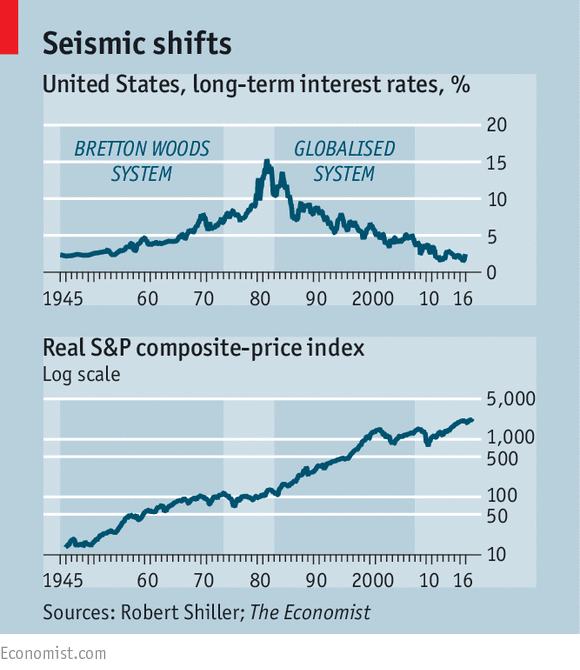
THANKS to Brexit and the election of Donald Trump, 2016 is widely viewed as a political turning-point. But it may also come to be seen as an economic turning-point, marking the third big change of direction since the second world war.
The post-war period from 1945 to 1973 was the era of the Bretton Woods system of fixed exchange rates and capital controls. It was a time of rapid economic growth in the rich world as countries rebuilt themselves after the war and as the technological innovations of the first half of the 20th century—cars, televisions, and so on—came into widespread use. High taxes reduced inequality; fiscal policy was used to control the economic cycle. It all came crashing down in the early 1970s as the fixed-currency system collapsed, and an oil embargo imposed by Arab producers ushered in stagflation (ie, high unemployment combined with inflation).
By the early 1980s, a new system had emerged. Currencies floated, capital controls were abolished, the financial sector was liberalised, industry was privatised and tax rates on higher incomes were cut. In this system inequality widened again (although…Continue reading
“Open outcry” is in retreat but futures and options trading-volumes surge
 Nothing to outcry about
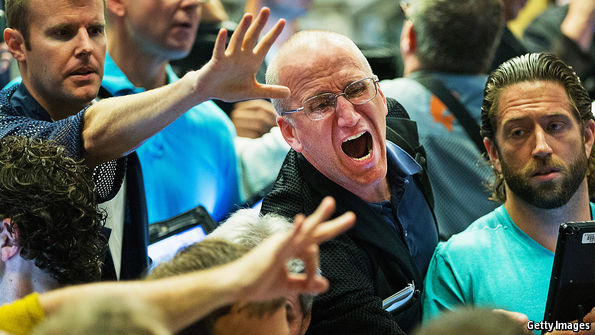
AS A new trading year began this week in the art-deco tower that houses the Chicago Board of Trade, big men were clustered around pits dealing in futures and options tied to various commodities. Their approach dates back to the building’s opening in 1930, and was once familiar in cities throughout America. But after decades of attrition, on December 30th the CME Group (named after the Chicago Mercantile Exchange) closed the “open outcry” trading pits that it operated in New York. In America, Chicago’s hue and cry has become unique.
Even this exchange is a shadow of its former self. There are now nine pits, down from 32 in 2007. A once teeming trading floor was closed in 2015. Most activity in the contracts still traded in the pits is electronic. No one in the surviving CME pits in Chicago seems worried by the New York closures. But they have a symbolic impact. The markets have long been a colourful, fractious component of America’s financial architecture.
They have always lured the ambitious. Two alumni of New York’s commodity markets have joined the Trump administration. Gary…Continue reading