
Tag: Gulliver
Emirates cuts services to America as Donald Trump’s actions bite

WHEN American officials announced last month that laptops and tablets would be banned from aeroplane cabins on flights from certain Muslim countries, many questioned the administration’s motive. Was it a proportionate response to specific intelligence about a terrorist threat? Or had the government taken the opportunity to clobber swanky foreign operators that compete with the country’s own woeful airlines?
If the latter view is too cynical, we can at least say that, for America’s carriers, it has been a serendipitous byproduct. On April 19th, Emirates announced that it is cutting its services to the United States by 20%. The United Arab Emirates (UAE), the airline’s home, was one of ten Muslim countries covered by the laptop ban. By happy coincidence, no American carriers served airports that were affected.
The restrictions on electronic devices are a particular problem for Emirates and the other Middle Eastern “superconnectors”, Etihad, also of the UAE, and Qatar Airways. Direct traffic between America and these airlines’ hubs is modest: most passengers use them to connect to or from other…Continue reading
New York may require Uber to provide an option to leave a tip

UBER has many virtues. The ride-hailing app has disrupted the cosy taxi cartels that care little for customers; it has made travel around cities cheaper, more convenient and reliable; and it has called into question the notion that taxi drivers must be tipped simply for doing their job. Sadly, a proposal in New York might pose a serious threat to the last of these qualities.
Currently, Uber’s smartphone app, which charges users automatically at the end of a journey, does not give the option of adding a tip. But Uber drivers in New York are petitioning officials to force the firm to change this. The chance to add a tip is already standard among many of the firm’s competitors, including Lyft. The city’s Taxi and Limousine Commission is hoping to write this approach into law. It will put forward a formal proposal in July.
Any such change in the rules would be a step back. The New York Times writes that there has “long been confusion” whether or not customers are supposed to tip Uber…Continue reading
America’s woeful image among travellers is self-perpetuating

WHAT sort of reception can travellers to America expect to receive? The answer is, overwhelmingly, a warm one. Americans are among the most helpful and friendly bunch on the planet. But unfortunately for this most hospitable of peoples, potential visitors must judge the country from a distance. And their impressions are coloured by reports of how its officials behave.
Hence, after watching the now-famous United Airlines video (see article), a Chinese person considering a trip to America might wonder why paying Asian passengers are dragged semi-conscious from planes to make way for off-duty airline staff. (They may also try—and fail—to imagine something similar happening on Cathay Pacific.) People of certain ethnicities will worry that travellers such as Juhel Miah, a British teacher supervising a school trip, are stopped from entering America simply because they have a foreign-sounding name or subscribe…Continue reading
United Airlines forcibly removes a man from an overbooked flight

MANY airlines habitually overbook flights, working on the assumption that a few passengers will always cancel at the last minute. By selling more tickets than seats, they can ensure their flights are full even when there are no-shows.
Sometimes that calculation misfires and airlines have to bump passengers. There is a right and a wrong way to do this. The option United Airlines plumped for on April 9th would strike most as the wrong way.
According to the Courier-Journal, after passengers had boarded a service from Chicago to Louisville, Kentucky, the airline discovered that it needed to fly some stand-by employees to Louisville for a flight the following day. When no passengers accepted an offer of $400 to be placed on a later flight, it upped the ante to $800 (plus a night in a hotel).
That was enough to tempt two passengers to leave. At that point, rather than raising the price further, the crew randomly selected a pair of travellers, apparently using a computer. The unlucky flyers were…Continue reading
Connecting flights hold the key to low-cost long-haul success

IT IS a peculiarity of the airline business that a connecting flight is often cheaper than a shorter nonstop route to the same destination. Normally, paying less to receive more is economically preposterous. But in transportation, where the fastest conveyance from A to B is the main utility, it makes perfect sense. For passengers, sitting on a plane any longer than necessary can be an exasperating, even painful experience. For airlines, flying empty seats is no less harmful. This inverse relationship between a journey’s value and its cost is something that Europe’s new breed of long-haul budget carriers may be overlooking.
As Gulliver reported in March, International Airlines Group (IAG), the holding company of several airlines including British Airways, is the latest pretender in the low-cost long-haul market. Its new venture, Level, has begun offering rock-bottom airfares from Barcelona to the West Coast of America, the Dominican Republic and Argentina. Routes from other European cities are expected shortly. In Germany, Lufthansa already deploys its low-cost carrier, Eurowings to the Americas, Thailand and Mauritius. Air…Continue reading
America may demand the right to peruse visitors’ mobile phones on arrival

THE effect that Donald Trump is having on American tourism seems pretty clear. Data from online travel agents, which analyse customers’ searches and are thus privy to the most timely information on travel trends, are unanimous in the bleakness of their assessments. Expedia, Cheapflights and Kayak are just some of the sites reporting that interest in travelling to the United States has fallen since Mr Trump’s inauguration and his attempted travel bans and drawbridge-up rhetoric. (The strong dollar hasn’t helped.) Economic forecasters are pessimistic, too. Oxford Economics, for example, reckons that as many as 6.7m fewer tourists will visit America this year; a fall of 8% compared to last year.
Those working in the American tourism industry are desperate to see the drip-drip of…Continue reading
Qatar Airways thinks it has found a way around America’s laptop ban

THE ban on taking large electronic devices into plane cabins, imposed on March 20th by United States on flights from ten Middle Eastern airports, is a particular headache for the four “superconnector” airlines. Etihad, Emirates, Qatar Airways and Turkish Airlines, like many carriers, depend on premium travellers for their profits. Those in business-class cabins like to get work done on long journeys; that is difficult without a computer. But, as their epithet implies, these airlines are also unusually dependent on on connecting traffic. By one estimate, 60% of Emirates flyers use Dubai as a layover on the way to somewhere else. As of last week, travellers heading, for example, from New York to Mumbai, must now choose between a superconnecter flight on which they will be without their tablets and laptops, or connecting through Europe on a European or United States airline which is not affected by the ban. (Or, perhaps, an Emirates flight connecting in Milan, which would also be exempt.) It is a fair bet that many are choosing to avoid the Middle Eastern hubs.
It felt a…Continue reading
What gets left behind in an Uber

IN THEORY, leaving an item in an Uber car should induce less panic than leaving something in a cab. After all, you can just pull out your phone and look up the name and number of your driver. Unless, of course, the item you left behind is your phone.
This week, the ride-hailing company unveiled the “Uber Lost & Found Index”, which documents the things most commonly left behind in its cars. Topping the list is, inevitably, phones.
Rings are the second most frequently abandoned possessions, followed by keys, wallets and glasses. The firm says that the day of the week has a significant effect on what is lost. (In truth, many of the conclusions can probably be explained by the Texas sharpshooter fallacy, but why spoil a fun story?) Saturdays bring the biggest haul of lost plane tickets. Passengers are likeliest to leave their swimsuits behind on Tuesdays. And wedding dresses are most often forgotten on Sundays—presumably because they are left behind by tired and emotional couples who had tied the knot the day…Continue reading
Smoking rooms in airports are being stubbed out

IT IS about 15 years since Gulliver gave up the evil weed. Over time, many of the hardships of being a smoker have become mere embers in his memory. But a recollection was kindled after reading a recent report by Airports Council International, an industry group. In it, ACI listed the three current amenities that are most likely to disappear from American airports in the near future. It is an unsurprising triumvirate: payphones, banks and smoking rooms.
There are good reasons to suppress memories of frantic searches for somewhere to have a final cough-and-a-drag before the forced abstinence of a long-haul flight. Even better cause to forget the disgusting rooms that awaited at the end of those searches. After reading the ACI report, a particular impression resurfaced of a tiny perspex pod in the departure lounge at Gatwick airport that used to pass as a smoking room. Standing in it, cheek to cheek with equally desperate souls, while fans thundered overhead, it felt as if your dignity was being sucked away alongside your smoke.
Those rooms have now gone….Continue reading
How airlines are responding to America’s laptop ban
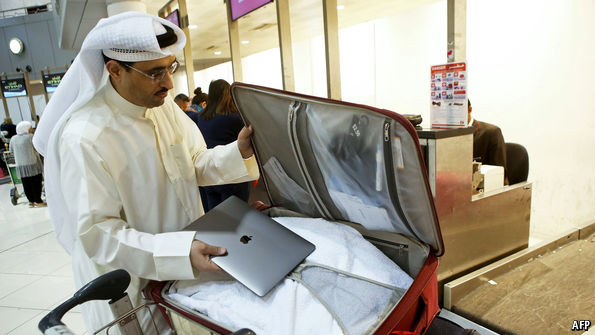
THE recently announced ban on laptops and other large electronic devices on direct flights from Middle Eastern airports to America is bad news for business travellers hoping to get work done on these long journeys. That, in turn, spells trouble for the airlines that fly these routes. Carriers like Emirates, Turkish, Qatar, and Etihad compete for long-haul flyers all over the world. They have just become a little bit less competitive. (Gulliver recently booked a flight from Manila to Washington, DC on Emirates, via Dubai; had he known what was coming, he might well have opted to fly via Tokyo or Beijing instead.)
Turkish Airlines stock tumbled more than 7% after the ban was announced in America. (Britain announced similar restrictions soon after, though crucially the superconnectors’ hubs in the United Arab Emirates, Qatar and Turkey were not included.) Rival airlines, meanwhile, are thrilled at the news. Emirates, Etihad and Qatar currently serve half the travellers flying between India and the United States, for example. Air India now