
Tag: Gulliver
Turkey’s dream of becoming the epicentre of global aviation looks shaky

UNTIL recently, the worst thing about transiting through Istanbul’s Ataturk Airport was the heaving throng of passengers crammed into its over-stretched terminals and under-staffed security lines. It was also the best thing. Witnessed from the sanctuary of a barstool with time on your side, the endless haze of Nigerians, Swedes and Pakistanis dancing around one another creates the most sublime of spectacles. It is a modernist dream that quickly becomes a nightmare, of course, when you join the scrum yourself. Yet the appeal of the global hub endures for all but the most battle-worn and hardened of business travellers.
So it was each time Gulliver visited Ataturk until September, when his stopover to East Africa and back took on a more sombre, desolate tone. This was his first time in the airport since June, when suicide bombers loyal to Islamic State killed 42 and injured 200 at the hub. The very next month, a failed coup d’état left 250 dead and 2,000 injured across the country. In the airport, complaints about the lack of free Wi-Fi were replaced by uneasy glances over hunched shoulders. Seats were easier to find.
Anecdotal…Continue reading
A Trump presidency probably spells bad news for America’s travel industry

OVER the weekend a United Airlines pilot was forced to leave his cockpit in order to mediate between fighting passengers, after a disagreement over the virtues of Donald Trump turned nasty. In today’s world that amounts to a non-story: people lose their senses on aircraft all the time. But it feels prescient to read that a Trump presidency is already disrupting travel. Many in the industry worry what effect his policies might have beyond an increase in the number of tetchy flyers.
So what will a Trump administration mean for American tourism? As with many things about the next four years, uncertainty abounds. Much will depend on the extent to which Mr Trump keeps his pre-presidential word.
Some of his pledges would clearly create problems for the industry. If he were, for example, to implement a ban on Muslims entering the United States—which he vowed to do on his first day in office, and which he could enact
Dubai is to test the feasibility of hyperloop trains

FOR years Elon Musk, a South African-born tech entrepreneur, has been telling anyone who will listen that the future of travel is the hyperloop. (Although he thinks it might also be driverless cars. Or perhaps affordable space travel.) Dubai may be about to test the limits of Mr Musk’s imagination.
The hyperloop is a train that moves along a tube that is kept at a thousandth of the normal atmospheric pressure at sea level. Because air resistance is one of the biggest obstacles to high-speed travel, all but eliminating it means that hair-raising velocity becomes possible. The proposed technology could shunt passengers along tunnels at perhaps 745mph, which is faster than a…Continue reading
France is having a terrible year for tourism

IT SHOULD have been a good year for French tourism. After all, as host of the Euros, the continent’s quadrennial international football tournament, it had the perfect chance to showcase its many charms. Instead, 2016 has been a disaster. Visits to the world’s most popular tourist destination have fallen by over 8% in the year to October, according to Bloomberg, compared with the same period in 2015. The number of nights spent in Parisian hotels fell by 21%.
Brexit hasn’t helped. Britain is the country’s second biggest source of overseas visitors. As sterling has plunged, France has become more expensive for those used to popping across the channel to stock up on plonk and Pont-l’Évêque. Consequently, arrivals from Britain are down by 4%.
But terrorism is the main reason for tourists’ squeamishness. Horrific attacks in Paris and Nice over the past 12 months that claimed hundreds of innocent lives, as well as several other well-publicised atrocities, have made Asians, in particular, think again. Nearly 40% fewer…Continue reading
Ryanair wants to control even more of Europe’s aviation market

IT HAS been a turbulent year for airlines in Europe. A slowdown in the growth of demand for air travel across the continent has hit both passenger volumes and fare levels. Last month, Europe’s two biggest low-cost carriers, Ryanair of Ireland and easyJet of Britain, slashed their profit forecasts following the post-referendum fall in the pound. Average fares in Europe could drop by as much as 15% year-on-year this winter as airlines try to keep planes full.
Yet earlier today, Ryanair’s results for the six months ending September took investors and analysts by surprise, and in a good way. In spite of fares falling by a tenth, post-tax profits increased 7% to €1.17bn ($1.29bn) compared with the same period last year. Revenues, too, were up slightly. Although the airline has been hit by Brexit, it says it will respond by shifting capacity growth next year from Britain to countries such as Germany, Italy and Poland.
Although this is all good news for travellers wanting to fly around Europe at the lowest possible cost, traditional full-service outfits should be worried by Ryanair’s ebullient mood. Ryanair has traditionally focused on…Continue reading
Uber plans for the arrival of flying cars

FOR decades, when asked to imagine the technology of the future, the stock answer has been flying cars. In reality, the passage of time has brought us innovations of a sort we never foresaw: the ability to send information instantaneously to the other side of the world, to look up any known fact with the click of a button, and to swap faces with a cat. Meanwhile, cars have remained earthbound and transportation technology—planes, trains and automobiles—has retained its familiar form.
Until now, perhaps. Last week Uber, a ride-hailing app, released a 97-page white paper. Its title was “Fast-Forwarding to a Future of On-Demand Urban Air Transportation”, and it proposed a programme called Elevate. But the two words that everyone took away from the report were the same ones that have always come to mind when the future is mentioned: flying cars.
Within the next decade, Uber aims to launch a network of flying cars that will turn a two-hour road trip into a 15-minute flight. And it…Continue reading
RFIDs are set almost to eliminate lost luggage

HAVING bags go astray on a flight is rare but infuriating. Indeed, according to a study by Skytrax, lost luggage was passengers’ number one complaint last year, beating even flight delays and cramped seats. That frustration could become rarer still. The aviation industry is increasingly using radio frequency identification devices (RFIDs, pictured) to track bags. Airlines have begun to attach these RFIDs to luggage tags. Doing so could significantly reduce the number of bags that are mishandled.
Research by SITA, an IT firm, and the International Air Transport Association, an industry association, found that a widespread adoption of RFIDs could allow 99% of bags to be tracked successfully. Already, other new technologies have cut the number of mishandled bags in half since 2007. RFIDs could reduce that number by a further 25% over the next six years, even as volume continues to increase.
Currently, as the Los Angeles…Continue reading
Aviation executives doubt a third runway at Heathrow will be built anytime soon

LAST week, the British government gave London Heathrow airport the go-ahead to expand. The decision to allow it to build a third runway had been a long time coming. It is 70 years since the area around London last saw a new one built, and Heathrow, Europe’s busiest hub, is operating at 99% capacity. But already two aviation executives have expressed their cynicism about whether a runway will be built anytime soon. Or to cost.
Willie Walsh (pictured), the boss of IAG, the parent company of British Airways (BA), by far Heathrow’s biggest tenant, kicked off proceedings. “Do I have confidence that the current team at Heathrow can do it?” he said in an interview on Friday. “No, I don’t.”
Mr Walsh is not exactly a disinterested observer. The proposed £17.6bn ($21.4bn) expansion of Heathrow is to be financed privately; IAG fears that this will mean higher charges for BA. Even before the vote Mr Walsh, perhaps disingenuously, had come out against the building of a new runway for this reason. Last year, after the Airports Commission had…Continue reading
Chinese firms are investing heavily in American hotels
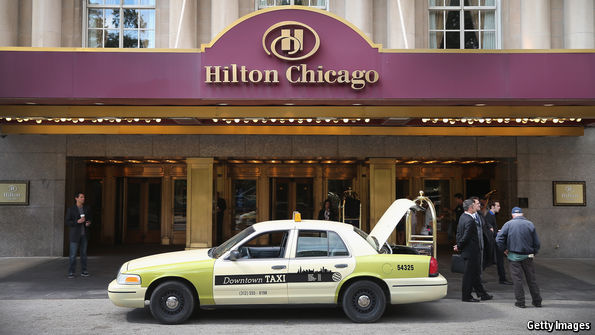
CHINESE tourists are an increasingly common sight in America’s cities, from New York to Honolulu. About 2m Chinese visit the country each year; that figure is expected to rise to over 3m by the end of the decade. But it is not just Chinese tourists who have been enjoying American hospitality; it’s Chinese investors, too.
This week HNA Group, a Chinese firm that began life as an aviation company, announced that it is to buy a 25% stake in Hilton Worldwide Holdings. It will be the largest shareholder in the hotelier whose brands also include Embassy Suites, Hampton Inn and Conrad.
The deal is the latest in a year that has already seen substantial Chinese investment in American hotels. In April, an HNA division announced it was buying Carlson Hotels, which owns Radisson and several other brands. Last month, Anbang Insurance Group completed the purchase of 15 American hotels in a deal worth more than $5bn, including the JW Marriott Essex House in New York, the Westin St. Francis in San Francisco, the InterContinental in Chicago, a Four Seasons in Washington, DC, and two Ritz-Carlton resorts. And just last week came the news that China…Continue reading
How not to annoy a flight attendant

THOSE of us who fly regularly have grown thoroughly accustomed to the usual interactions with flight attendants. Yet because most cabin crew are so courteous and professional, few of us probably have a good sense of how they would like us to behave so that they can go about their jobs as efficiently and pleasantly as possible. Do they, for example, get annoyed when they have to respond to the hellos of each arriving passenger, or do they feel snubbed if someone doesn’t greet them? Does it bother them when absolutely no one is watching as they perform the safety announcements? How about those who stretch in the aisles?
Business Insider interviewed more than 60 flight attendants to compile a list of the behaviours that annoy. There are 21 common complaints, it seems. They can be broken into three categories.
The first might be described as the kind of behaviour that would be an affront to anyone with a modicum of decency. This includes passengers hogging the overhead bins. This is equivalent to putting a…Continue reading