
Tag: Gulliver
Donald Trump says he will cancel an order for a new presidential jumbo jet

EVEN when all other orders evaporate, at least Boeing can rely on one important customer for its jumbo jet: the president of the United States. That was the gist of a post that Gulliver wrote earlier this year on the travails of the 747, a once-popular aircraft that has fallen foul of today’s aviation economics.
Gulliver may have spoken too soon. Today, Donald Trump seemingly announced that he would cancel an order to develop a new jumbo, due to come into service in 2024, to ferry around whomever is then the leader of the free world. In a tweet, Mr Trump wrote: “Boeing is building a brand new 747 Air Force One for future presidents, but costs are out of control, more than $4 billion. Cancel order!” He later reiterated his concern outside Trump Towers, his New York hotel, saying: “The plane is totally out of control. I think it’s ridiculous. I think Boeing is doing a little bit of a number. We want Boeing to make a lot of money but not that much money.”
Mr Trump already has his own plane—a Boeing 757. Might he be planning to steer clear of the vehicle that comes with his…Continue reading
Transport employees in America were secretly paid by the government to search travellers' bags

THERE are many reasons why you might have been stopped at an American transport hub and your bag searched by officials. You might have be chosen at random. Perhaps you matched a profile. Or you could have been flagged by an airline, railroad or security employee who was being secretly paid by the government as a confidential informant to uncover evidence of drug smuggling.
A committee of Congress heard remarkable testimony last week about a long-running programme by the Drug Enforcement Administration. For years, officials from the Department of Justice testified, the DEA has paid millions of dollars to a variety of confidential sources to provide tips on travellers who may be transporting drugs or large sums of money. Those sources include staff at airlines, Amtrak, parcel services and even the Transportation Safety Administration.
The testimony follows a report by the Justice Department that uncovered the DEA programme and detailed its many potential violations. According to that report, airline employees and other informers had an incentive to search more travellers’ bags, since…Continue reading
Why the Chapecoense football team’s plane ran out of fuel

MUCH remains unknown about Lamia Airlines flight 2933, which crashed into the hills of Colombia on November 28th, killing 71 of the 77 people on board (see article in this week’s print edition). Fans of Chapecoense, a Brazilian football team, must wait to hear the full story of how a plane carrying 22 of their players and several staff members failed to arrive safely. (Only three players are among the survivors.) Many Brazilian reporters covering the crash knew one of the 21 journalists on board, and are starting to ask why these lives were lost in such devastating circumstances.
The chartered plane was to fly the footballers from São Paolo in Brazil to the Colombian city of Medellín for the biggest match of their lives, the final of a continental club tournament. Two refuelling stops in Bolivia were scheduled, first in Santa Cruz de la Sierra and then in Cochabamba. But the second of these never happened. In a black-box recording leaked to the press, the pilot, Miguel Quiroga, could be heard saying that the plane was running out of fuel…Continue reading
How “driver mode” for phones will affect those who work behind the wheel

FOR business travellers moving between cities, there’s no better place to get work done than the train. But for travellers in America, going by rail is generally not an option outside of the transit corridor from Washington, DC to Boston. And so people covering ground for business are often forced to make do with cars, and with whatever they can manage behind the wheel—which usually means making a lot of phone calls.
That could soon change. Just as airplane mode has restricted travellers from using cellular networks while in the skies, “driver mode” may soon severely limit communications on the road.
Last week, the National Highway Traffic Safety Administration called for makers of mobile phones and similar devices to include a driver mode on those products that will prevent drivers from making calls, sending texts and checking social media. Under these guidelines, all applications other than music and navigation could be locked for drivers.
“Distraction is still a problem,” the transportation secretary, Anthony Foxx, Continue reading
Barcelona hits Airbnb with a hefty fine

THE phoney war between home-sharing websites and Barcelona seems to have come to an end. After months of sparring between the parties, this week Barcelona levied fines of €600,000 ($636,000) each on Airbnb and HomeAway, which it says have been offering to rent properties that do not have a tourist licence to holidaymakers. The firms had already been fined a nominal amount last year. HomeAway says it will pay the fine; Airbnb is appealing.
Airbnb says that it is “part of the solution” in Barcelona. That depends on which problem it thinks it is addressing. Barcelona is a cramped town. The number of visitors to the city has more than doubled since the start of the decade, from 3.1m in 2000 to 7.8m in 2014. That is close to five tourists for every inhabitant. Tourist accommodation is scarce. The average hotel occupancy rate in Barcelona is 78%, the highest of any of Spain’s main towns. Hotels’ revenue per room, too, is higher than in other cities. All of which suggests a strong demand for…Continue reading
Internet on trains hits the buffers

THE train is often the best way to travel for business. Anyone heading to Paris from London for a meeting, for example, would be mad to choose an Airbus over a Eurostar. The journey time by rail may be more than twice as long—two hours and forty minutes compared with an hour and a quarter in the air—but that doesn’t take into account the fact that passengers must mope about the airport for a couple hours before boarding their flight. (Eurostar suggests turning up 30-45 minutes before the train leaves; for domestic trains you just need a few minutes.) Furthermore, unlike St Pancras station and Gare du Nord, Heathrow and Charles de Gaulle are some distance from the centre of town. In fact passengers will probably need to board a train to get there.
But time-saving is the least of it. In most instances, travelling by rail is simply more pleasant. Assuming that they have booked a seat and don’t have to squat in the aisles, passengers get more space, get a full-size window through which they can watch the world fly by and are able to get up and wander about. They may even get a table big enough to allow them to spread out their papers, laptop and a sandwich at the same…Continue reading
By launching Trip, Airbnb hopes to capture every step of the travel process

OVER the past year, cities around the world have begun to crack down on illegal Airbnb listings, threatening the home-rental firm’s seemingly unstoppable expansion. As regulation bites in some of its most important markets, so Airbnb is looking for new ways to grow.
Last week, the company announced the launch of Trips, a service through which locals can offer guided tours and other experiences to travellers. It will start modestly, offering 500 things to do across 12 cities: London, Miami, Nairobi, Havana, Florence, San Francisco, Los Angeles, Tokyo, Detroit, Seoul, Paris and Cape Town. These include activities like “violin making in Paris or marathon running in Kenya”, according to the site. An additional 39 cities will soon be added; experiences will range in cost from $30 to several hundred dollars for multi-day events.
That is only the start. Airbnb hopes ultimately to capture every step of the travel process. Eventually Trips will offer travellers the ability to rent cars, book flights and restaurants, and order groceries. At a time when both leisure and business travellers are…Continue reading
By launching Trips, Airbnb hopes to capture every step of the travel process
OVER the past year, cities around the world have begun to crack down on illegal Airbnb listings, threatening the home-rental firm’s seemingly unstoppable expansion. As regulation bites in some of its most important markets, so Airbnb is looking for new ways to grow.
Last week, the company announced the launch of Trips, a service through which locals can offer guided tours and other experiences to travellers. It will start modestly, offering 500 things to do across 12 cities: London, Miami, Nairobi, Havana, Florence, San Francisco, Los Angeles, Tokyo, Detroit, Seoul, Paris and Cape Town. These include activities like “violin making in Paris or marathon running in Kenya”, according to the site. An additional 39 cities will soon be added; experiences will range in cost from $30 to several hundred dollars for multi-day events.
That is only the start. Airbnb hopes ultimately to capture every step of the travel process. Eventually Trips will offer travellers the ability to rent cars, book flights and restaurants, and order groceries. At a time when both leisure and business travellers are…Continue reading
Will supersonic passenger planes boom again?

SINCE the moment that three British Airways Concordes touched down at Heathrow in 2003, on their final journey before being retired from service, air-heads have pined for the days of supersonic passenger jets. Concordes were cramped and noisy, but they were the very emblem of the jet-setting elite. One’s time had to be very valuable indeed to justify paying thousands of pounds extra to shave three-and-a-half hours off of a transatlantic trip.
One of Concorde’s most wide-eyed fans was Richard Branson. The airline boss apparently kept a model of the plane—with his Virgin livery replacing British Airways’, naturally—on his desk. Little wonder, then, that he is putting his effort behind the latest in a line of pretenders to the supersonic crown.
This week Boom Technology unveiled a prototype of a plane that will eventually be capable of flying at Mach 2.2. That would allow the three-engine, 50-seat jet (pictured above) to cross the Atlantic in three hours and thirty minutes, about the same as the old Concorde. It hopes to test a one-third-sized model in the skies next year, with the final version ready to take paying passengers in 2023—20 years after the…Continue reading
Airlines are finally explaining what “last class” means. It isn’t pretty
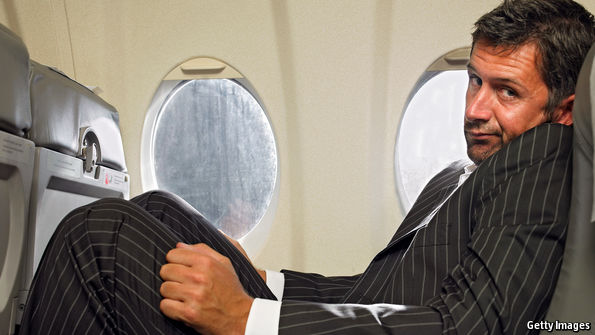
OVER the past couple of years America’s three biggest carriers, Delta, United and American, have each unveiled a fare class below economy. The new designation, known as “basic economy” to the airlines and derided as “last class” by their customers, is an attempt to compete with the low fares on profitable no-frills carriers such as Spirit and Frontier.
From the airlines’ initial announcements, it seemed that the sacrifices passengers would have to make in order to secure last-class fares would be modest. The most notable was the inability to select seats when booking a flight. For families travelling together that might be unpalatable, since they would run the risk of being split up. For solo travellers it would mean more chance of a middle seat—not ideal, but worth the lower cost for many flyers.
That changed this week when United, on a call with investors, dropped a bombshell: flyers in basic economy would be barred from using the overhead bins. Instead, they will be allowed only a small carry-on bag that can fit under the seat in…Continue reading