
Tag: Gulliver
Korea Air admits to tasering unruly passengers

CABIN crew on Korea Air flights have used electric stun guns to pacify flyers on five occasions, according to an investigation by the BBC. The report says that South Korea’s national carrier is the only big airline known to fly with such tasers on board. They were first introduced on its planes in 2002.
According to the Beeb, the airline is now “ramping up training for staff using the guns after criticism for the way it handled a recent in-flight disturbance”. In that instance, an all-female cabin crew apparently took four hours to subdue a drunk passenger, with other paying flyers forced to help them do so.
Allowing flight attendants to use weapons on planes is troubling. If it takes demure crew several hours to pacify a drunkard, it will not take much for a ne’er-do-well to take the weapon from them for his own means. And no matter how well trained the crew are at handling a taser, they were presumably not selected by the airline for their dead-eye abilities. The danger of something going wrong is too great.
If someone must be responsible for electrocuting flyers, it should be a…Continue reading
Korean Air admits to tasering unruly passengers
CABIN crew on Korean Air flights have used electric stun guns to pacify flyers on five occasions, according to an investigation by the BBC. The report says that South Korea’s national carrier is the only big airline known to fly with such tasers on board. They were first introduced on its planes in 2002.
According to the Beeb, the airline is now “ramping up training for staff using the guns after criticism for the way it handled a recent in-flight disturbance”. In that instance, an all-female cabin crew apparently took four hours to subdue a drunk passenger, with other paying flyers forced to help them do so.
Allowing flight attendants to use weapons on planes is troubling. If it takes demure crew several hours to pacify a drunkard, it will not take much for a ne’er-do-well to take the weapon from them for his own means. And no matter how well trained the crew are at handling a taser, they were presumably not selected by the airline for their dead-eye abilities. The danger of something going wrong is too great.
If someone must be responsible for electrocuting flyers, it should be a…Continue reading
Should films on planes be censored?

“FLYING’S very dangerous. In 1987, there were 30 airline accidents; 211 were fatalities and 230 were definitely passengers.” When “Rain Man” was released in 1988, airlines edited this scene out of the film before showing it to passengers. The deleted segment was important to the plot—it explains why Raymond and Charlie drive cross-country rather than use more convenient modes of transport. Still, airlines’ squeamishness is hardly surprising. Despite Tom Cruise’s assurances that air travel is “the safest…in the world”, flyers prefer not to be reminded of the one-in-11m chance that they might die. To this day, airlines avoid playing the scene on shared screens. (Only Qantas allowed it to be shown: Raymond lists it as the only airline to have never crashed.)
If aeroplane-disaster flicks such as “Sully” (2016, pictured above) and “Flight” (2012) are obviously unsuitable for in-flight entertainment, what do carriers look for when offering a film? On short-haul flights with shared screens, the goal is to find something that might appeal to everybody. That is a tough task. In his book on censorship, Michael Cornick argues that “terrorism, nudity or sex…Continue reading
Air India may segregate some women passengers for their own safety

SEGREGATION on airlines has a long history. Sometimes it is understandable. Carriers’ business models depend on them drawing a curtain between those of us stuffed into economy-class seats and our betters who have paid for lie-flat beds. Other times it has been immoral. While racial segregation on American planes was never legal, in some airports during the first half of the 20th century it was the norm to insist that blacks did not mix with whites in the terminals.
That particular outrage has been consigned to the past. But new forms of segregation are replacing it. This time, though, they are less to do with enshrining differences and more for the benefit of those being segregated. Or so the argument goes.
On 11th January, Ashwani Lohani, the boss of Air India, told The Hindu newspaper that the carrier plans to reserve six seats in the front rows of its aeroplanes for women passengers who are travelling alone. As the paper explains:
The move assumes significance, as it comes soon after an on-board…Continue reading
Thousands of flyers have been caught trying to smuggle loaded guns onto American planes

ON JANUARY 6th, a gunman ran amok at Fort Lauderdale-Hollywood International Airport, killing five people. Earlier this week, Esteban Ruiz Santiago, a 26-year-old Iraq war veteran, appeared in court charged in relation to the horrific crime. If convicted, the judge told him, he could face the death penalty.
Mr Santiago allegedly pulled a gun out of his luggage in the baggage reclaim area. Although he appears to have a history of questionable mental behaviour, including entering an FBI building with a magazine of ammunition, he had probably checked his weapon into the hold of his flight legally. According to Transport Security Administration (TSA) rules, “You may transport unloaded firearms in a locked hard-sided container as checked baggage only. Declare the firearm and/or ammunition to the airline when checking your bag at the ticket counter. The container must completely secure the firearm from being accessed.”
Yet despite such an easy-going attitude to allowing passengers legitimately to fly with guns, an increasing number try to do so illegally, by sneaking firearms…Continue reading
New York’s airports may finally be upgraded

BUSINESS travellers have innumerable reasons to look forward to a visit to New York, and a few grounds to dread getting there. Chief among them are the city’s hellish airports. A study in November found that New York’s three international airports are the very worst among America’s 30 busiest hubs, in terms of ease of access, wait times and amenities.
The oft-derided LaGuardia came in dead last, with the highest rate of flight delays and cancellations, but the city’s bigger problem is John F. Kennedy Airport, which has more international passengers than any other airport in America. According to the study, it is massively inconvenient, with the longest drive time to the city centre and the longest waits to get through security.
That might be about to change. Last week, New York Governor Andrew Cuomo laid out a plan for a $10bn overhaul of JFK. One-fifth of that funding could go toward improving road access, which is described in the plan as a “confusing spaghetti network for on-airport roads that lead to multiple bottlenecks and…Continue reading
British Airways crew walk out over “poverty” pay
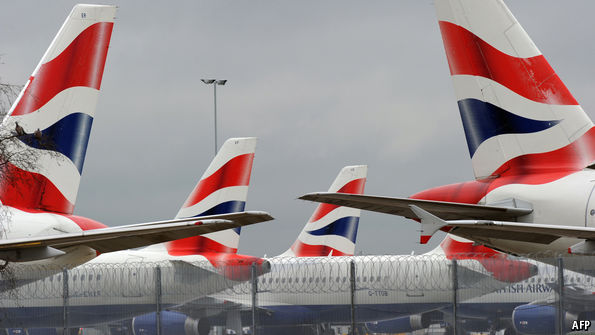
BARRING a last-minute breakthrough, about 2,500 cabin crew members employed by British Airways (BA) will strike this week over alleged “poverty pay” at the airline. Workers originally planned walkouts for the Christmas period, but suspended the action to consider a revised pay offer. Having rejected that offer by a 7-1 margin, the strikes will now occur on 10th and 11th January. BA says the impact will be minimal, with 85% of cabin crew reporting for duty and just 12 return flights being cancelled each day. Passengers due to travel on those affected flights, which all leave from London Heathrow Airport, will be rebooked onto alternative services. Still, the slightest whiff of disruption will prompt howls of discontent in a week in which strikes on both London Underground and some national rail services into the capital are adding to the misery.
This is not the first time BA cabin crew have called industrial action. In 2010, a series of strikes caused 22 days of travel chaos. Then, cabin crew were angry about staffing cutbacks and the introduction of new contracts, dubbed “mixed-fleet” contracts, which offered inferior terms for new…Continue reading
MasterCard could estimate passengers’ weight for airlines based on what they buy

FIRMS must tread lightly around the subject of their customers’ weight. It is a sensitive subject for many. Still, a lot of organisations would like to be able to size up those who use their services.
MasterCard, a credit-card company, has filed a patent application for what it describes as “a system, method, and computer-readable storage medium configured to analyse the physical size of payment accountholders based on payment transactions, and allowing a transportation provider to apply the physical size of payment accountholders to seating”. In plain English, the firm plans to estimate its customers’ size and weight based on their clothing and shoe purchases. It could then transmit this information to airlines (and other transportation providers, such as rail and bus companies) which might use it to assign seats.
Exactly how airlines would deploy this information is not known. In its application, MasterCard takes a charitable interpretation, writing that “for the comfort of their passengers, transportation providers should avoid seating physically large strangers next to each…Continue reading
Plastic planes will allow airlines to increase cabin pressure

A FELLOW Gulliver, cheery chap that he is, kicked off the new year explaining why 2017 might be even worse for business travellers than the year we have just put behind us. The reasons are largely geopolitical: the fallout from Brexit, the uncertainty surrounding soon-to-be-President Donald Trump, the likely rise in oil prices, the Chinese economic slowdown and the threat of terror. But there’s one trend that could have a pleasant effect on travel, making flying more comfortable despite efforts by airlines to pack passengers in tighter and charge for the most basic amenities. No doubt you’ve beaten me to it: carbon-reinforced plastic composites.
Much of the discomfort of flying—whether reclining in a private first-class suite or jammed into coach—comes from two factors: air pressure and humidity. At 35,000 feet, the air pressure outside an aeroplane is extremely low, so the cabin is pressurised to bring it to a level closer to what we experience on the ground. The trouble is that lowering it all the way to sea-level pressure would put tremendous strain on the body of the plane, which would…Continue reading
Virtual-reality headsets on planes mean we can isolate ourselves from irritating cabin-mates

IN THE early days of commercial flight, people would dress up to take to the air and marvel at the fact that they, members of a heretofore land-bound species, were flying through the sky. Nowadays we clamour for the opposite mindset: one in which we do our best to pretend we are not flying at all.
Such denial has moved a step closer. A French startup called SkyLights has produced a 3-D virtual-reality (VR) headset, with noise-cancelling headphones, that envelops travellers in a cinematic world completely removed from their airborne surroundings. In mid-December, XL Airways, a French low-cost carrier, became the first airline to offer SkyLights to flyers. For $16 per flight, travellers can immerse themselves in new Hollywood releases, in their own individual theatres.
For travellers who want to get away from the many annoyances of flying—from the screaming child in the next row, the loud conversation across the aisle, the seatback movie selection that seems to consist entirely of lowbrow sequels—SkyLights and similar technology could be a godsend. And yet there’s something sad, something resigned, about confining oneself to an…Continue reading