
TAURUS
Morgan Stanley recibirá una comisión récord de 110 millones por asesorar la compra de Monsanto
Es la mayor comisión que se embolsa un banco de inversión por asesorar una operación empresarial de estas características, según Financial Times. Leer
El Deutsche Bank vende una cartera de crédito y activos en España
La entidad no revela el nombre del comprador, que ha pagado 430 millones
El déficit comercial baja un 31,6% hasta agosto
El déficit comercial alcanzó los 10.996,3 millones de euros en los ocho primeros meses del año, el segundo mejor saldo para este periodo desde 1997
A simple, surprisingly good election forecasting method

PUNDITS, journalists, campaign hands and others spend an awesome amount of time during election season trying to work out what factors will swing the vote one way or another. Could it be a candidate’s likeability? Differences in policy? Her ad strategy? His habit of insulting large swathes of the electorate?
Campaign choices matter, but political science research suggests that the lay of the electoral land is largely shaped by factors beyond candidates’ control. People vote retrospectively, based on their perception of how things are going for them and those around them. But their perceptions are shaped by all sorts of things. As Christopher Achen, of Princeton University, and Larry Bartels, of Vanderbilt University, describe in Democracy for Realists, a book published earlier this year, voters sometimes punish politicians for bad weather, random misfortunes—an outbreak of shark attacks appears to have cost Woodrow Wilson votes in the 1916 election—and the performance of the local American football team.
Perhaps more importantly, voters are extremely myopic. They care about their economic welfare, and especially about whether or not their…Continue reading
Bankinter pide que se subaste BMN y que no se ofrezca solo a Bankia
Dancausa, consejera delegada, critica la decisión de Economía porque va contra la igualdad de reglas en el mercado
Techno wars
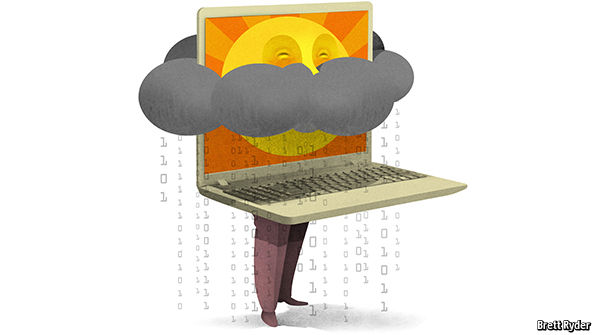
THE most striking battle in modern business pits the techno-optimists against the techno-pessimists. The first group argues that the world is in the middle of a technology-driven renaissance. Tech CEOs compete with each other for superlatives. Business professors say that our only problem will be what to do with the people when the machines become super-intelligent. The pessimists retort that this is froth: a few firms may be doing wonderfully but the economy is stuck. Larry Summers of Harvard University talks about secular stagnation. Tyler Cowen, of George Mason University, says that the American economy has eaten all the low-hanging fruits of modern history and got sick.
Until recently the prize for the most gloom-laden book on the modern economy has gone to Robert Gordon of Northwestern University. In “The Rise and Fall of American Growth”, published in January, Mr Gordon argues that the IT revolution is a minor diversion compared with the inventions that accompanied the second industrial one—electricity, motor cars and aeroplanes—which changed lives profoundly. The current information upheaval, by contrast, is merely altering a narrow range of…Continue reading
The trials of Juno

IN THE pharma business, Juno Therapeutics, a small firm based in Seattle, is just a stripling. It is three years old, has not a single drug approval to its name but is nonetheless valued at $2.8 billion. That value is derived from the fact that it is on the forefront of the most promising area of cancer treatments in decades: immuno-oncology.
Juno’s edge comes from its attempts to master one of the most important parts of the immune system: the T-cell. It is developing a so-called CAR-T therapy, in which its scientists extract T-cells from a cancer patient, modify them with gene therapy so that they can recognise cancer cells, and then put them back in the patient’s body ready to attack. The process has a reputation for inducing rapid remissions in cancers of the blood for patients who have exhausted all other options.
Small, innovative biotech firms such as Juno are intriguing because nowadays they are the main engine of global drug innovation. Alexis Borisy, a partner in Third Rock Ventures, a venture-capital firm in Boston, notes that pharma companies now buy in three-quarters of their pipelines, and develop only…Continue reading
It knows their methods
 When you’ve eliminated the impossible…
JOINING “Hamilton”, a Broadway show, and concerts by Adele, a British soul diva, on the list of tickets-to-kill-for in New York is a screening in an ugly new office building that recently popped-up in the East Village, a place best known for offbeat culture. There is a ten-week-long queue to see simulations by Watson, IBM’s cognitive artificial-intelligence platform.
Initially known for stunts such as beating the world’s best chess player, Watson has been seeking a wider audience. It has found a vast potential one in the world of financial regulation. Rules have become so sprawling and mysterious that even regulators have begun asking for a map. In response, a market is springing up: for “regtech”, fintech’s nerdy new offspring.
On September 29th, IBM announced the purchase of Promontory, a 600-strong consultancy whose senior staff include former officials from the Federal Reserve, the World Bank, the Securities and Exchange Commission and other regulators. The hope is that person and machine will combine into a vast business. Promontory was founded in…Continue reading
Turning the tables
 All wood, few trees
WALK through the workshop of Vinayak Home, a furniture-making outfit based in the outskirts of Jodhpur in the state of Rajasthan in north-west India, and the results of globalisation are evident. Sleek hardwood furniture that would suit Scandinavian interiors is being readied for shipment; carpenters distress the paint on a newly-made chest of drawers to make it look as if it has come straight from a flea market in Brooklyn. But the company’s order book suggests that globalisation is fading. Vinayak Home is one of a cluster of Rajasthan furniture-makers that used to do nothing except export to Europe and America, but nearly all of what they make today they ship into Indian living rooms.
Jodhpur, on the edge of a desert with few trees to feed sawmills, is an unlikely woodworking hub. But when tourists came to survey the arid landscape and the 15th-century fort that overlooks the city, many also admired the hardwood carvings by skilled artisans (pictured). When India liberalised its economy in the early 1990s, a small group of European exporting agents encouraged independent furniture-makers. Then volumes…Continue reading
Spectral forms
 Will they Passera?
FROM the mists of Italian banking, new shapes are emerging. One is at last becoming flesh: on October 15th the shareholders of two lenders, Banco Popolare and Banca Popolare di Milano, approved a merger that has been months in the making. The substance of another—Banca Monte dei Paschi di Siena, the world’s oldest bank as well as Italy’s most troubled—is still shrouded, but it is likely to become clearer at a meeting of Monte dei Paschi’s board on October 24th.
The merged bank, to be called Banco BPM, will surpass Monte dei Paschi to become Italy’s third-largest lender. Its creation is a small triumph for Matteo Renzi, the centre-left prime minister. Last year Mr Renzi introduced a reform obliging Italy’s ten biggest popolari, or co-operative banks, to become joint-stock companies by the end of 2016. The hope was that this would spur takeovers, yielding fewer, stronger, more efficient banks.
The Banco BPM deal, which promises annual savings of €290m ($318m), or 10% of the combined cost base, is Mr Renzi’s first result. Two awkward obstacles stood in its…Continue reading