
Economía
Insurers grapple with cyber-attacks that spill over into physical damage

AS HACKERS wreak havoc with depressing regularity, the insurance industry finds itself forced to contemplate a whole new set of risks. They range from the theft of millions of credit-card numbers from American retailers to the disabling of the power grid, as happened in Ukraine last December. The dedicated “cyber-insurance” policies that companies offer against data breaches have become relatively routine. But the risks they insure under other policies are also affected by cyber-risks—and they are still struggling to understand this so-called “silent” cyber-exposure.
Insurance that protects firms who suffer data breaches has been on offer for around 15 years. It is much harder to put a precise value on, for example, stolen health records than on a property or car. Insurers sidestep the problem by covering only the direct costs that a company incurs from a hack. Typically, these include hiring a specialised forensics firm to work out exactly what was stolen, notifying affected customers (which 47 American states currently require), short-term business interruption and fines.
The industry will be shaken up by new EU data-protection…Continue reading
Africa’s stock exchanges meet but size holds them back
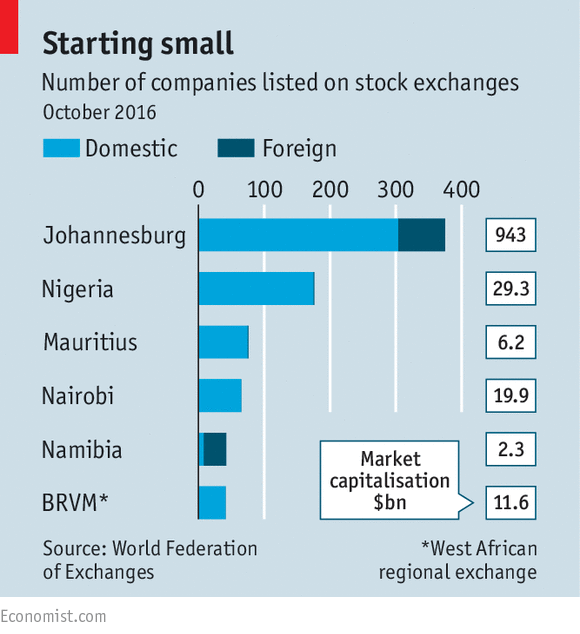
AS THE trading bell rings, a handful of brokers, in crisp scarlet jackets, gather around a whiteboard at the Rwanda Stock Exchange in Kigali. There are only seven listed companies, and it takes just a couple of minutes to write up the day’s bids. But Celestin Rwabukumba, its chief executive, is excited for the future. “If it works elsewhere, then why not here?” he asks.
Why not indeed? Johannesburg, with a market capitalisation of nearly $1trn, is in a league of its own. But sub-Saharan Africa has many small exchanges, lots of them created in the 1990s to help privatise state enterprises. Most struggle to attract new issues. Seven of the eight domestic listings on the Uganda Securities Exchange came from government divestments. Older exchanges, in Kenya and Nigeria, are dominated by big firms: a third of Nigeria’s market is the Dangote Group, a conglomerate with interests from cement to salt.
Stock-exchange leaders were in Kigali this week for the annual conference of the African Securities Exchanges Association. Much of the talk was about coaxing smaller, family-owned businesses to list. But many owners are loth…Continue reading
Sell-side share analysis is wrong
“SELL-SIDE” analysts, whose firms make money from trading and investment banking, are notoriously bullish. As one joke goes, stock analysts rated Enron as a “can’t miss” until it got into trouble, at which point it was lowered to a “sure thing”. Only when the company filed for bankruptcy did a few bold analysts dare to downgrade it to a “hot buy”.
Economic research shows that there is some truth to the ribbing. The latest figures from FactSet, a financial-data provider, show that 49% of firms in the S&P 500 index of leading companies are currently rated as “buy”, 45% are rated as “hold”, and just 6% are rated as “sell”. In the past year, 30% of S&P 500 companies yielded negative returns.

Profits forecasts made more than a few months ahead have a dismal record of inaccuracy. According to Morgan Stanley, a bank, forecasts for American firms’ total annual earnings per share made in the first half of the year had to be revised down in 34 of the past 40 years. Studying their forecasts over time reveals a predictable pattern (see chart 1).
In theory, a diligent share analyst should do his own…Continue reading
Revising bank-capital standards
A STEEP climb awaited the Basel Committee on Banking Supervision in Santiago on November 28th and 29th. The central bankers and regulators hoped to agree on revisions to Basel 3, the post-crisis version of bank-capital standards. On November 30th Stefan Ingves, the group’s chairman and head of Sweden’s central bank, said that “the contours of an agreement are now clear”. But the climbers are still short of the summit.
The committee had proposed restricting the use of banks’ internal models for calculating risk-weighted assets—which in turn help determine how much capital banks must have at hand. Models varied too much, it said; low risk-weights were flattering some banks’ ratios. But European bankers and officials had complained for months that the proposals would penalise banks that have lots of (low-risk) corporate loans or mortgages (eg, in Germany or Sweden). They sniffed an American plot: American banks, holding fewer such assets, would be untouched.
Mr Ingves gave few details, but said that the new set-up would “largely retain” internal models, though with minimum values for important parameters (such as the probability of default). A “standardised” approach will replace alternatives based on banks’ models for estimating operational risk (big fines, say, or cyber-security breaches).
Not surprisingly, the thorniest topic…Continue reading
The yuan’s weakness is a dilemma for China’s central bank

YUAN forecasters have had it easy for the past decade. But for a few isolated days, China’s currency has been a one-way bet for years on end, whether appreciating against the dollar, pegged to it or, more recently, depreciating. The pace at which it has risen and fallen has also been predictable: the central bank always made it gradual. So Guan Qingyou, of Minsheng Securities, thought himself on solid ground when he predicted in early November that the yuan would stay above 6.82 per dollar for the rest of the year. Less than a week later he was proved wrong: the yuan fell to an eight-year low. Mr Guan published an apology: the art of knowing the yuan’s future with any precision, he conceded, had become rather tricky.
Most analysts, investors and companies believe that the Chinese currency has further to fall against the dollar, but can only guess as to how far and how quickly. Their uncertainty reflects a new reality. The government, long able to exercise tremendous control over the yuan, has started to lose its grip. A new exchange-rate mechanism, introduced last year, has made the currency more flexible but also more responsive to…Continue reading
Ikea lanza en Madrid ‘Salvemos los muebles’ para la compra-venta de productos usados
El grupo probará a partir del 12 de diciembre una iniciativa que espera dar nuevos usos a unos 600 muebles
Un grupo estadounidense planea un macrocomplejo de hoteles y ocio en Madrid
El proyecto presentado por The Cordish Company contará con una inversión inicial de 2.000 millones y prevé crear 56.000 puestos de trabajo