
Economía
Career breaks
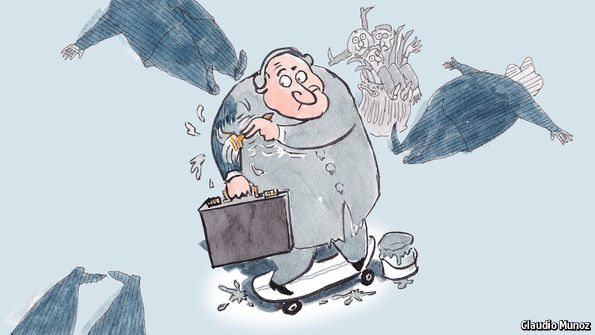
FRANK LLOYD WRIGHT quipped that “the modern city is a place for banking and prostitution and very little else.” Little did the early 20th-century architect know how banks would flourish, hoovering up much of the world’s talent by the early 2000s. But this golden age is ending: bankers’ jobs are at risk from the digital revolution on the one hand, and falling profits on the other.
Nowhere have bankers fallen from grace with such a bump as in Europe. This week ING, the Netherlands’ largest bank, announced that up to 7,000 jobs would be cut in the next five years. Commerzbank, Germany’s second-largest bank, had already reported it would cut its workforce by 9,600, nearly a fifth.
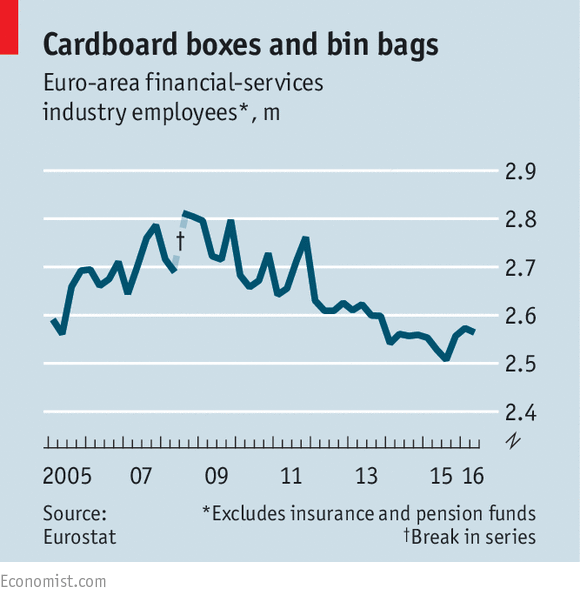
Across Europe, bankers are packing up. In Britain more than 10% of bank jobs were cut between 2011 and 2015; in Germany the workforce has shrunk by around 20% since 2001. Since the start of the year Credit Suisse has got rid of…Continue reading
Your name will also go on the list

FIRMS must list foreign workers, blares the headline of London’s Times newspaper today after a speech from the Conservative government’s new home secretary, Amber Rudd. The idea, it seems, is not to list each and every individual but for companies to list the total number of their foreign employees so that they can be “named and shamed”.
Conservative Home Secretaries have a tradition of throwing red meat to delegates so it may be that this policy never goes any further. On the BBC’s Today programme this morning, Ms Rudd was emphasising that the policy was only “for consultation”, and if she consults business, she’ll probably get a pretty rude answer. Which business would want to be named and shamed at the top of the list, with all the potential for adverse publicity, demonstrations etc? It’s all a bit reminiscent of the first world war, when shops with German-sounding names had their windows broken and the Royal family changed its name from Saxe-Coburg-Gotha to Windsor.
But this was not the only bad idea to come out of the current Conservative conference. First, there was the idea of
Fat help

BACK in Syria food was cheap, remembers Maya, as she sits cross-legged in the small flat she shares with her husband, their five children and another couple in Amman, Jordan’s capital. When she first arrived here, she had to cut back. But now, with her husband working and 20 dinars ($28) a month from the World Food Programme (WFP), a UN agency, she can buy the children a treat like fish or chicken.
Scattered across Turkey, Lebanon and Jordan are 4.4m registered Syrian refugees, 90% of whom, like Maya, live outside formal refugee camps. This makes it a logistical nightmare to get the traditional food aid to them—sacks of rice and pulses. The WFP, the world’s largest food-aid provider, has adapted: a decade ago, it doled out aid only in kind. Now just over a quarter of its aid globally is cash-based. Every month Maya gets a text message alerting her that her special debit card, which she can use only to buy food, has been topped up. The WFP reaches around 1.1m refugees like this in Jordan, Lebanon and Turkey.
This week saw the launch in neighbouring Turkey of the largest-ever humanitarian-aid project financed by the EU: a whopping €348m…Continue reading
La Bolsa alcanza los 10.000 puntos pero la industria y los servicios no despegan
Los mercados anticipan una recuperación a un año vista. El peligro es, si alimentados por los bancos centrales, no se han excedido. Leer