
Finanzas
Food packaging is not the enemy of the environment that it is assumed to be

ROUGHLY a third of food produced—1.3bn tonnes of the stuff—never makes it from farm to fork, according to the UN’s Food and Agriculture Organisation. In the poor world much of this waste occurs before consumers even set eyes on items. Pests feast on badly stored produce; rough roads mean vittles rot on slow journeys to market. In the rich world, waste takes a different form—items that never get picked off supermarket shelves, food that is bought but then goes out of date.
Such prodigious waste exacts multiple costs, from hunger to misspent cash. Few producers and processors record accurately what they throw away, and supermarkets resist sharing such information. But some estimates exist: retailers are reckoned to mark down or throw out about 2-4% of meat, for example. Even a tiny reduction in that amount can mean millions of dollars in savings for large chains.
Waste also damages the environment. The amounts of water, fertiliser, fuel and other resources used to produce never-consumed food are vast. The emissions generated during the process of making wasted food exceeds those of Brazil in total. Squandering meat is particularly…Continue reading
An airline apologises after threatening to sack a pilot who was too tired to fly

A POST on this blog from earlier this month talked about how airlines are sweeping the issue of pilot fatigue under the carpet. The London School of Economics had surveyed some 7,000 European captains and first officers—around 14% of all commercial pilots in the region—on various issues. Although most said that airline managers take safety seriously, they have a blindspot when it comes to tiredness. Close to 60% of pilots said that they and their colleagues were often fatigued and half said that their employers do not pay enough heed to the issue.
Right on cue, Thomas Cook Airlines, a British carrier, has been forced to apologise to a pilot who refused to take to the air because he was too knackered to fly. Captain Mike Simkins was suspended for six months and told he faced the sack after refusing to fly his Boeing 767 with over 200 passengers. According to BALPA, a pilots’ union, Mr Simkins took the difficult decision not to take off “after three extremely early starts…Continue reading
Dow 20,000?
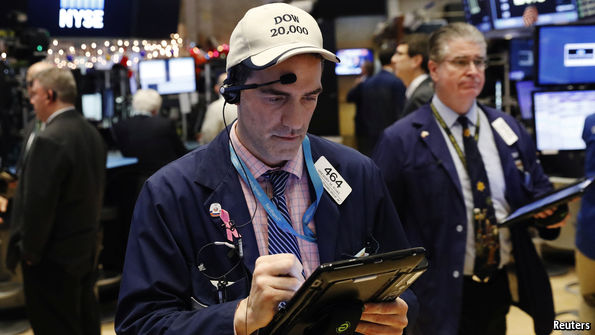
SOME time soon, the Dow Jones Industrial Average seems likely to break through the 20,000 barrier, an event that will be greeted with banner headlines and a sign that capitalism is flourishing again. In fact, the Dow is a flawed measure, which uses the odd approach of weighting its component companies by share price. The biggest stock in the Dow is Goldman Sachs and despite its prominence on the campaign trail (and among Donald Trump’s new team), it is hardly the most important company in America; its weight depends on its near-$240 share price. Like other financial shares, it has shot up in the wake of Mr Trump’s election; boosted both by hopes of bank deregulation and of potentially higher interest rates, which tend to boost bank profits. William Wright of New Financial estimates that Goldman staff’s wealth, in the form of options and shares, has risen by $2.3bn since the polls; not exactly a «revolt against the elite».
The Dow is up 9% since November 7th, well ahead of the more broadly-based S&P 500’s 6.6% gain. The S&P uses a weighting by market value—its…Continue reading
Macrooperación contra el fraude masivo del IVA de hidrocarburos
La Guardia Civil detiene a una veintena de personas acusados de fraude fiscal y blanqueo de capitales
Criteria pone a la venta el 1,7% de CaixaBank
La sociedad inicia la colocación del paquete, valorado en 327 millones, entre inversores institucionales
“A los bancos les gustaría dar más crédito a las pymes, pero el BCE lo impide”
La Sociedad de Garantía Recíproca, que presta a las pequeñas empresas, critica que miles de empresas se quedan fuera del circuito de la financiación
La justicia insiste en que Portugal debe pagar 1.800 millones al Banco Santander
Los tribunales británicos confirma cinco sentencias anteriores pero el Gobierno insiste en recurrir
El FMI pide a España subir el IVA y revisar el gasto en Educación y Sanidad
El Fondo denuncia el abuso de la contratación temporal y pide una reforma que haga atractiva la indefinida
El Gobierno quiere atraer a bancos de la City de Londres con una bajada de IRPF
El Gobierno español ha entablado contacto ya con varios grupos, básicamente bancos de inversión estadounidenses y japoneses
El Banco de Sabadell sale de Portugal
El BCP quedará en manos de los chinos de Fosun