
Finanzas
Alphabet’s Google is searching for its next hit
 Deflated hopes
“JUDGE a man by his questions, rather than his answers,” Voltaire advised. Google has become one of the most successful firms in history by heeding that advice. It evaluates the intention of web-surfers’ queries and returns relevant advertising alongside search results. But for years there has been a lingering question about Google: can it create a new, highly profitable unit to rival its search business?
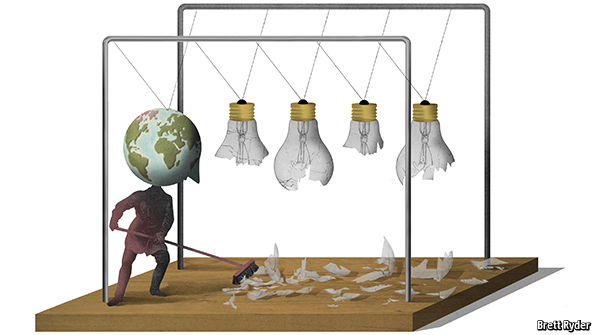
Not yet. In the past five years, Alphabet, formed as a holding company for Google and other disparate projects in October 2015, has spent $46bn on research and development (see chart). Much has gone to so-called “moonshot” projects, such as self-driving cars, smart contact lenses and internet delivered via balloons. Its British artificial-intelligence unit, DeepMind, also falls into the category of other projects. Since the start of 2015, these bets have together recorded a loss of $6bn.
 Continue reading
What DeepMind brings to Alphabet

DEEPMIND’S office is tucked away in a nondescript building next to London’s Kings Cross train station. From the outside, it doesn’t look like something that two of the world’s most powerful technology companies, Facebook and Google, would have fought to acquire. Google won, buying DeepMind for £400m ($660m) in January 2014. But why did it want to own a British artificial-intelligence (AI) company in the first place? Google was already on the cutting edge of machine learning and AI, its newly trendy cousin. What value could DeepMind provide?
That question has become a little more pressing. Before October 2015 Google’s gigantic advertising revenues had cast a comfortable shade in which ambitious, zero-revenue projects like DeepMind could shelter. Then Google conjured up a corporate superstructure called Alphabet, slotting itself in as the only profitable firm. For the first time, other businesses had their combined revenues broken out from Google’s on the balance-sheet, placing them under more scrutiny (see Continue reading
Management theory is becoming a compendium of dead ideas
NEXT year marks the 500th anniversary of the event which, more than any other, gave birth to the modern world: Martin Luther promulgated his 95 theses and called the Catholic church to account for its numerous theological errors and institutional sins. Revisionist historians have inevitably complicated the story (including questioning whether he did actually nail his proposals to the door of All Saints’ Church in Wittenberg) but the narrative remains clear. The church was ripe for change. It was sunk in corruption and divorced from the wider life of society. And by unleashing that change, Luther brought the Christian faith, including Roman Catholicism itself, a new lease of life.
The similarities between medieval Christianity and the world of management theory may not be obvious, but seek and ye shall find. Management theorists sanctify capitalism in much the same way that clergymen of yore sanctified feudalism. Business schools are the cathedrals of capitalism. Consultants are its travelling friars. Just as the clergy in the Middle Ages spoke in Latin to give their words an air of authority, management theorists speak in mumbo-jumbo. The medieval…Continue reading
Bruselas sale en defensa de Grecia por el bloqueo a reestructurar la deuda
Moscovici: «Grecia no puede ser condenada a la austeridad para siempre»
La deuda pública de las comunidades autónomas baja por primera vez
Los pasivos del conjunto de las Administraciones alcanzan un récord de 1,017 billones, la cifra más alta de la serie histórica trimestral
El Gobierno destinará 450 millones para ayudas al salario juvenil
Empleo se compromete con Ciudadanos a poner en marcha un programa piloto para complementar las rentas más bajas
Republican plans to cut corporate taxes may have unpleasant side-effects

SINCE Donald Trump won America’s presidential election investors have salivated over the prospect of lower taxes. Mr Trump has promised to cut corporation tax, a levy on firms’ profits, from 35% to 15%. Republicans remain in charge of both houses of Congress; Paul Ryan, the speaker of the House of Representatives, wants to cut the levy to 20%. The coming reforms, though, are about more than just lower rates. Republicans want to overhaul business taxes completely. Unfortunately, this task is far from straightforward.
America’s corporate-tax rate, which reaches 39.6% once state and local levies are included, is the highest in the rich world. But a panoply of deductions and credits keeps firms’ bills down. These include huge distortions, such as a deduction for debt-interest payments, as well as smaller scratchings of pork like special treatment for NASCAR racetracks. After all the deductions are doled out, corporate-tax revenues are roughly in line with the average in the rest of the G7, according to economists at Goldman Sachs.
Still, a high tax rate and a narrow tax base is a glaringly inefficient combination. Politicians of all…Continue reading
The Fed finally manages to lift rates in 2016

TODAY, finance and economics journalist gathered for a long-awaited Federal Reserve announcement: that the Fed’s benchmark interest rate would rise once more, by 25 basis points, to a range between 0.5% and 0.75%. If the scene looked familiar, well, no surprise there. It was December a year ago that the Federal Reserve announced another increase in its benchmark interest rate, of 25 basis points—the first in nearly a decade. It was also December a year ago that Fed projections suggested that rates would soar upward in 2016, to close to 1.5% by year’s end. The Fed has repeated that tradition as well; the projections published today repeat last year’s heroic call, of a rate near 1.5% one year hence.
Whether the third act of the holiday tradition—an inevitably disappointing performance of inflation and wage growth, which forces the Fed to abandon all but one of its expected rate hikes—will also be repeated remains to be seen. In some important ways, conditions…Continue reading
Janet Yellen, independiente y transparente
Las decisiones de ayer, referencia de la banca central ante su secuestro por los Gobiernos
La Reserva Federal de EE UU sube tipos por segunda vez en una década
Los miembros del banco central ven posible tres incrementos en 2017 aunque condicionado al efecto de las políticas de Donald Trump