
Tag: Approved
How companies should treat their most enthusiastic customers

THE hero of Nick Hornby’s novel, “High Fidelity”, cannot get enough of vinyl records. By day Rob Fleming runs a record shop where he spends his time sampling the stock and constructing fantasy compilations with his equally obsessive assistants. By night he moons over his favourite songs. “Is it so wrong, wanting to be at home with your record collection?” he asks himself. “There’s a whole world in here, a nicer, dirtier, more violent, more peaceful, more colourful, sleazier, more dangerous, more loving world than the world I live in.”
Rob is an example of what management gurus dub “super-consumers”, “lead consumers” or “high-passion fans”. Only a tenth of customers are super-consumers but they account for 30-70% of sales, an even greater share of profits and almost 100% of “customer insights”, says a new book, “Super-Consumers”, written by Eddie Yoon of the Cambridge Group, a consultancy.
These people are not defined simply by the amount of stuff they buy (though they tend to be heavy users), but by their attitude to the product. Like Rob, they regard the things that they consume as answers to powerful…Continue reading
The business of reselling returned shop items
 Can I send him back, too?
IN STORES and warehouses across America, they wait: towers of toys, scarves piled on scarves, box upon box of shoes. The official start of holiday shopping in America begins on “Black Friday” on November 25th. Retailers hope to sell more than $650bn of goods this season, roughly the annual economic output of Switzerland. Ideally, companies’ supply of products would precisely match demand for them. In reality millions of items will stay on shelves or get sent back after purchase—in all of 2015 Americans returned goods worth $261bn, out of a total $3.3trn sold. What happens next?
Some returned goods will be resold by the very same retailer, but many will not. By the time an item is returned it might be either damaged or stale, points out Steven Barr of PwC, an accounting firm and consultancy; shops might want to offer newer wares. And resale is not an option for the stacks of goods that are never sold at all.
For retailers and manufacturers, this is a big headache. Dealing with unwanted goods can amount to a tenth of the cost of making and distributing them in the first place. But for…Continue reading
The future of the A380

AT THE world’s major airports, plane-spotters often spend days waiting for the world’s largest passenger plane, the Airbus A380, to make an appearance. The nerds at Dubai International Airport are spoilt for choice. It is home to Emirates, an airline that owns 86 of the monster aircraft, almost half of the global A380 fleet. These planes have propelled Emirates from insignificance a decade ago to its position as the world’s biggest carrier (measured by international passenger mileage in 2015). Now the airline has hit a rough patch. That is bad news for Airbus, the European aerospace and defence giant which makes the A380, and for the plane itself.
Demand once seemed insatiable for flights through Emirates’ hub in Dubai, which is known in the industry as a “super-connector” airport. Now its location helps explain the airline’s difficulties as well as its spectacular past growth, says its president, Sir Tim Clark. When he helped set up the airline in 1985, he says, Dubai was “an enchanting Arab village” that generated little air traffic. Instead of filling up the planes with locals, his strategy was to use its position halfway between…Continue reading
India grapples with the effects of withdrawing 86% of cash in circulation
 A short, sharp liquidity shock
A NEW strain of trickle-down economics has been spawned by the decision, on November 8th, to withdraw the bulk of India’s banknotes by the end of this year. As holders of now-useless 500-and 1,000-rupee ($15) notes rushed to deposit them or part-exchange them for new notes, an e-commerce site offered helpers, at 90 rupees an hour, to queue outside banks in order to save the well-off the bother.
Elsewhere, a chronic shortage of banknotes in a cash-dominated economy has left most trades depressed. Seven out of ten kiranas (family-owned grocers) have suffered a decline in business, according to a survey by Nielsen, a consultancy. Supply chains, in which wholesalers and truckers deal mostly in cash, have fractured. Some 20-40% less farm produce reached markets in the days after the reform. City folk admit to hoarding the 100-rupee note, the largest of the old notes to remain legal tender. Taxi drivers refuse to break the new 2,000-rupee note. Road-tolls have been suspended until at least November 24th, to prevent queues. Beggars have disappeared from parts of Delhi; no one has…Continue reading
American bankers look forward to a bonfire of financial rules

BEFORE the presidential election, Wall Street dreaded Donald Trump as a dangerous, unpredictable and disruptive, if improbable, president. Since his victory, fear has turned to hope. Stockmarkets are at record highs and shares in financial institutions have been among the best performers. Mr Trump, it turns out, looks to big finance like good news.
Partly this reflects Mr Trump’s change of tack. He campaigned as the leader of a rustbelt revolt against the besuited, pampered elites. As president-elect, he seems less of an outsider. Among the rumoured names he has been mulling as his choice for treasury secretary are Jamie Dimon, boss of JPMorgan Chase, and Steven Mnuchin, a 17-year veteran of Goldman Sachs. Wall Street’s access to the corridors of power seems likely to be unimpaired.
But the euphoria mostly reflects the finance industry’s excitement at one of the more achievable of Mr Trump’s campaign promises: to cut red tape. In a YouTube video this week outlining his priorities, he announced a new rule: for every new regulation, two old ones must be eliminated. No industry in America feels as browbeaten by regulators as does…Continue reading
Donald Trump’s conflicts of interest
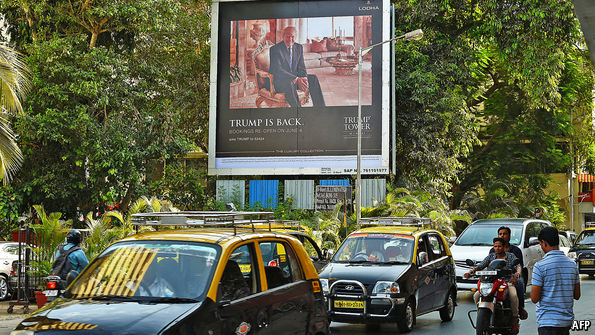
THE NEW Trump Tower in Worli, a buzzing district of Mumbai, looks like any building site but its marketing sells a dream. A golden structure soars to the sky alongside a picture of Donald Trump. He is—potential residents are assured—the gold standard around the globe, a dealmaker without peer who operates across the gateway cities of the world and the man who built the American dream. Until a few days ago the developer, Lodha, carried a message on its website: “Congratulations Mr President-elect”. But now that a storm has blown up over the possible conflicts of interest between the various operations of Mr Trump’s group and his new job, it has been deleted.
The self-embellished legend is of a global tycoon. In a kind of mirror image, outraged suspicion is mounting that the Trump Organisation could morph into a vast global network of cronyism. America has been treated to reports of multi-billion dollar projects across the planet, to photos of Mr Trump glad-handing businessmen and to images of exotic, Trump-branded buildings standing like monuments to the decay of American ethics. Paul Krugman, a left-of-centre economist, has suggested that the…Continue reading
British mutual-fund fees are too high

BANKS tend to grab the headlines when it comes to financial scandals and systemic risk. But many people have a lot more money squirrelled away with the asset-management industry, in the form of pensions and lifetime savings, than they do in their bank accounts. A new report* from one of Britain’s regulators, the Financial Conduct Authority (FCA), suggests that the industry is not doing a great job at looking after investors’ interests.
The British fund-management industry is huge, with some 1,840 firms managing around £6.9trn ($8.6trn) of assets. With the ten biggest fund managers representing only around 47% of the market, competition ought to be pretty intense. But the FCA report finds that fees in the actively managed sector (ie, funds that try to beat the market by picking the best stocks) have barely shifted in the past ten years. Operating margins across a sample of 16 fund-management firms have averaged 34-39% in recent years, one of the highest of any industry. Profits that heady smack more of an oligopoly than of a cut-throat battle for business.
There is one part of the market where fees have come down—passive, or tracker, funds…Continue reading
Malaysia’s central bank tries to stem a slide in the ringgit
“THERE is no new policy on capital flows. There is no proxy capital control either,” insisted Muhammad Ibrahim, governor of Malaysia’s central bank, in a dinner speech on November 18th. This echoed a similar central-bank promise 15 months ago. For those hoping to bring money in and out of Malaysia, the commitments are reassuring. The frequency with which they need reiterating is less so.
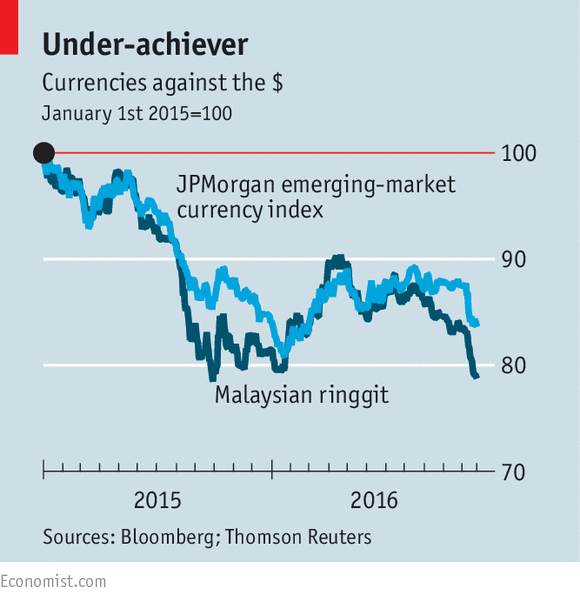
It is no secret that the central bank is worried about the sharp drop in Malaysia’s exchange rate. Like other emerging-market currencies, the ringgit has suffered from China’s slowdown in the past two years and Donald Trump’s upset victory on November 8th. But, like Malaysia’s politics, beset by lurid tales of financial malfeasance, the currency has been unusually skittish (see chart).
Mr Muhammad blames what he calls “the arbitrary and unpredictable devices of the offshore markets”. Whereas China has been keen to “internationalise” the yuan, Malaysia’s central bank has an equally determined policy of “non-internationalisation”. It prohibits the trading of ringgit assets outside of its…Continue reading
The global bond-market rally tests Japan’s ability to keep yields down

HARUHIKO KURODA is not a man to be put off by an unexpected setback. On November 17th the governor of the Bank of Japan (BoJ) gave his defiant take on the implications for Japanese monetary policy of the global market gyrations that have followed the surprise election of Donald Trump. Interest rates, he noted, have risen in America. “But that doesn’t mean that we have to automatically allow Japanese interest rates to increase in tandem.”
A sell-off triggered by Mr Trump’s win wiped more than $1.2trn off the value of the world’s bond markets as investors bet that his administration will stoke America’s economic engines and drive up inflation. Bond yields rose sharply around the world as investors sold assets to buy dollar-denominated ones. In Japan the yen weakened and the yield on ten-year government bonds (JGBs) crept above zero for the first time in nearly two months. Since he was appointed by Shinzo Abe, the prime minister, in March 2013 as custodian of the monetary wing of “Abenomics”, Mr Kuroda has been fighting to end years of debilitating deflation. Keeping bond yields down is an important part of that…Continue reading
False news items are not the only problem besetting Facebook

“MARK ZUCKERBERG, dead at 32, denies Facebook has problem with fake news.” The satirical headline, which made the rounds online this week, nicely encapsulates the most recent woes of the world’s largest social network: its algorithms, critics say, filled users’ newsfeeds with misinformation—and in the process influenced the American election result. But this is not the only problem the firm is grappling with. A volatile share price, privacy policies and advertising metrics have also kept Mr Zuckerberg (pictured) busy.
“News” that the Pope had endorsed Donald Trump or that a pizzeria in Washington, DC, is the home base of a child-abuse ring led by Hillary Clinton, were not confined to Facebook (nor were fake stories only a right-wing phenomenon). They often originate elsewhere, for instance on fake-news websites in Macedonia, which make good money via online ads, and on Twitter. But Facebook’s algorithms give prominence to such misinformation. They are tuned to maximise “engagement”, meaning they present users with the type of content that has already piqued their interest, as outrageous headlines tend to do.
Yet despite…Continue reading