
Tag: Approved
A showdown looms over bank-capital rules
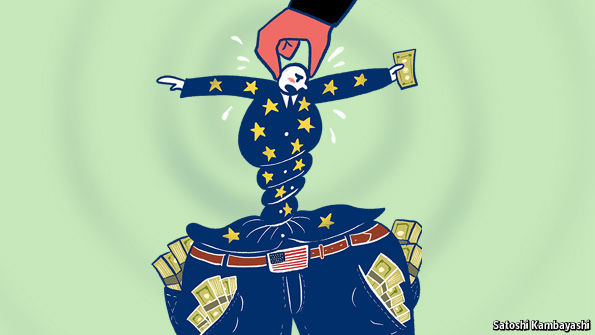
THEY lack the magic of “Harry Potter” and provoke even less laughter than “Police Academy”, but the sequels keep coming. In Santiago on November 28th and 29th the committee of central bankers and supervisors from nearly 30 countries that draws up global bank-capital standards is due to thrash out revisions to Basel 3, the version agreed on after the financial crisis of 2008. European (and some Asian) bankers and officials fear additional capital requirements are coming; Americans are all for the changes. Stand by for a standoff in Chile.
Spurred by Basel 3, banks have stuffed billions into capital cushions that the crisis showed to be woefully thin. Between mid-2011 and the end of last year, 91 leading lenders bolstered their common equity by €1.4trn ($1.5trn), or 65%, according to the Bank for International Settlements (BIS), which provides the Basel committee’s secretariat. The ratio of equity to risk-weighted assets, an important regulatory gauge, climbed from 7.1% to 11.8%. Although Basel 3 need not be fully honoured until 2019, most banks are far above the minimum of 4.5% (additional buffers, some at national level, raise the actual floor…Continue reading
Samsung is sucked into South Korea’s political crisis

IT WAS the third raid on the Samsung group in as many weeks. On November 23rd state prosecutors combed more offices of the South Korean consumer-electronics firm, part of a probe into an influence-peddling case that could be the undoing of President Park Geun-hye’s administration. The deepening inquest compounds a miserable few months for Samsung, which recently recalled 3m faulty washing machines and killed a new line of Galaxy Note phones after dozens exploded due to flawed batteries.
Last week prosecutors accused Ms Park of conspiring to coerce 50-odd companies to funnel 80bn won ($70m) to two foundations, Mir and K-Sports, controlled by Choi Soon-sil, a confidante indicted for abuse of power. The biggest grant, 20.4bn won, came from Samsung. Prosecutors suspect that it funnelled a further €2.8m ($3m) to Ms Choi through Widec Sports, a German company she used to buy horses and equestrian lessons for her daughter, a dressage athlete.
Investigators had said that the firms, including many in the pantheon of South Korean business, such as Lotte, a retail giant, and SK Group, a conglomerate, both of whose offices were raided this week,…Continue reading
Economists are prone to fads, and the latest is machine learning
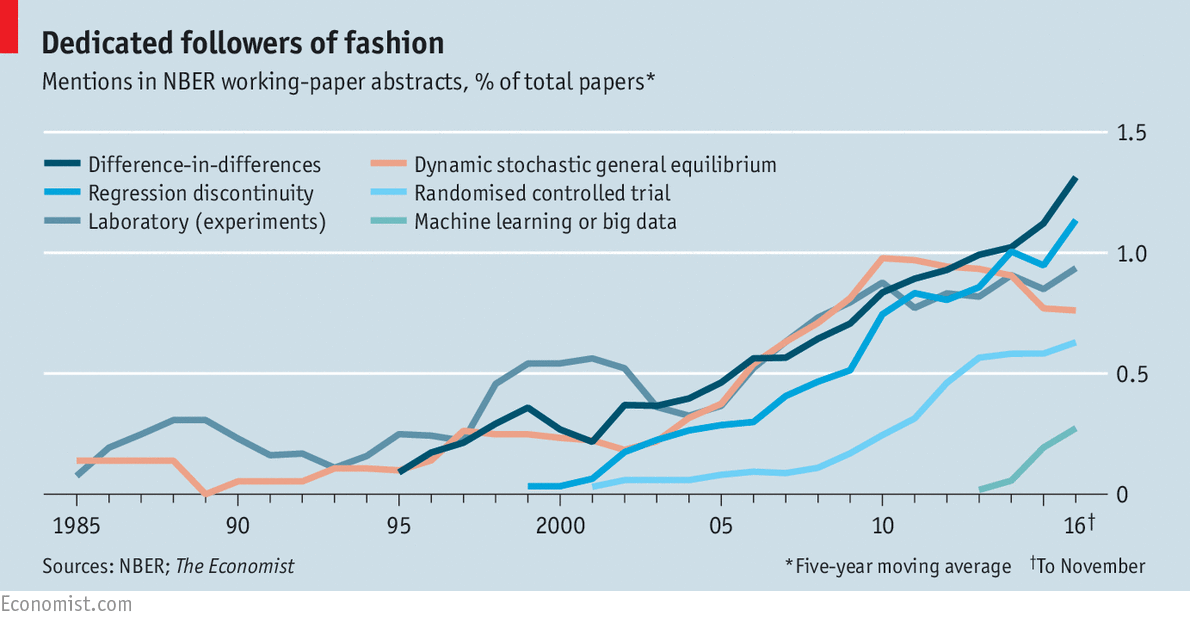
WHAT is the collective noun for a group of economists? Options include a gloom, a regression or even an assumption. In January, when PhD students jostle for jobs at the annual meeting of the American Economic Association, a “market” might seem the mot juste. Or perhaps, judging by the tendency of those writing economic papers to follow the latest fashion, a “herd” would be best. This year the hot technique is machine learning, using big data; Imran Rasul, an economics professor at University College, London, is expecting to read a pile of papers using this voguish technique.
Economists are prone to methodological crazes. Mr Rasul recalls past paper-piles using the regression-discontinuity technique, which compared similar people either side of a sharp cut-off to gauge a policy’s effect. An analysis by The Economist of the key words in working-paper abstracts published by the National Bureau of Economic Research, a think-tank (see chart), shows tides of enthusiasm for laboratory experiments, randomised control trials (RCTs) and the difference-in-differences approach (ie, comparing trends…Continue reading
The global bond-market sell-off tests Japan’s ability to keep yields down

HARUHIKO KURODA is not a man to be put off by an unexpected setback. On November 17th the governor of the Bank of Japan (BoJ) gave his defiant take on the implications for Japanese monetary policy of the global market gyrations that have followed the surprise election of Donald Trump. Interest rates, he noted, have risen in America. “But that doesn’t mean that we have to automatically allow Japanese interest rates to increase in tandem.”
A sell-off triggered by Mr Trump’s win wiped more than $1.2trn off the value of the world’s bond markets as investors bet that his administration will stoke America’s economic engines and drive up inflation. Bond yields rose sharply around the world as investors sold assets to buy dollar-denominated ones. In Japan the yen weakened and the yield on ten-year government bonds (JGBs) crept above zero for the first time in nearly two months. Since he was appointed by Shinzo Abe, the prime minister, in March 2013 as custodian of the monetary wing of “Abenomics”, Mr Kuroda has been fighting to end years of debilitating deflation. Keeping bond yields down is an important part of that…Continue reading
You may be higher up the global wealth pyramid than you think

IF YOU had only $2,220 to your name (adding together your bank deposits, financial investments and property holdings, and subtracting your debts) you might not think yourself terribly fortunate. But you would be wealthier than half the world’s population, according to this year’s Global Wealth Report by the Crédit Suisse Research Institute. If you had $71,560 or more, you would be in the top tenth. If you were lucky enough to own over $744,400 you could count yourself a member of the global 1% that voters everywhere are rebelling against.
Unlike many studies of prosperity and inequality, this one counts household assets rather than income. The data are patchy, particularly at the bottom and apex of the pyramid. But with some assumptions, the institute calculates that the world’s households owned property and net financial assets worth almost $256trn in mid-2016. That is about 3.4 times the world’s annual GDP. If this wealth were divided equally it would come to $52,819 per adult. But in reality the top tenth own 89% of it.
Technology firms may struggle to disrupt the food business

THE office parks of Silicon Valley boast many firms that are trying to change the world. But there are plenty with more modest goals. Zume Pizza, a tiny startup that is located a few miles from the sprawling headquarters of Google, wants to redesign the way pizzas are made. Zume has programmed robots to make pizzas that are then baked inside vans as they hurtle towards customers. Ovens are timed to finish cooking in sync with the vehicles’ arrival at their destination, so the pies are always piping hot.
In recent weeks spies from rival pizza companies and from food-delivery firms have been driving by in unmarked cars taking photographs of the office and the vans, says Julia Collins, one of Zume’s co-founders. To protect its business, the startup has patented the process of cooking food in ovens while a vehicle is moving (the patent probably gives Zume fairly defensible intellectual property, according to one patent lawyer). The company only operates in Mountain View, but has expansion plans. Since its founding last year it has reportedly raised $6m from investors, among them Jerry Yang, a co-founder and former boss of Yahoo, an early giant of the…Continue reading
The sharing economy brings tycoon lifestyles within reach of some

LAMENTING the rise of inequality is one of the few growth industries in an age of stagnation. One authority on the American wealthy, Robert Frank of CNBC, a TV channel, worries that the rich are “floating off” into their own country. Chrystia Freeland, a journalist-turned-politician, frets about the rise of the “new global super-rich” and the fall of everyone else. Charles Murray, America’s gloomiest social scientist, warns that society is “coming apart” as the rich retreat into their gated communities.
At the top of the income scale, however, a small counter-trend is observable. Never before have so many people been able to get access to the accoutrements of tycoonery—private planes, luxury yachts, fancy cars and interior-designed, exclusive homes. There is only so much comfort to be had from the fact that it is easier for the merely rich to lay claim to the lifestyle of the super-rich. But as a result of a combination of new technologies and businesses, that is nonetheless what is happening.
Tycoon living begins with a private jet. Whereas yachts are dispensable (not everyone wants to float around for weeks with the…Continue reading
Amp my ride

“THE car is the ultimate mobile device,” said Jeff Williams, an executive at Apple, last year. It was taken as another sign that the maker of iGadgets would be deepening its interest in the automotive sector (among other projects, it is developing an in-house smart car that is codenamed Project Titan). Now Samsung Electronics, its big rival in the smartphone world, is following. On November 14th the South Korean company said it would pay $8bn for Harman, a firm based in Stamford, Connecticut, that makes internet-connected audio, information and security systems for cars. The deal is Samsung’s largest ever, and the first big transaction for its vice-chairman and heir apparent, Lee Jae-yong, grandson of the firm’s founder.
Though it is best known for its sound systems, Harman is one of the world’s largest supplier of smart parts for “connected cars” that help owners to drive by linking to the internet and to chip-enabled devices. It made $7bn in revenue in the year to September, two-thirds or so of it from the car sector, and has over three times that in new orders. Its products are the first step towards autonomous vehicles. Over 30m…Continue reading
Clash of the Tatas

COMPANY bosses who get the sack react in different ways: some quietly leave, others graciously wish their successor luck, most try to nurse hurt pride as best they can. Not Cyrus Mistry, who on October 24th was ousted as chairman of the Tata Group, India’s biggest conglomerate. Bemused and angered at having his predecessor, Ratan Tata, suddenly seize back control, he has refused to go. The schism at the heart of Tata has drawn attention to what made it possible in the first place: an overly complex structure trying to oversee too many businesses, deficient corporate governance and a penchant for opacity. Whether these problems are addressed, and how, will shape the group and its reputation for decades to come.
Tata’s reasons for sacking Mr Mistry are unclear. He is from a family that has had a nearly 20% shareholding in the group for decades (most of the other shares are controlled by charities that are chaired by Mr Tata). Allies say that after four years in the job, Mr Mistry had got to grips with the inner workings of the company. He was ready to start changing it.
His critics, on the other hand, never believed that any executive…Continue reading
Vein hope

DONALD TRUMP’S grandfather, Fred, got his start in the hotel industry at the turn of the 20th century supplying rooms, food, booze and female company to prospectors flocking to north-western Canada in the so-called Klondike gold rush. It may be part of this legacy that gave America’s president-elect his taste for golden fixtures and fittings. But it may also make miners a bit wary of Mr Trump. After all, their pockets have been “mined” by a Trump once before.
So the world’s biggest mining companies are downbeat about the rally in commodities prices that accompanied Mr Trump’s election victory, which briefly pushed up prices of copper at their fastest rate in five years and sent iron-ore prices to two-year highs close to $80 a tonne. On November 15th Rio Tinto, one of the world’s biggest mining companies, told 440 workers at an iron-ore mine in Western Australia to take two weeks off at Christmas, not as a celebration, but as a precautionary measure to reduce supply. It expects conditions to get much tougher in 2017. Its main rival, BHP Billiton, is also nonplussed. It predicts economic uncertainty, political instability and a…Continue reading