
Tag: Approved
System crash
 The world according to Thiel
“I’D LIKE to wake up now please,” tweeted Sam Altman, who heads Y Combinator, Silicon Valley’s foremost startup school. The sentence neatly encapsulates the mood in the high-tech hub. To many in the technology industry, America under Donald Trump means dystopia. Perhaps no other sector regards his victory with less enthusiasm.
The main reason is that his stated views are antithetical to the beliefs that most entrepreneurs and tech types hold on a range of topics from trade to offshoring to policy on immigration. By one estimate the tech industry gave nearly $8m to Hillary Clinton’s campaign. Silicon Valley also worries that it will lose its direct lines to the administration in Washington. According to the Campaign for Accountability, a transparency group, no fewer than 22 former White House officials have gone to work for Google since Barack Obama moved in. Under Mrs Clinton the door would have kept revolving.
Only one noted Valleyite is likely to have the president’s ear: Peter Thiel, a venture capitalist. He alone supported Mr Trump, speaking at the Republican convention…Continue reading
Online checkout

“EVERY little helps.” The thieves may have found Tesco’s advertising slogan only too apt. Over the weekend of November 5th and 6th, Tesco Bank, the financial arm of Britain’s biggest retailer, detected “suspicious transactions” on 40,000 current (ie, checking) accounts. Online raiders succeeded in stealing from 9,000: some customers spotted dodgy payments to companies in Brazil and Spain. On November 8th Tesco Bank said it had reimbursed all losses, to the tune of £2.5m ($3.1m). Online transactions from current accounts, which it had suspended, were up and running again.
If the bank or other investigators have any idea who stole the money and how, they are not saying. Reports say that GCHQ, a spy agency, has been called in. All this has fed rather than starved speculation: an MP has said “state-sponsored” crime cannot be ruled out. There is little to go on, notes Alfredo Pironti of IOActive, a cyber-security company. One possibility is that the thieves found a weakness in the bank’s web application. Another is that they managed to filch lots of customers’ passwords over a period of time and exploited them in one go. Still…Continue reading
The great divergence

ONE of Joseph Schumpeter’s best-known observations was that successful businesses stand on ground that is “crumbling beneath their feet”. A danger is that standing still and resting on your laurels can precipitate a swift tumble. Rivals, meanwhile, can draw on the available stock of knowledge and technology to catch up with the leaders. To stay ahead, front-runners must keep inventing new things. This means that capitalism is inherently unforgiving: today’s leader is tomorrow’s failure. But it also means that it is inherently progressive, since clever ideas are quickly spread through the economy.
Some striking new research suggests that this Schumpeterian mechanism may have broken down. The leaders are staying ahead much longer than is desirable. A group of researchers at the OECD, a club of mostly rich countries, examined the performance of a representative set of companies in 24 of its 35 member countries between 2001 and 2013. They discovered that the top 5% of them, dubbed “frontier firms”, have continued to increase their productivity while the other 95% (the laggards) have been stagnant in this regard.
Plenty of economists…Continue reading
Taking notes

NOT much distinguishes a valuable banknote from any old piece of printed paper, as Indians discovered this week. In a surprise televised address on November 8th, Narendra Modi, the prime minister, announced that the country’s two highest-denomination notes, worth 500 and 1,000 rupees ($7.50 and $15), were to be legally worthless with near-immediate effect. This odd variant of alchemy is the latest in a series of moves to curb illicit income; economists hope long-term gains will justify a chaotic spell as India adapts.
The idea is not as barmy as it might first appear. Mr Modi has implemented a flurry of schemes to flush out “black money”, the term Indians use for cash which is both unaccounted for and outside its formal financial system. Piles of ill-gotten income have long been easy to launder into gold or property, where using notes for at least part of a purchase is the norm. “Demonetising” high-value tender means existing notes must be traded in at banks and post offices before the end of the year. That will force those with suitcases of cash either to come clean or to renounce their loot.
Still, it is dramatic: central banks…Continue reading
African potholes
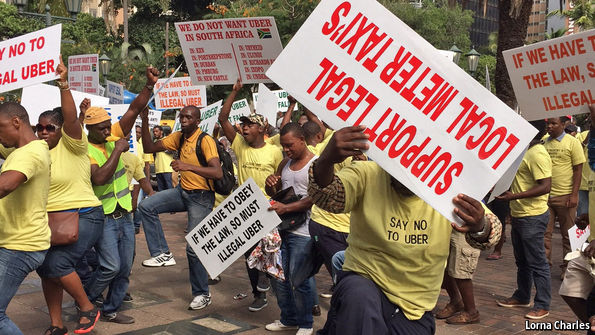
“I WAS lucky my customers were three big white guys,” says Themba, an Uber driver in Johannesburg recounting a close call with taxi-drivers who tried to block him from collecting passengers at the airport that serves South Africa’s economic hub. “They pushed them out the way and we managed to drive off.”
The ride-hailing app has made a splashy if slow start in Africa. Of the 529 cities in which Uber connects riders with drivers, just 14 are on the continent. Yet Africa is fertile ground for a firm offering cheap and safe transport. Most passengers have to spring for overpriced cabs or catch a white-knuckled ride on the back of a motorcycle taxi.
In Abuja, locals have long used a low-tech version of ride-sharing. Many folk simply stick out a hand at the roadside to hail any passing car before negotiating a fare. Yet locals warn that fake taxis cruise the streets with robbers hiding in the boot, ready to jump out at a traffic light. In Lagos some taxi-drivers are even thought to be in cahoots with kidnappers. Not surprisingly, Uber seems to be growing quickly in the few cities where it has launched. In many places rides cost less…Continue reading
Internship
Internship: Applications are invited for a Marjorie Deane internship in The Economist’s New York bureau. The award is designed to provide work experience for a promising journalist or would-be journalist, who will spend three to six months at The Economist writing about economics and finance. Applicants are asked to write a covering letter and an article of no more than 500 words, suitable for publication in The Economist. Applications should be sent by December 14th to deaneinternny@economist.com.
A long road to recovery

THERE are two ways of dealing with a worrying problem in a car engine. One is a complete overhaul; the other is to tinker under the bonnet and hope the trouble goes away. Volkswagen’s efforts to deal with an emissions-cheating scandal that emerged in September 2015 are of the tinkering type. The German carmaker is desperate to draw a line under its ill-fated decision to fit software to 11m diesel cars that detected emissions tests and artificially reduced the amount of nitrogen oxide pumped out. But the disconcerting rumbles continue.
The latest setback came on November 6th, when VW said that a German investigation of market manipulation was examining the role of Hans Dieter Pötsch, chairman of its supervisory board. The probe, which began in June, is looking at whether Martin Winterkorn, VW’s former chief executive, and Herbert Diess, who oversees the core VW brand, should have disclosed the emissions cheating before the company publicly admitted wrongdoing. This is deeply uncomfortable for both VW and Mr Pötsch, who used to be the chief financial officer and was nominated to become chairman on the day the crisis began. It is also a reminder…Continue reading
The cost of poor lending
 The Miami blues
“A TODDLER drowns in the swimming pool of his neighbour’s vacant house. A firefighter dies falling through the floor of a vacant building. A gang take over an empty house…to advertise prostitution.” Thus begins an incendiary supporting brief filed by a trade union for police officers and firefighters in a suit brought by the city of Miami against Wells Fargo and Bank of America. The suit argues that mortgages granted by the banks to black and Hispanic residents who later defaulted caused the city to lose tax revenue and forced it to fork out more for services. This, it contends, entitles Miami to damages.
The case was largely dismissed in the trial court, reversed on appeal and then accepted by the Supreme Court, which heard oral arguments on November 8th. At issue is who can sue for alleged discrimination, and whether irresponsible loans can be blamed for broader economic damage. A separate court will consider whether the banks were actually guilty of discrimination (they deny it).
Part of civil-rights legislation passed in 1968, the “Fair Housing Act”, the statute under which the case…Continue reading
The big sort

“THE vultures all start circling, they’re whispering, ‘You’re out of time’…but I still rise!” Those lyrics, from a song by Katy Perry, an American pop star, sounded often at Hillary Clinton’s campaign rallies but will shortly ring out over a less serious event: a late-night party in Shenzhen to kick off “Singles’ Day”, an online shopping extravaganza that takes place in China on November 11th every year.
The event was not dreamt up by Alibaba, but the e-commerce giant dominates it. Shoppers spent $14.3bn through its portals during last year’s event. That figure, a rise of 60% on a year earlier, was over double the sales racked up on America’s two main retail dates, Black Friday and Cyber Monday, put together. Chinese consumers are still confident, so sales on this Singles’ Day should again break records.
It points to an intriguing question: how will all of those purchases get to consumers? Around 540m delivery orders were generated during the 24-hour spree last year. That is nearly ten times the average daily volume, but even a slow shopping day in China generates an enormous number. By the reckoning of…Continue reading
To those that have

PITTSFIELD, a city of 43,000 on the Housatonic River in western Massachusetts, is a quintessentially American place, but in many ways an unlikely spot for a housing boom. The 255-year-old former industrial hub boasts the country’s earliest written reference to baseball. Its economy was dominated by General Electric for much of the 20th century. But by 2000 it had experienced ten years in which hardly any new jobs had been created. Incomes were 12% below the national average. The city’s population had been shrinking for decades. And yet between 2000 and 2007, amid a nationwide, credit-fuelled property boom, house prices in Pittsfield jumped by 70%, or 8% per year.
These days, such rapid growth in economically struggling cities is rare. Whereas local housing markets rose and fell together during the housing bubble and bust, the housing recovery which began in America in 2012 has been patchy. Cities and towns with growing economies have seen big gains; places like Pittsfield have stagnated (see chart 1). Such trends are contributing to a widening of America’s already unequal distribution of wealth.
According to an annual…Continue reading