
Tag: Approved
Polluting the outlook
 So they hope
IT WAS on November 16th that the International Energy Agency (IEA), an organisation that represents oil- and gas-consuming countries, announced its prediction that over the next quarter of a century renewable energy, such as wind and solar, and natural gas will hugely eclipse the traditional role that coal and oil have played in satisfying the world’s growing demand for energy (see chart). That is the base case for what it says is a powerful shift in the global energy landscape towards cleaner fuels.

The trouble is that after the projections were calculated, Donald Trump, who is both a climate sceptic and a fossil-fuel fan, was elected as America’s next president. As Fatih Birol, the IEA’s executive director, pointed out this week, no one knows what his energy policies will be. Yet he will run the world’s biggest producer and consumer of oil and natural gas.
Many…Continue reading
That Eighties show
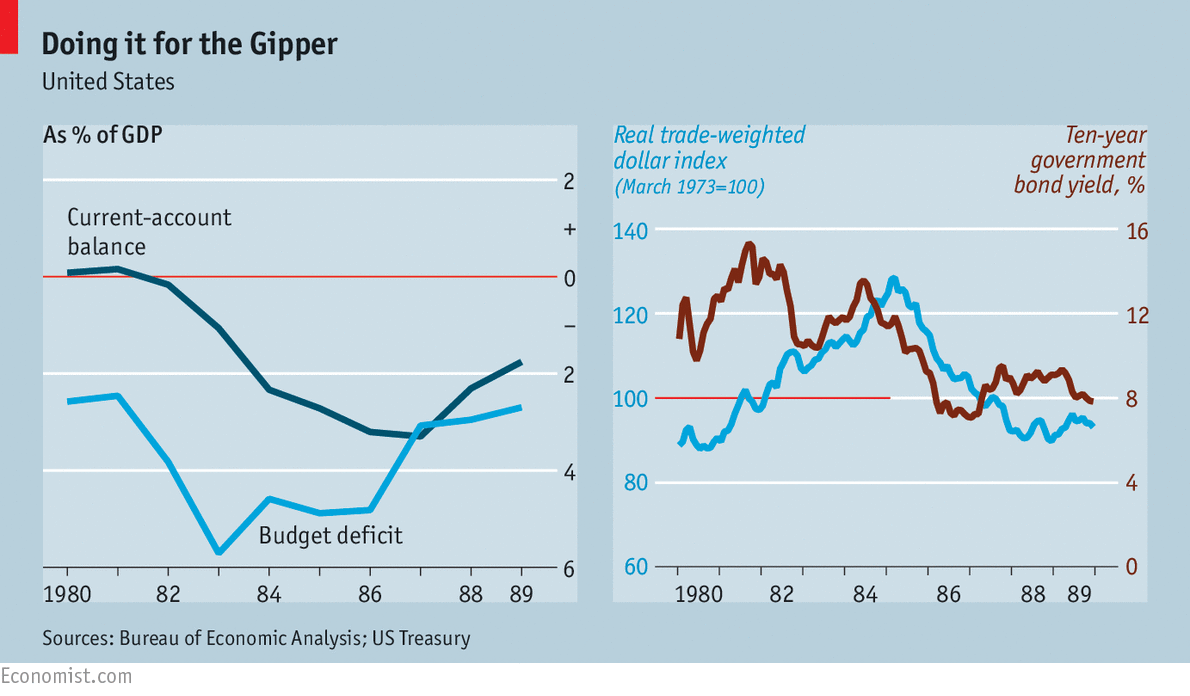
FOR the moment, the policy priorities of the Trump administration-in-waiting are a basket of unknowables. Plans to scrap Obamacare or re-deregulate America’s financial sector, though dear to Republican hearts, are easier to champion on the campaign stump than to implement. A step away from globalism—Donald Trump’s most consistent campaign theme—could make for an awkward opening gambit given pockets of Republican resistance to overt protectionism. Tax cuts and infrastructure spending, on the other hand, look like an easy and unifying win for the new administration. And indeed, market moves since Mr Trump’s victory seem to imply an expectation of a Ronald Reaganesque turn in American fiscal policy; government-bond yields have risen, seemingly in expectation of bigger deficits, faster growth and higher inflation. Yet any resemblance that Mr Trump’s plans may bear to Reaganomics is as much a cause for concern as for optimism.
The president-elect’s tax proposals are easily the boldest since Reagan’s. Mr Trump’s plan would slash the highest marginal income-tax rates, cut rates of tax on corporate income and on capital…Continue reading
Just spend

ON NOVEMBER 11th, Alibaba, a Chinese e-commerce giant, posted nearly $18bn in sales for the day. This broke last year’s record for Singles’ Day, an anti-Valentine’s Day that has become a love affair with spending. The popularity of the company’s virtual credit-card, Huabei (roughly translating as “Just spend”), may have helped. Consumers who spend less than 1,000 yuan ($146) online a month spend 50% more once they get one, according to Ant Financial Services, an Alibaba affiliate. To older generations, taught to save, borrowing is shameful. But financial habits are changing: Chinese consumers are being encouraged to develop credit histories.
Last year, the government awarded eight companies consumer credit-rating licences. Their pilot programmes are an attempt to flesh out thin financial records and get people thinking about their credit scores. This is new for most Chinese, who do not use credit cards and have never had credit scores. As of 2014, the People’s Bank of China maintained credit histories for around 350m citizens—less than one-third of the adult population. In America 89% of adults have credit scores. Without a credit history,…Continue reading
Iceland does not face another bust, but its economy looks lopsided
 No eruptions on the horizon
GOOD times are rolling again in Iceland. In June it beat England in a football match. On The Economist’s “glass-ceiling index”, it is the world’s best country for working women. And the economy is purring. After a thumping crash in 2008-09, GDP is expected to grow by 5% this year, faster than any other rich economy. The ruling (conservative) Independence Party has been rewarded: it won 30% of the vote in the election in October, more than any other party. But some fret that Iceland’s economic stability is, again, built on molten lava.
The biggest worry is over its treatment of foreign creditors. When the crisis hit, the country slapped on capital controls, protecting the krona by preventing investors from pulling capital from the country. Recently the government has been loosening restrictions. Icelanders may soon no longer have to present airline tickets in order to buy foreign currency for their holidays.
One group of foreign investors, however, accuses Iceland of, in effect, defaulting on its debts. They own offshore, krona-denominated, assets worth…Continue reading
State of grace

IN ITS never-ending quest to rein in profligate local officials, China this week ordered its indebted cities and provinces to draw up detailed repayment plans. But for these rules to work, the central government must prove that it is willing to let the miscreants default. Creditors doubt its resolve and expect it to go on bailing out the spendthrifts. As a result, they systematically give more generous lending terms to state-owned enterprises (SOEs) than to their private peers.
The bias is not immediately obvious. Looking at interest costs, China seems to have a level playing field. A 2011 survey, for example, revealed that the median interest rate on bank loans to private firms was 7.8%, just above the 7.5% average at the time. Borrowing rates for both SOEs and private firms have remained in line with each other since then, declining in tandem.
But this appearance of parity is superficial. Borrowing costs only tell half the story. The other half is the borrower’s quality. When investors assess the risk of lending to Chinese companies, they price in the assumption that the state will stand behind SOEs. How much is this…Continue reading
Sanctions with Chinese characteristics

THE fines paid to America’s financial regulators by errant bankers vary enormously these days: from sky-high to stratospheric. Deutsche Bank is fighting a demand for $14bn. BNP Paribas paid $9bn last year for facilitating the evasion of American sanctions. So eyebrows were raised at the final settlement disclosed this month between the state-controlled Agricultural Bank of China (ABC) and New York’s Department of Financial Services (DFS). The fine imposed on the bank was a mere $215m.
The comparative leniency towards ABC is probably a consequence of a failure to prove that many illegal transactions took place. But that by itself produced unresolved suspicions; compliance systems made transfers untraceable. In 2014 a new compliance officer at the two-year-old New York branch reported finding an “alarming” pattern of transactions; 20-30% were “virtually impervious to screening” for sanction violations.
In the “alarming” category were large transfers between Chinese companies and companies in Russia and Yemen; dollar-denominated payments from the United Arab Emirates; and dollar transfers from a Turkish bank to an Afghan one…Continue reading
Kash call

SINCE Donald Trump won the election, American bank shares have surged on traders’ hopes of a bonfire of financial regulations. So a proposal from Neel Kashkari, head of the Minneapolis Federal Reserve, vastly to increase capital requirements looks ill-timed. On the other hand, the plan mimics the direction—if not the extent—of one backed by congressional Republicans.
Mr Kashkari is an experienced financial firefighter. An alumnus of Goldman Sachs, best-connected of investment banks, he spent much of 2008 and 2009 in the Treasury department overseeing the Troubled Asset Relief Programme, under which the American government bought more than $400bn of toxic assets to prop up teetering financial institutions. In 2014 he ran to become governor of California as a Republican. He now says that, despite the efforts of regulators since the crisis, much more needs to be done to avoid future bail-outs of banks that are “too big to fail”.
Using an IMF database, the Minneapolis Fed logged the levels of bank capital that would have been needed to avert 28 financial crises in rich countries between 1970 and 2011. Based on the historical…Continue reading
Save yourself

IN A world of low investment returns, many a pension scheme is in trouble. In both Britain and America employers who have promised to pay workers a pension based on their final salary are struggling to cope with huge deficits.
But the problem is not confined to those with so-called defined-benefit (DB) pensions. It also affects those saving for retirement via a defined-contribution (DC) scheme, where both employer and employee contribute, and the worker takes charge of the pot when his career ends. In America the most popular form of DC savings are called 401(k) schemes after a section of the tax code.
In an article* in the Journal of Retirement, three authors from AQR Capital Management, an investment group, argue that workers in 401(k) schemes are simply not putting enough money aside.
What you get out of a pension depends on what you put into it. One would expect a DC pension to deliver a smaller income than a DB scheme because less money tends to be put in the pot. Total DC contributions average around 9% of payroll (6% from employees; 3% from employers). But figures from the Centre for Retirement Research at…Continue reading
Pot of gold
 Flat white joint to go
IN THE 1990s Snoop Dogg, a rapper, called cannabis “chronic”. The drug was illicit and cool. In 2016 Mr Dogg is a cannabis investor, and the drug is poised to earn another title: consumer staple. On November 8th four states, including California, voted to approve recreational cannabis use. Four other states eased rules for medical marijuana. About three-fifths of America’s population lives in states that now allow cannabis use in some form.
So pot entrepreneurs face the thrilling prospect of normality. This week industry leaders were meeting in Las Vegas to discuss how the sector might expand. They have in prospect a vast, partially established market. More than 32m Americans already use cannabis. As the business becomes more normalised, it is sure to attract new customers. “It’s not often that you see an industry and you know the inevitability of it,” says Brendan Kennedy of Privateer Holdings, a private-equity firm that specialises in cannabis. Last year legal sales reached $6bn, according to the Arcview Group, an investment and market-research firm. By 2020 Arcview expects legal sales to be…Continue reading
Seize the day
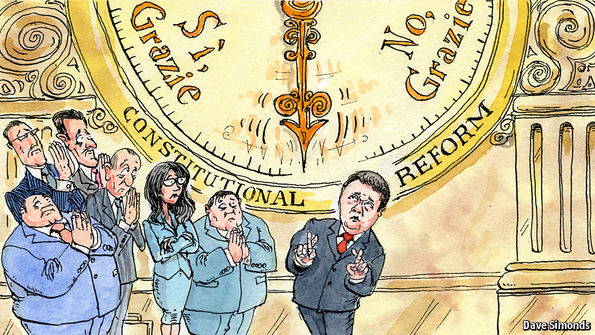
“THE biggest risk in Europe is the Italian referendum,” said Gianfelice Rocca, head of Assolombarda, Milan’s chamber of commerce, this summer. For corporate Italy, much is at stake in the vote on constitutional reform, which will be held on December 4th. Victory for Matteo Renzi, the business-friendly prime minister, could mean a big fillip for firms of all sizes, whereas a loss would be “a shock in the system”, said Mr Rocca.
The national employers’ federation, Confindustria, agrees with him. If those campaigning for a “yes” vote are to be believed, firmer government, easier conditions for investors and generally brighter economic prospects would follow. The two main issues to be decided are reform of the Senate’s powers—whether to let the lower chamber pass future laws, even when opposed by the Senate—and whether decision-making powers should be brought back from regional governments to the centre.
Francesco Starace, the chief executive of Enel, a giant European electricity company that is one of Italy’s more successful firms, sets out a strong case that the proposed changes would bring important benefits to…Continue reading