
Tag: Approved
Financial regulators too often think “this time is different”
FOR a phenomenon with such predictably bad outcomes, a financial boom is strangely seductive. Not a decade after the most serious financial crisis since the Depression, the world watches soaring markets with a mixture of serenity and glee. Natural impulses make finance a neck-snappingly volatile affair. Governments, though, deserve heaps of blame for policies that amplify both boom and bust. As regulators begin picking apart reforms only just enacted, it is worth asking why that is so.
Finance is hopelessly prone to wild cycles. When an economy is purring, profits go up, as do asset values. Rising asset prices flatter borrowers’ creditworthiness. When credit is easier to obtain, spending goes up and the boom intensifies. Eventually perceptions of risk shift, and tales of a “new normal” gain credence: new technologies mean profits can grow for ever, or financial innovation makes credit risk a thing of the past. But when the mood turns, the feedback loop reverses direction. As asset prices fall, banks grow stingier with their loans. Firms feel the pinch from falling sales, get behind on their debts and sack workers, who get behind on theirs. The desperate sell what they can, so asset prices tumble, worsening the crash. Mania turns to panic.
The pattern is an ancient one. In their book “This Time is Different”, Carmen Reinhart and Kenneth Rogoff,…Continue reading
Morgan Stanley’s unexciting model takes the prize on Wall Street
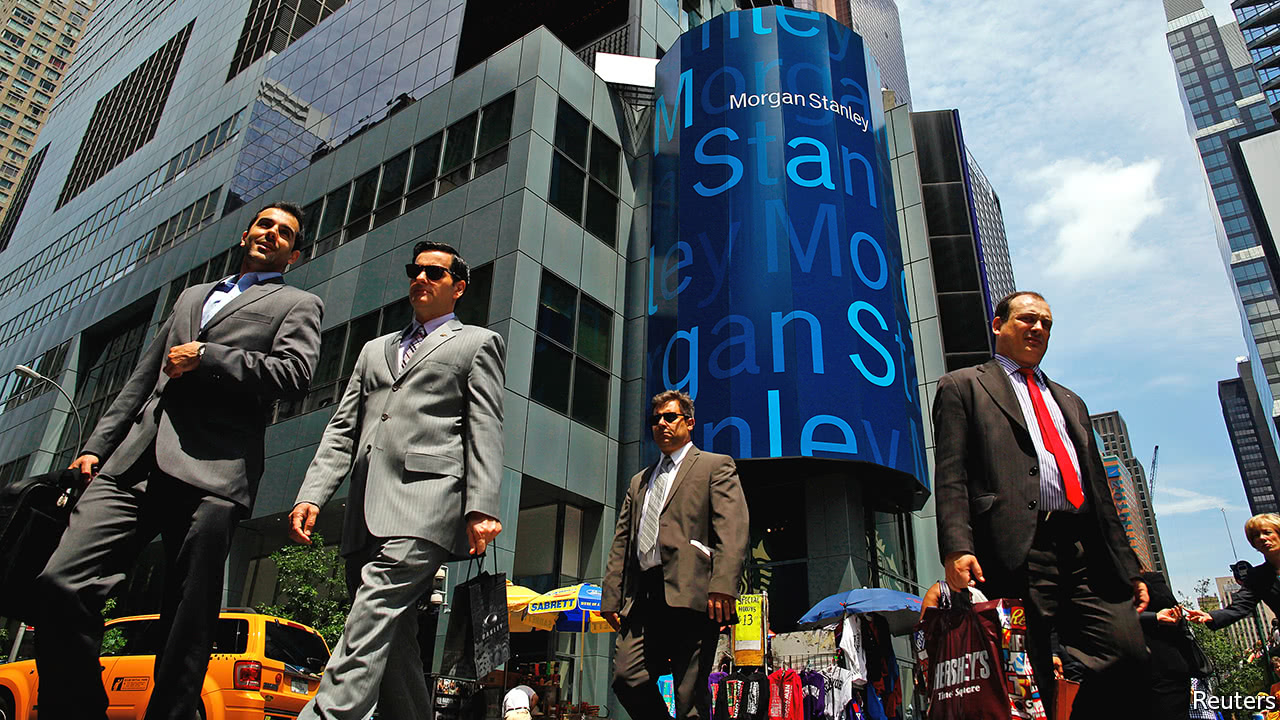
MORGAN STANLEY emerged in 1935 out of a global financial disaster, as one of Wall Street’s leading firms. In a rare shred of consistency in America’s turbulent markets, history has repeated itself. But it was a close call. An ill-timed infatuation with debt ahead of the 2007-08 financial crisis threatened to add it to the industry’s towering funeral pyre, which consumed all its big competitors with the exception of Goldman Sachs.
Of the two, Morgan Stanley came out of the crisis the more tarnished, less for what it did than for what it was: less profitable; less connected, through its former employees, to political power; and less respected for having evaded disaster. But after the release of financial results from the fourth quarter of 2017, Morgan Stanley’s valuation has surpassed Goldman Sachs’s. This reflects not only the improvement in its profitability but also investors’ greater confidence in how it is managed.
Goldman, with some justice, finds the comparison unfair….Continue reading
Direct-lending funds in Europe
WHEN Caronte & Tourist, a Sicilian ferry company, needs a new ship, it is cheap and easy to borrow from a bank. But in 2016, when Caronte’s controlling families wanted to buy back the minority stake held by a private-equity firm, banks balked at the loan’s unusual purpose. Edoardo Bonanno, the chief financial officer, also worried that the €30m ($33m) in extra bank debt might make shipping loans harder to obtain from them in future. So he turned instead to a direct-lending fund run by Muzinich & Co, an asset manager.
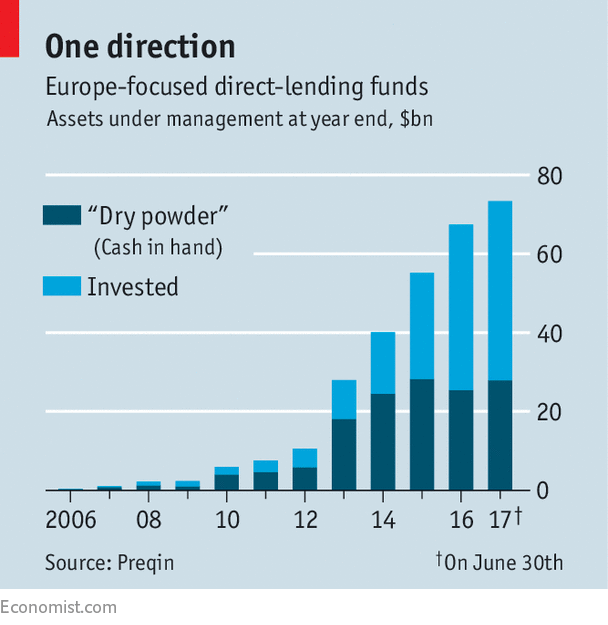
Such funds are only about a decade old in Europe (and not much older in America, where they started). Assets under management at Europe-focused funds increased from a mere $330m at the end of 2006 to $73.3bn by mid-2017, which includes $27.9bn of “dry powder”, or funds yet to be lent out (see chart). In 2017 alone 24 direct-lending funds raised a record $22.2bn. Such funds do what they say on the tin: lend directly to firms, usually in the form of big, multi-year loans. The borrowers are often either companies that are too small to raise equity or debt on capital markets, or private-equity funds buying such firms.
How microcredit can help poor countries after natural disasters

BOTH, in different ways, worry about liquidity. And global warming may, indeed, be bringing meteorologists and financiers together. On January 18th, VisionFund, a microlending charity, and Global Parametrics, a venture that crunches climate and seismic data, launched what they billed as the “world’s largest non-governmental climate-insurance programme”. The scheme will offer microfinance to about 4m people across six countries in Asia and Africa affected by climate-change-related calamities.
Natural disasters are becoming more frequent and severe. They disproportionately affect poor countries, where many eke livings from vulnerable agricultural land. Yet it is often in the aftermath of disaster that credit is hardest to obtain. As non-performing loans rise and the perception of risk increases, microfinance institutions (MFIs) rein in lending; they receive little support from donors and relief programmes, which tend to favour humanitarian aid….Continue reading
Monetary policy suffers a shortage of central bankers
IN THEIR quest to stabilise the job market, central banks are setting a bad example. Jerome Powell, whom senators this week confirmed as the next chairman of America’s Federal Reserve, will lead an institution with three existing vacancies on its seven-member board, and a fourth that will open up imminently. Not since July 2013 has its rate-setting committee boasted the full complement of 12 voting members.
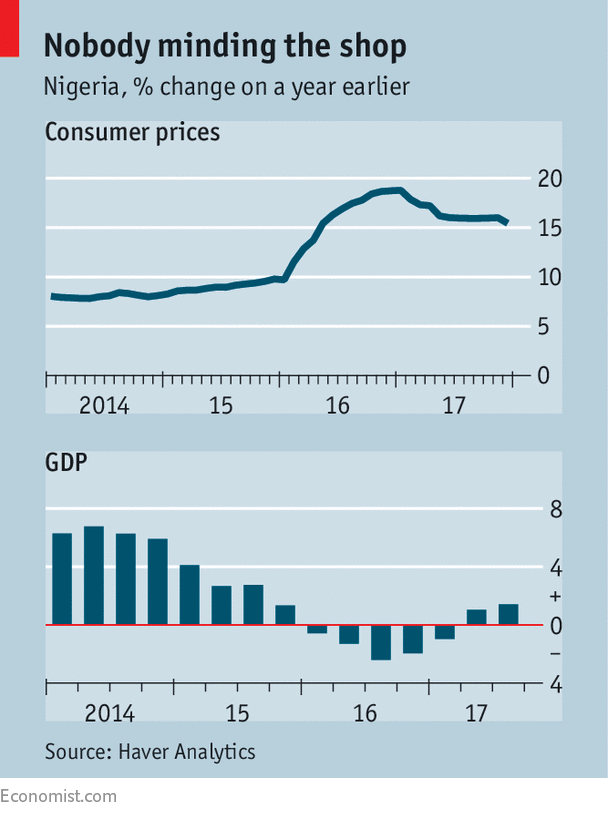
This monetary undermanning is, however, much worse in Nigeria. Its monetary-policy committee was unable to meet as scheduled on January 22nd-23rd because it lacked the six members necessary for a quorum. Five recent nominees still await confirmation by the country’s Senate. The chamber is holding up all but a few executive appointments in retaliation for President Muhammadu Buhari’s failure to remove an official (the acting anti-corruption tsar) whom the Senate twice rejected. In the absence of a monetary-policy meeting (and the lengthy communiqué that eventually follows it), the central bank…Continue reading
WhatsApp: Mark Zuckerberg’s other headache
“THERE’S too much sensationalism, misinformation and polarisation in the world today,” lamented Mark Zuckerberg, the boss of Facebook, recently. To improve things, the world’s largest social network will cut the amount of news in users’ feeds by a fifth and attempt to make the remainder more reliable by prioritising information from sources which users think are trustworthy.
Many publishers are complaining: they worry that their content will show up less in users’ newsfeeds, reducing clicks and advertising revenues. But the bigger problem with Facebook’s latest moves may be that they are unlikely to achieve much—at least if the flourishing of fake news on WhatsApp, the messaging app which Facebook bought in 2014 for $19bn, is any guide.
In more ways than one, WhatsApp is the opposite of Facebook. Whereas posts on Facebook can be seen by all of a user’s friends, WhatsApp’s messages are encrypted. Whereas Facebook’s newsfeeds are curated by algorithms that try to maximise the time users spend on the service, WhatsApp’s stream of messages is solely generated by users. And whereas Facebook requires a fast connection, WhatsApp is not very data-hungry.
Bangladesh experiments with a new approach to poverty alleviation

BESIDES shoes and shrimp, Bangladesh exports poverty cures. Microfinance was developed there in the late 1970s before spreading. In 2002 BRAC, a charity, started giving assets such as cows (and training in how to manage them) to desperately poor women. That approach has spread, too. The latest poverty remedy to emerge from Bangladesh is different: it targets men, and rather than trying to make people more productive in their villages, it encourages them to move.
In Rangpur, a northern district, agricultural labourers endure an annual hunger in the autumn, known as monga. The rice crop has been planted but is not ready to harvest, so work is scarce. Jobs abound in the cities, but poor farmers are loth to use their dwindling savings on a bus ticket. It is a good example of a poverty trap.
So, for the past ten years, researchers led by Mushfiq Mobarak, an economist at Yale University, have tried offering cash to poor households so long as somebody moves to a city to…Continue reading
When you cannot sue your employer

IMAGINE wanting to sue your employer, because you have been harassed or discriminated against, only to find that your access to the courts is blocked. It turns out you signed away your right to use the judicial system when you started the job: somewhere, hidden in the documents that came with your employment contract, was a clause obliging you to resolve future disputes through private arbitration, rather than in court.
An increasing number of American employees find themselves in this situation. Over half of non-unionised employees are covered by arbitration requirements, estimates Alexander Colvin of Cornell University, based on a survey in 2017 of 627 private-sector workplaces. Such agreements have come under greater scrutiny after the wave of workplace sexual-harassment revelations last year. Gretchen Carlson, a former news anchor for Fox, a broadcaster, has called arbitration “the harasser’s best friend”. Prevented by an arbitration clause from suing the network, Ms Carlson sued her boss…Continue reading
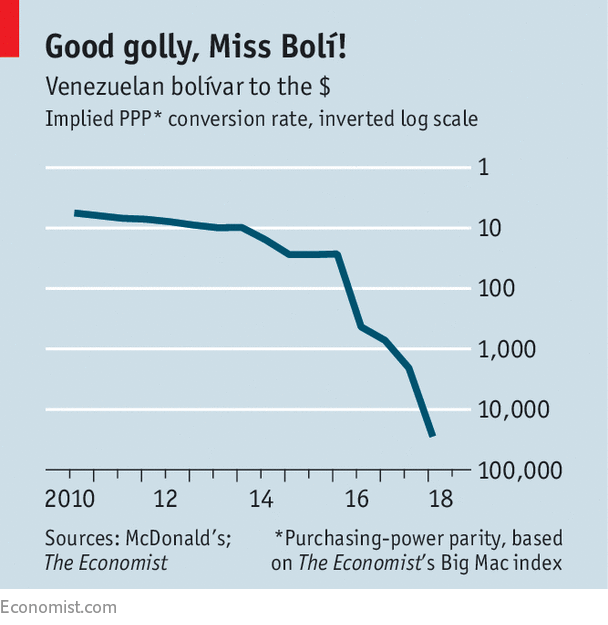
Venezuela’s currency plumbs unknown depths
EVEN a modest rate of inflation compounds over time. This is why your tipsy grandfather might wistfully recall how little a pint of beer cost in his heyday. In Venezuela, where prices are rising at a four-figure annual rate, the good old days were last month. The defence minister, Vladimir Padrino López, on January 19th urged business leaders to peg back prices to their levels of December 15th, when presumably everything was just fine.
The spending power of the bolívar, Venezuela’s currency, had collapsed long before then. The Economist’s Big Mac Index gives a rough guide to how fast it has fallen. The index is based on the idea of purchasing-power parity (PPP), which says a fair-value exchange rate is one that leaves consumer prices the same in different countries. In our index, the price of a Big Mac is a proxy for all goods. In Caracas, this week, a Big Mac cost 145,000 bolívars; in American cities, it cost an average of $5.28. The ratio of those prices gives a PPP exchange rate of 27,500 bolívars. Two years ago, the rate was 27 bolívars. By this yardstick, the currency has lost 99.9% of its value in almost no time.
GM takes an unexpected lead in the race to develop autonomous vehicles

GENERAL MOTORS reveals barn-sized truck at Detroit motor show. What else is new, you might now ask. But the launch on January 20th of the Chevrolet Silverado, a pickup that will go on sale at the end of the year, highlights a surprising turnaround for America’s largest carmaker.
The good news is not just the Silverado’s outsized margins, which are important for a firm that relies heavily on trucks—after Mary Barra, GM’s boss, gave an ebullient performance at an investors’ conference that coincided with the motor show, the release of GM’s quarterly results on February 6th are likely to include record profits. It is also that the money thrown off by vehicles such as the Silverado will help the firm navigate the tricky terrain that lies ahead of all the world’s big carmakers.
One task is to ensure that their current business of selling vehicles with internal-combustion engines stays healthy. At the same time, they must prepare for a future of electric and autonomous cars (EVs…Continue reading