
Tag: Approved
Market volatility has been low, encouraging risk-taking
MAY YOU live in boring times. Financial markets have become dull, if profitable. The S&P 500 index, America’s leading equity benchmark, has notched up its longest-ever streak without a 5% reversal. Bond yields may have inched up in recent months, but are still at the bottom of historical ranges. Institutions famed for their trading prowess, such as Goldman Sachs, have seen profits dented by the quiescence of the markets.
This lack of market volatility owes much to the steadiness of monetary policy since the depths of the financial crisis. Central banks have kept short-term rates low and have intervened to push down bond yields through their programmes of quantitative easing (QE). The classic method of pricing financial assets is to say they are worth the discounted value of future cashflows; since central banks have kept the discount rate steady, prices have been steady too.
The late Hyman Minsky, an economist, thought that long booms sowed the seeds of their own destruction. He argued that, when the economy was doing well, investors tended to take more risk (such as taking on more debt). These speculative positions are vulnerable to a shock, such as a sudden rise in interest rates, which can turn into a fully fledged crisis.
In these days of sophisticated markets, speculators are not restricted to their own capital or even to borrowed money to…Continue reading
Qualcomm is fined for anti-competitive practices—again

THE tech industry hardly needs another reminder that trustbusters are on its case. But the European Commission is always happy to oblige. On January 24th Europe’s executive body slapped a penalty of €1bn ($1.2bn) on Qualcomm, one of the world’s largest chip-designers, for abusing its dominance in baseband processors, a critical component in mobile phones.
Large fines are becoming something of a habit for Qualcomm, which will have paid out nearly $1bn a year, on average, to trustbusters the world over since 2015. This week’s penalty, which amounts to nearly 5% of the company’s global annual revenue, is a reflection of what Margrethe Vestager, the European competition commissioner, described as its “very illegal behaviour” between 2011 and 2016. During that time, according to Ms Vestager, the company attempted to shore up its dominant position—it is estimated to supply up to four-fifths of essential types of baseband chips—by paying Apple, its biggest customer, billions of dollars in…Continue reading
GE’s flow of financial information has become fantastically muddled

IN THEIR documentary “The Vietnam War”, Ken Burns and Lynn Novick, the directors, dwell on the flawed information that American politicians got from Indo-China. The generals on the ground focused on the “kill ratio”, or the number of enemies killed per American or South Vietnamese soldiers killed. That bore no relationship to victory—North Vietnam quickly replaced its dead soldiers. And it corrupted behaviour, leading American troops to embellish numbers and count dead civilians as “wins”.
The curse of rotten information can strike companies, too. That seems to be the case with General Electric (GE), which has had a vertiginous fall. Its shares, cashflow and forecast profits have dropped by about 50% since 2015. On January 16th it disclosed a huge, $15bn capital shortfall at its financial arm due to a revision in insurance reserves. And on January 24th it revealed a $10bn loss for the fourth quarter. In its core industrial arm, returns on capital have sunk from 20% in 2007 to a puny 5%…Continue reading
The World Bank’s “ease of doing business” report faces tricky questions
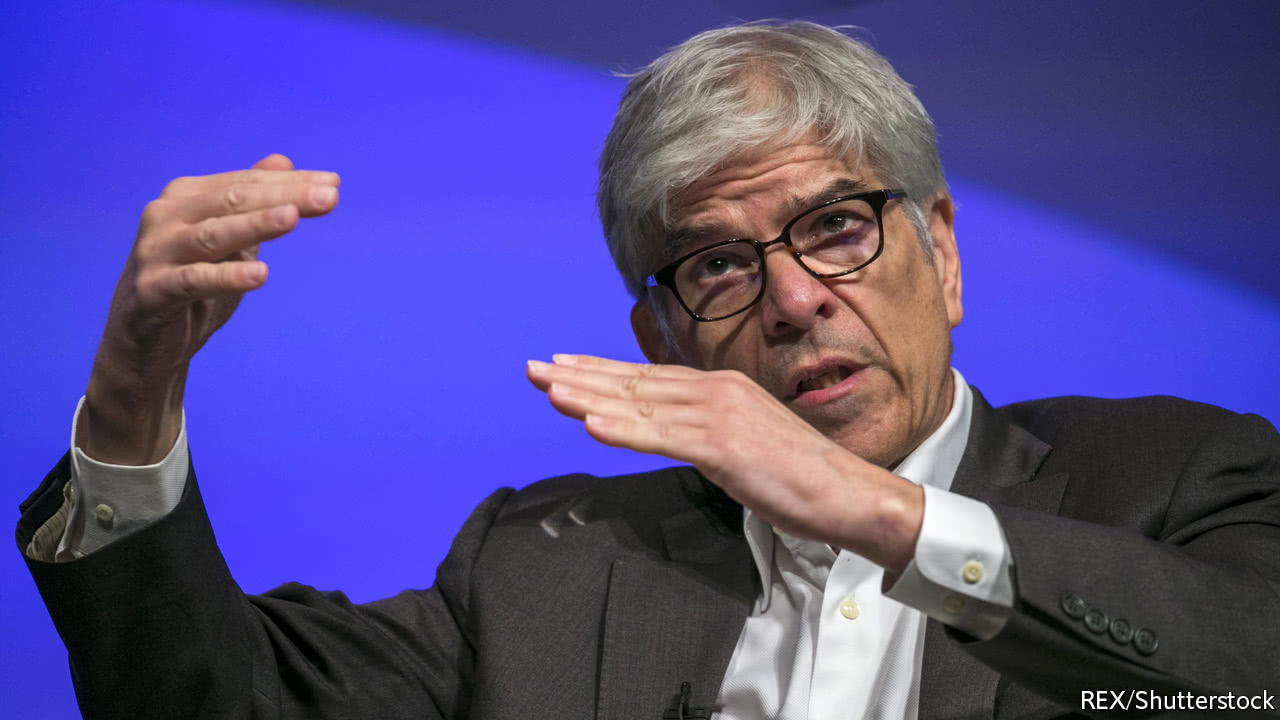
HOW many days does it take to correct a misleading newspaper interview? Four, in the case of Paul Romer, the World Bank’s chief economist. On January 12th a surprising article in the Wall Street Journal alleged that one of the bank’s signature reports—on the ease of doing business around the world—may have been tainted by the political motivations of bank staff. The story was based on an interview with Mr Romer, who pointed out that Chile’s ranking in the yearly report had dropped sharply during the presidency of Michelle Bachelet, a left-leaning politician who took office for the second time in 2014. Chile sank so heavily not because doing business had become harder, but because the bank had repeatedly changed its method of assessment.
That method mostly entails answering measurable questions, such as how many days does it take to start a business, register a property or file taxes. The answers determine a country’s score (known as its “distance to…Continue reading
The French government experiments with venture capitalism

AS A boy, Antoine Hubert used to catch butterflies. These days, the agro-engineer has eyes only for meal worms. In a demonstration factory near Dole in eastern France, he shows how trayfuls of plump, half-grown worms are fed, left to grow in a darkened dormitory, and then—after two months—slaughtered and cleaned with a blast of steam. A machine divides the resulting mush into oil and protein powder.
Around 70% of a worm is protein, making it ideal for animal feed. Demand is soaring, notably at fish and shrimp farms. Mr Hubert predicts aquaculture businesses will need 70m tons of feed annually in ten years’ time, up from 40m now. The global market for animal feed, he reckons, is already worth €500bn ($610bn).
Ynsect, his firm, thus expects to grow once it opens a new factory this year. He dreams of annual output exceeding 1m tonnes, hinting at a hunger for scale often left unsatisfied in a French entrepreneur: local…Continue reading
Our Big Mac index shows fundamentals now matter more in currency markets
IT IS usually considered quaint to predict foreign-exchange movements by reference to whether currencies are dear or cheap. Metrics such as The Economist’s Big Mac index, a lighthearted guide to exchange rates, hint at how far currency values are out of whack. But they are often driven further out of kilter by capital flows, by fear and greed, by the interventions of policymakers, and so on.
Since our last look at the index in July, cheap currencies have narrowed the valuation gap against the dollar—almost completely in case of the Canadian dollar (see chart). Fundamentals, such as fair value, seem (at last) to have greater sway in the foreign-exchange market.
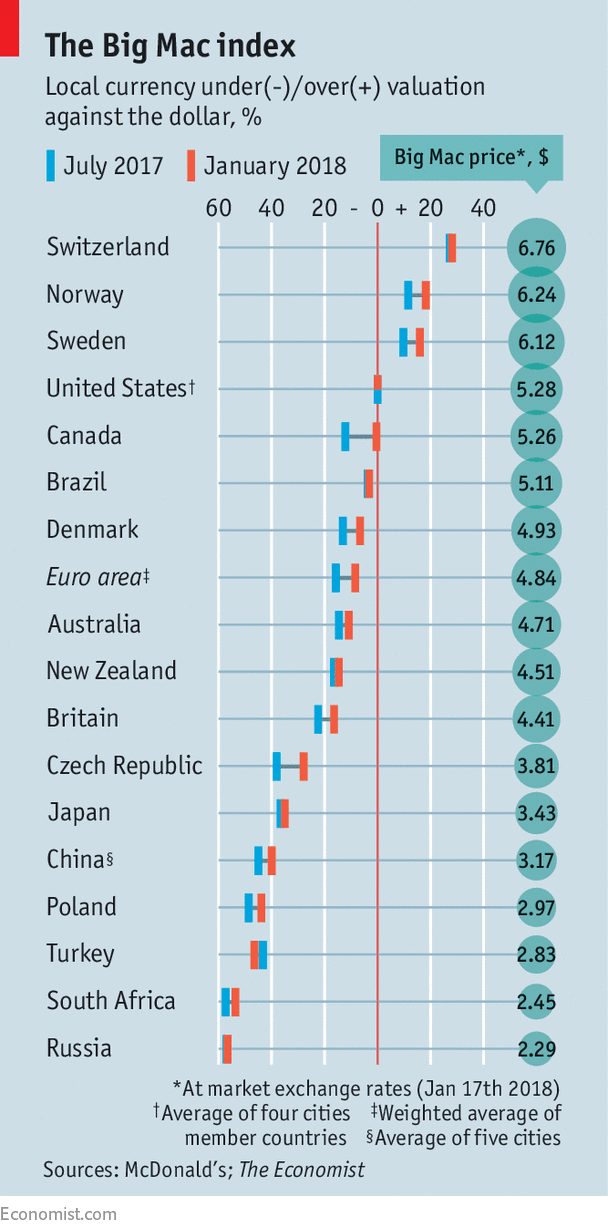
The index is based on the idea of purchasing-power parity, which says exchange rates should move towards the level that would make the price of a basket of goods the same in different countries. Our basket contains only one item, but it is found in around 120 countries: a Big Mac hamburger. If the local cost of…Continue reading
Why driverless cars may mean jams tomorrow

THE most distractingly unrealistic feature of most science fiction—by some margin—is how the great soaring cities of the future never seem to struggle with traffic. Whatever dystopias lie ahead, futurists seem confident we can sort out congestion. If hope that technology will fix traffic springs eternal, history suggests something different. Transport innovation, from railways to cars, reshaped cities and drove economic advance. But it also brought crowded commutes. Now, as tech firms and carmakers aim to roll out fleets of driverless cars, it is worth asking: might this time be different? Alas, artificial intelligence (AI) is unlikely to succeed where steel rails and internal-combustion engines failed.
More’s the pity. In America alone, traffic congestion brings economic losses estimated in the hundreds of billions of dollars each year. Such costs will rise unless existing transport systems receive badly needed investment. For example, fixing New York’s beleaguered, overcrowded subway will…Continue reading
Why the oil price is so high

PERHAPS the most vexing thing for those watching the oil industry is not the whipsawing price of a barrel. It is the constant updating of theories to explain what lies behind it. In March 2014, when the price of a barrel of Brent crude was in three figures, the then boss of Chevron, an oil giant, observed that the scarcity of cheap oil meant “$100 per barrel is becoming the new $20”. Two years later, when the oil price slumped below $28, the talk was of a global oil glut caused by the furious efforts of the OPEC cartel to regain market share. Now that oil prices have tested $70, analysts are again scratching their heads.
In “1984”, George Orwell coined the term “doublethink”, the ability to believe two contradictory things. Oil analysis seems to require similar cognitive gymnastics. Three big questions arise. First, why has the oil price more than doubled in the space of two years, against all expectation? Second, why has this surge been met with cheers from global stockmarkets and not…Continue reading
The threat of tough regulation in Asia sends crypto-currencies into a tailspin
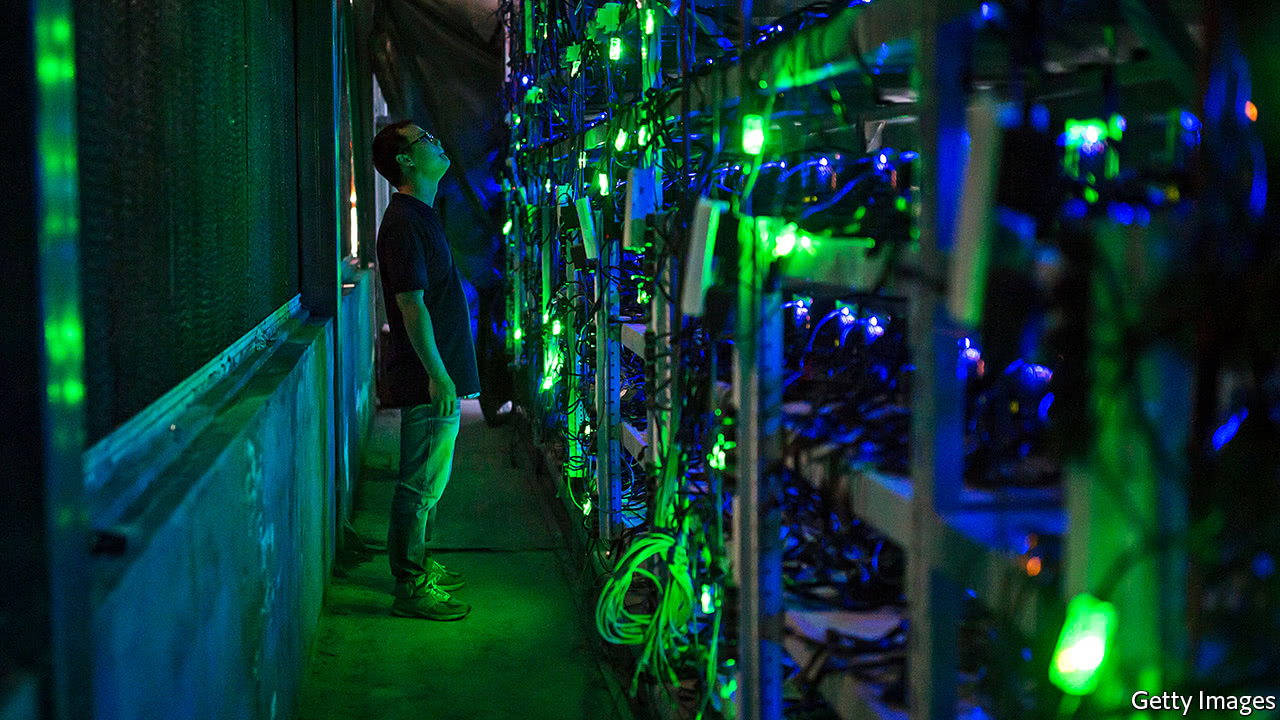
IT HAS been another week of vertiginous swings in the prices of bitcoin and other crypto-currencies. This time, the moves have mostly been downwards, with some days seeing falls of over 20%. Views on this were as divided as they were during the giddy climb: did it mark the definitive bursting of a bubble as rapidly inflated as any in history (see chart)?

Asia provides both an explanation of this week’s sell-off and a glimpse of crypto-currencies’ future. The threat of a ban in bitcoin-trading in South Korea was the proximate cause of the plunge. As to the future, the question is which Asia? At one end of the spectrum…Continue reading
The hedge-fund delusion that grips pension-fund managers
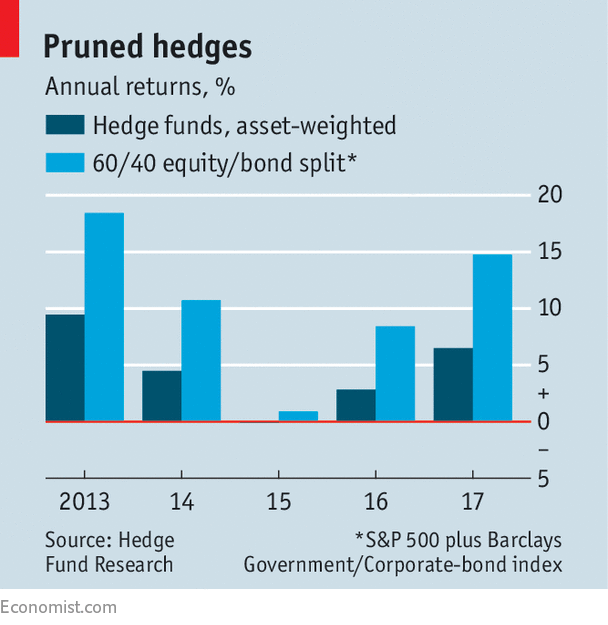
HEDGE-FUND managers may be feeling quietly smug about their performance in 2017. They returned 6.5% on average, according to Hedge Fund Research, a data provider, their best year since 2013.
But those returns do not really suggest that they are masters of the investing universe. The S&P 500 index, America’s main equity benchmark, returned 21.8%, including dividends, last year. More tellingly, a portfolio split 60-40 between the S&P 500 and a mixture of government and corporate bonds (an oft-used benchmark for institutional portfolios) would have returned 14.8%. Last year was the fifth in a row when hedge funds underperformed the 60/40 split (see chart).
That ought to be a salutary lesson for those institutions who think that backing hedge funds is the answer to their prayers. Despite the highs recorded by stockmarkets, many employers are struggling to fund their final-salary pension promises. In 2016 the average American public-sector plan was just 68%-funded, according to the Centre for…Continue reading