
Tag: Approved
Technology is revolutionising supply-chain finance

IN 2015 Kiddyum, a small company from Manchester that provides frozen ready-meals for children, won a contract from Sainsbury’s, a big British supermarket chain. Jayne Hynes, the founder, was delighted. But sudden success might have choked Kiddyum’s cashflow. Sainsbury’s pays its suppliers in 60 days; Ms Hynes must pay hers in only 30.
In fact Kiddyum gets its cash within a few days. Once approved by Sainsbury’s, its invoices are loaded onto the supermarket’s supply-chain finance platform, run by PrimeRevenue, an American company. The Royal Bank of Scotland (RBS) picks up the bills, paying Kiddyum early. Kiddyum pays a fee which, Ms Hynes says, is a small fraction of the cost of a normal loan. Sainsbury’s pays RBS when the invoice falls due.
Suppliers, of course, have always needed finance for the gap between production and payment. Traditionally, they could borrow on their own account, or sell their receivables—unpaid invoices—at a discount to businesses known…Continue reading
Why McKinsey is under attack in South Africa
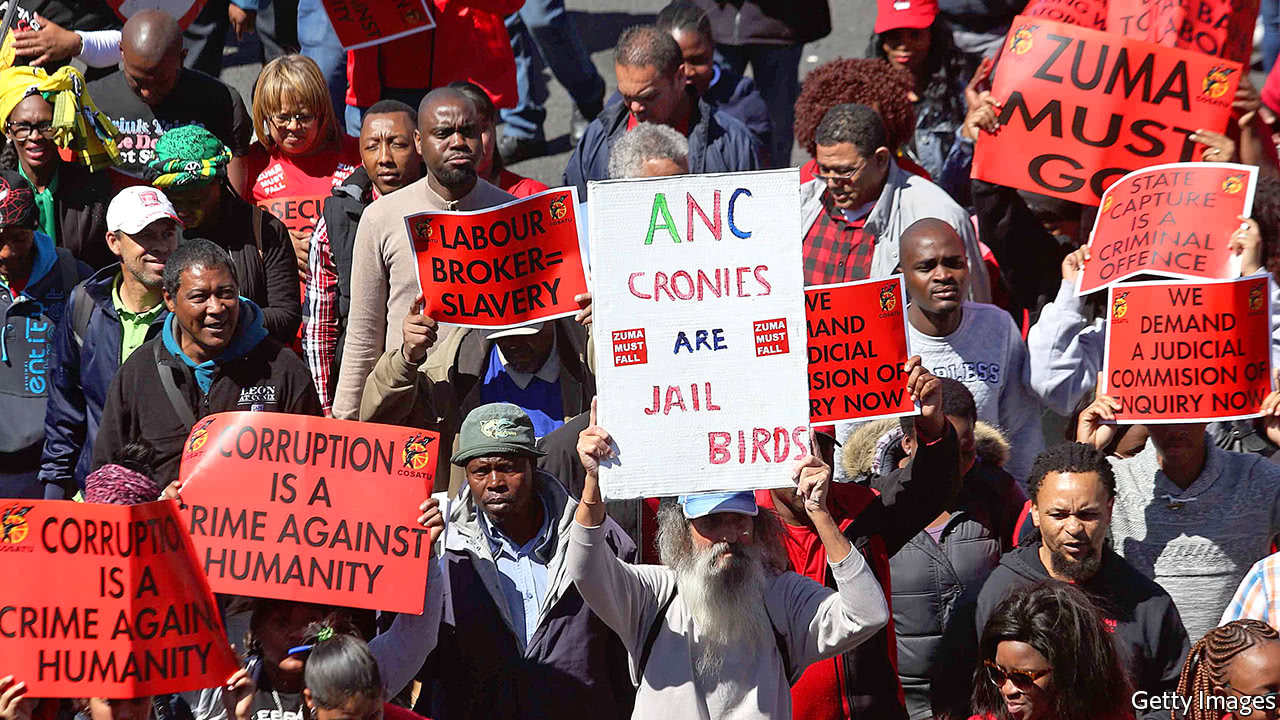
MCKINSEY, a global management consultancy known for its discreet profile and rarefied air, is unused to the sort of tub-thumping popular revolt it is experiencing in South Africa. Such is public outrage over the Guptas, an Indian-born business dynasty accused of growing rich off their relationship with President Jacob Zuma, that a few professional-services firms linked to the family, including McKinsey—as well as SAP, a German software giant—have become targets of Twitter storms and protest banners.
Anti-corruption groups and the opposition Democratic Alliance (DA) have drawn blood in the case of Bell Pottinger, a British public-relations firm accused of orchestrating a racially divisive public-relations campaign on behalf of the Guptas. A complaint by the DA to a British PR industry association set in motion Bell Pottinger’s swift implosion in September. At KPMG, a global audit firm, eight senior executives in South…Continue reading
An assessment of the White House’s progress on deregulation

DEREGULATION, along with tax cuts and trade reform, is one of the three pillars of President Donald Trump’s economic agenda. Republicans promise that, freed of red tape, American firms will invest more and unleash faster economic growth. And while Mr Trump has yet to unite his party around a major piece of legislation, the White House has plenty of sway over regulatory policy. For a start, the government agencies Mr Trump commands can regulate and deregulate on their own (subject only to the instructions that Congress has given them in the past). How much red tape have they managed to tear down since Mr Trump took office?
Regulation is difficult to measure precisely, but the long-term trend towards excessive rulemaking has been obvious. In 1970 there were about 400,000 prescriptive words such as “shall” or “must” in the code of federal regulations, according to the Mercatus Centre, a libertarian-leaning think-tank. Today there are 1.1m (see chart). Wonks of many stripes agree…Continue reading
American efforts to control Chinese firms abroad are dangerous
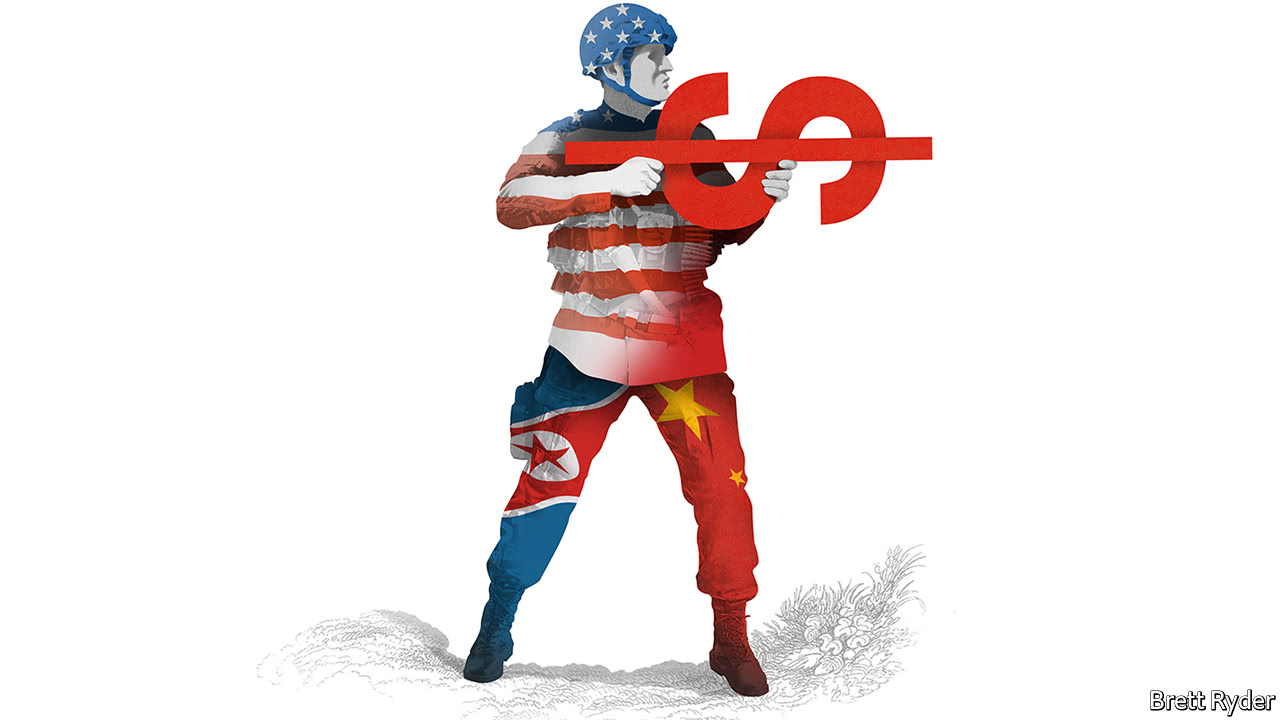
WARS are fought with weapons, but also with money. To understand the global balance of power in the coming decades, it helps to pay attention to the commercial subplot of the North Korean crisis. For the first time, America is attempting to use its full legal and financial might to change the behaviour of Chinese companies and banks, which it believes are propping up North Korea by breaking UN and American sanctions. Some American politicians have concluded that, as China’s firms have integrated with the global economy, they have become more vulnerable to Uncle Sam’s wrath. America has potent weapons, but the trouble is that China can retaliate in devastating fashion.
North Korea is highly dependent on China. Some 60-90% of its trade is with its northern neighbour. China’s state-run energy giant, CNPC, is thought to have sold it oil in recent years—and is the parent of PetroChina, which has depositary receipts listed in New York. North Korean banks and firms operate in China, and…Continue reading
Richard Thaler wins the Nobel prize for economic sciences

THE credit-card bill arrives. You have enough money in a savings account to pay it off—the sensible thing to do, arithmetically speaking, since the interest rate on the credit-card balance far exceeds that earned on the savings. Yet you leave the savings untouched, and pay only as much of the bill as your current-account balance allows. What looks a daft choice to most economists made perfect sense to Richard Thaler, who on October 9th was awarded the Nobel prize for economics for his work in behavioural economics. Mr Thaler helped demonstrate how human reasoning diverges from that of the perfectly rational homo economicus used in most economic modelling. The world, and the field of economics, is better for his contributions.
Economists mostly recognise that normal people—their friends and family—fall short of omniscience and perfect rationality in making day-to-day decisions. Economic modelling requires simplification, however, and economists generally suppose that…Continue reading
A Chinese carmaker agrees to buy a Danish investment bank
A COMPANY that moves up the value chain from refrigerator parts to cars is impressive but not that surprising. A car company that buys an investment bank is audacious. But Zhejiang Geely Holding Group, a conglomerate based in Hangzhou, China, did not become big by paring its ambitions. Having successfully made the fridge-parts-to-cars transition at home, it went global in 2010. It acquired Volvo, a Swedish carmaker, from Ford of America. Now Geely is back in Scandinavia for another acquisition. This time it is buying one of Denmark’s biggest banks.
Saxo Bank announced on October 2nd that Geely would acquire 51.5% of its shares. It will spend over $800m on the deal, which still requires regulatory approval. Sampo Group, a Finnish insurance company, will acquire 19.9% of Saxo shares for €265m ($311m), and Kim Fournais, Saxo’s co-founder and chief executive, will retain 25.7%. The sellers are Sinar Mas, an Indonesian conglomerate, and TPG, an American private-equity firm.
Saxo was an early adopter of online securities trading and still invests heavily in financial technology. It makes a substantial portion of its profits from selling trading platforms to other firms. Daniel Donghui Li, Geely’s chief financial officer, says Geely hopes to expand Saxo’s technologies into Asia. Besides facilitating this expansion, Geely does not intend to change how…Continue reading
A new study details the wealth hidden in tax havens
SWITZERLAND, which developed cross-border wealth-management in the 1920s, was once in a league of its own as a tax haven. Since the 1980s, however, tax-dodgers have been spoilt for choice: they can hide assets anywhere from the Bahamas to Hong Kong. The percentage of global wealth held offshore has increased dramatically. But it has been hard to say how much that is, and who owns it.
Few offshore centres used to disclose such data. But in 2016 many authorised the Bank for International Settlements (BIS) to make banking statistics publicly available. Using these data, a new study by Annette Alstadsaeter, Niels Johannesen and Gabriel Zucman, three economists, concludes that tax havens hoard wealth equivalent to about 10% of global GDP. This average masks big variations. Russian assets worth 50% of GDP are held offshore; countries such as Venezuela, Saudi Arabia and the United Arab Emirates climb into the 60-70% range. Britain and continental Europe come in at 15%, but Scandinavia at only a few per cent.
One conclusion is that high tax rates, like those in Denmark or Sweden, do not drive people offshore. Rather, higher offshore wealth is correlated with factors such as political and economic instability and an abundance of natural resources.
Proximity to Switzerland also remains a good indicator. But assets held there have declined since the financial…Continue reading
Tech giants are building their own undersea fibre-optic networks

WHEN Cyrus Field, an American businessman, laid the first trans-Atlantic cable in 1858, it was hailed as one of the great technological achievements of its time and celebrated with bonfires, fireworks and 100-gun salutes. Alas, the reason for the festivities soon went away. Within weeks the cable failed.
On September 21st the completion of another trans-Atlantic cable was welcomed with much less ado. But it is remarkable nevertheless: dubbed Marea, Spanish for “tide”, the 6,600km bundle of eight fibre-optic threads, roughly the size of a garden hose, is the highest-capacity connection across the ocean. Stretching from Virginia Beach, Virginia, to Bilbao, Spain, it is capable of transferring 160 terabits of data every second, the equivalent of more than 5,000 high-resolution movies. It is jointly owned by Facebook and Microsoft.
Such ultra-fast fibre networks are needed to keep up with the torrent of…Continue reading
How protectionism sank America’s entire merchant fleet

IN APRIL 1956 the world’s first container ship—the Ideal X—set sail from New Jersey. A year later in Seattle the world’s first commercially successful airliner, Boeing’s 707, made its maiden flight. Both developments slashed the cost of moving cargo and people. Boeing still makes half the world’s airliners. But America’s shipping fleet, 17% of the global total in 1960, accounts for just 0.4% today.
Blame a 1920 law known as the Jones Act, which decrees that trade between domestic ports be carried by American-flagged and -built ships, at least 75% owned and crewed by American citizens. After Hurricane Irma, a shortage of Jones-Act ships led President Donald Trump on September 28th to waive the rules for ten days to resupply Puerto Rico. This fuelled calls to repeal the law completely.
Like most forms of protectionism, the Jones Act hits consumers hard. A lack of foreign competition drives up the cost of coastal transport….Continue reading
Ford has a clear plan to fix its present failings
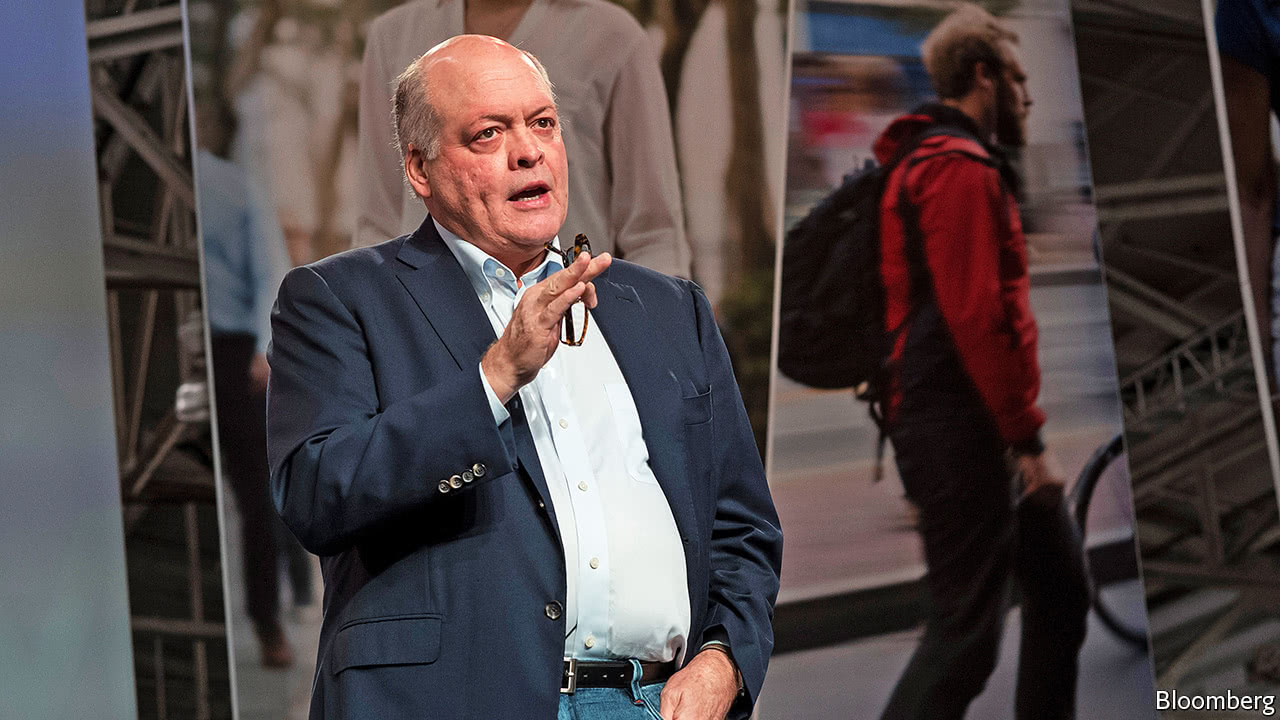
LIKE any mechanic with a misfiring car, Ford’s new boss has had his head under the bonnet working out what needs attention. Jim Hackett emerged on October 3rd with a checklist of repairs to present to investors, who have been awaiting his diagnosis since he took over in May. The list is short but the engineering is complicated: restore Ford’s competitiveness while preparing for a future of electric vehicles (EVs), self-driving cars and transport services. But those expecting a radical overhaul were probably disappointed.
Mr Hackett’s predecessor, Mark Fields, was shown the door by Bill Ford, the firm’s chairman, for failing to make a persuasive case that he was reinventing Ford as a mobility firm at the forefront of automotive technology. Despite acknowledging to investors that he and Mr Ford agreed that his new job was “about the future not the past”, Mr Hackett was clearest about how to make Ford fit for the…Continue reading