
Tag: Approved
An Indian aviation visionary runs into bureaucratic turbulence

ALL great aviation ventures start with mavericks willing to defy both the laws of physics and the scepticism of their peers. William Boeing, Oleg Antonov and Howard Hughes are some of the best-known examples. Next, perhaps, is Amol Yadav, who for much of the past decade has been building aeroplanes on the roof of the Mumbai flat he shares with 18 family members, and battling the Indian authorities to let him fly them.
Admittedly, only experts would be able to distinguish the six-seater propeller plane (pictured) Mr Yadav has designed from scratch from a run-of-the-mill Cessna. But his plane is the only one in decades with wholly Indian credentials, he says. Much larger outfits have tried but struggled to get an indigenous craft certified for production, including National Aerospace Laboratories, one of several state-owned aviation mastodons.
Self-identified visionaries are commonplace in…Continue reading
IBM lags in cloud computing and AI. Can tech’s great survivor recover?

TECHNOLOGY giants are a bit like dinosaurs. Most do not adapt successfully to a new age—a “platform shift” in the lingo. A few make it through two and even three. But only a single company spans them all: IBM, which is more than a century old, having started as a maker of tabulating machines that were fed with punch cards.
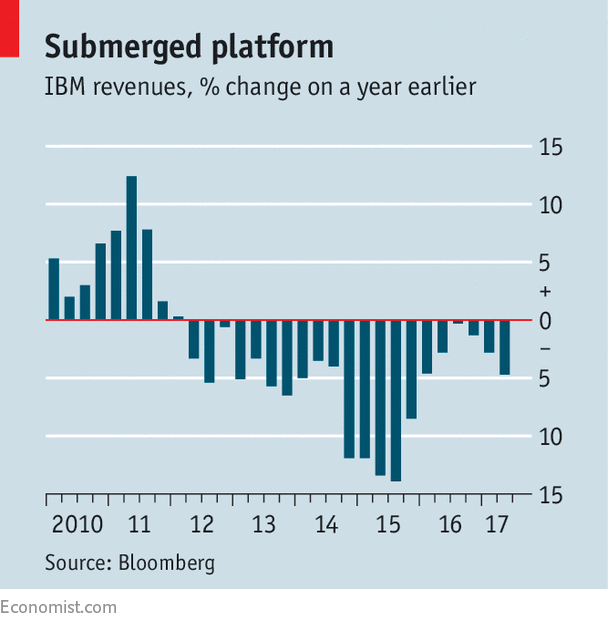
Yet after 21 quarters with falling year-on-year revenues (see chart), doubts had been growing about whether IBM would manage the latest big shifts: the move into the cloud, meaning computing delivered as an online service; and the rise of artificial intelligence (AI), which is a label for…Continue reading
Multilateral lenders vow openness about their carbon footprints
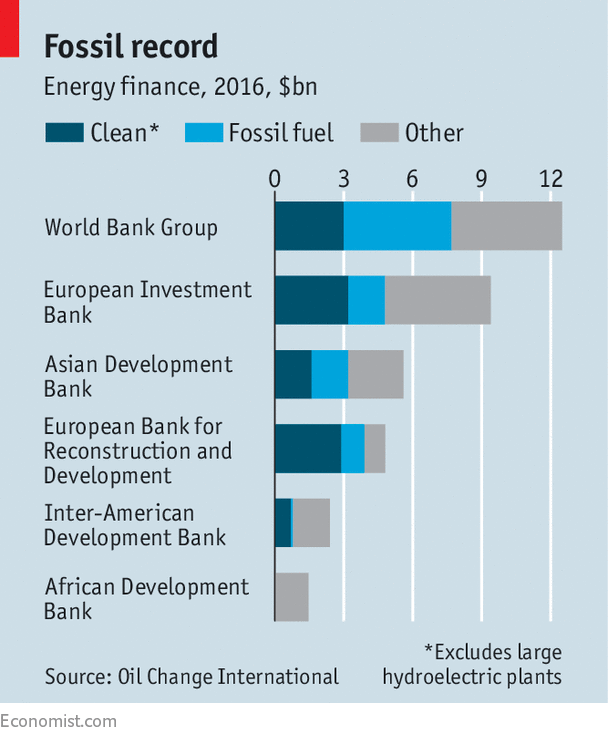
THE World Bank gets a lot of flak. Developing countries clamour for a bigger role in its management. President Donald Trump’s administration lambasts it for lending too much to China. Employees are in open rebellion against their boss, Jim Yong Kim. Now the embattled institution faces criticism from a traditionally friendlier quarter: environmentalists. They accuse it and other multilateral development banks (MDBs) of not being upfront about their true carbon footprint.
That must hurt. After all, MDBs pioneered climate-friendly finance. Ten years ago the European Investment Bank issued the world’s first green bond to bolster renewables and energy-efficiency schemes. The World Bank has not backed a coal-fired plant since 2010. In 2011-16 it and the five big regional lenders in the Americas, Asia, Africa and Europe offered developing countries a total of $158bn to help combat climate change and adapt to its effects. They disclose the amount of carbon dioxide emitted by their day-to-day…Continue reading
A Lloyd’s report urges insurers to ask “what if?”

ON JULY 7th disaster was narrowly averted when an Air Canada passenger plane, trying to land on a full taxiway at San Francisco airport, pulled up just in time. Five seconds longer, and it might have crashed into fully loaded planes and killed over 500 people, in potentially the deadliest aviation disaster ever. Instead, the incident became a non-event—not just in collective memory but also in insurance. With no losses, there was nothing to log. Yet ignoring such near-misses, argues a report published this week by Lloyd’s of London, an insurance market, and RMS, a risk-modeller, is a missed opportunity.
Counterfactual “what if” thinking may be an enjoyable pastime for historians—“What if Hitler had been assassinated?” being one favourite—but is not common among underwriters. They prefer to base estimates of future risk—and hence premiums—on hard data of what happened in the past, eg, the number of aeroplanes that crashed and the total losses incurred. Since actual…Continue reading
A rash of bankruptcies hits Chinese lenders backed by state firms

THE Communist Party dominates China’s economy and uses state-run companies, which it controls with an iron fist, to enforce its diktats. Or so the theory goes. Reality is messier: the party often struggles to monitor state-owned enterprises (SOEs), let alone to get them to toe its line. As it convenes its five-yearly congress, one of the financial system’s dodgiest corners has served up a reminder of the limits to its power.
In the past two months at least seven online lenders backed by SOEs have collapsed. It was a business none should have been in, far removed from the industries they were supposed to focus on. The money potentially lost is trivial—roughly 1bn yuan ($150m), compared with government assets worth more than 100trn yuan. Still, these cases highlight how hard it is for the party to stamp its authority on the vast state sector.
The troubled SOEs include distant subsidiaries of the national nuclear company, an aviation company and a big energy…Continue reading
Workers are not switching jobs more often

EVERYBODY knows—or at least thinks he knows—that a millennial with one job must be after a new one. Today’s youngsters are thought to have little loyalty towards their employers and to be prone to “job-hop”. Millennials (ie, those born after about 1982) are indeed more likely to switch jobs than their older colleagues. But that is more a result of how old they are than of the era they were born in. In America at least, average job tenures have barely changed in recent decades.
Data from America’s Bureau of Labour Statistics show workers aged 25 and over now spend a median of 5.1 years with their employers, slightly more than in 1983 (see chart). Job tenure has declined for the lower end of that age group, but only slightly. Men between the ages of 25 and 34 now spend a median of 2.9 years with each employer, down from 3.2 years in 1983.
How should recessions be fought when interest rates are low?

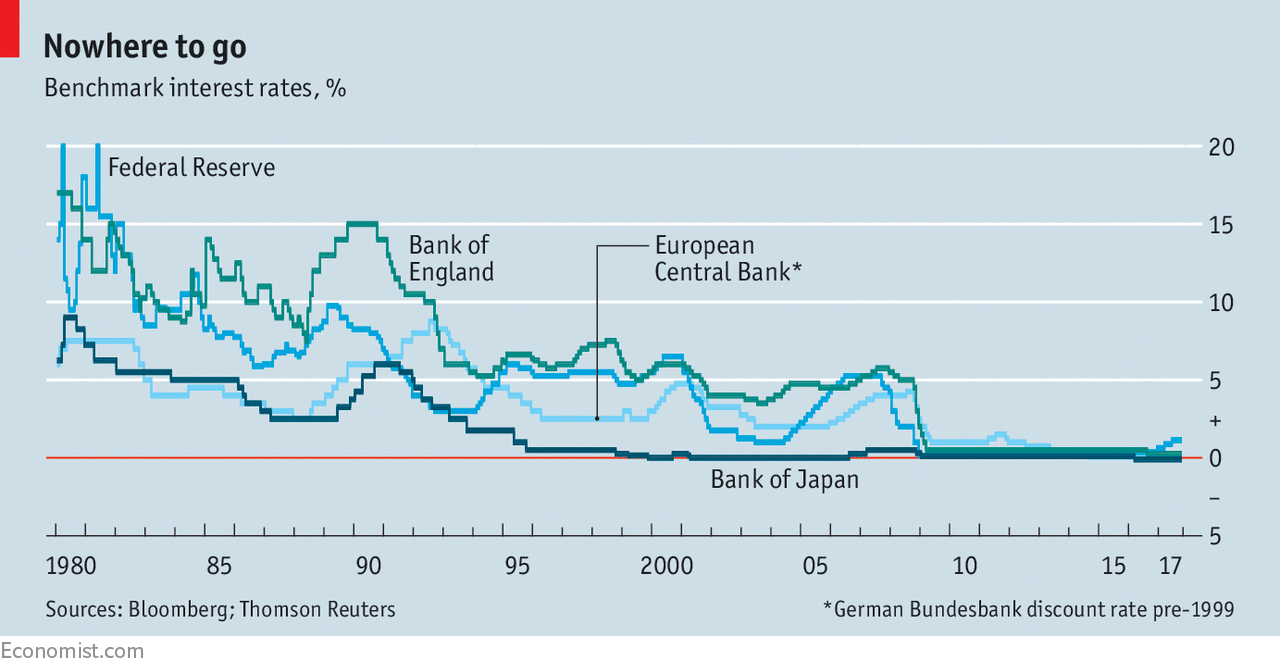
ONE day, perhaps quite soon, it will happen. Some gale of bad news will blow in: an oil-price spike, a market panic or a generalised formless dread. Governments will spot the danger too late. A new recession will begin. Once, the response would have been clear: central banks should swing into action, cutting interest rates to boost borrowing and investment. But during the financial crisis, and after four decades of falling interest rates and inflation, the inevitable occurred (see chart). The rates so deftly wielded by central banks hit zero, leaving policymakers grasping at untested alternatives. Ten years on, despite exhaustive debate, economists cannot agree on how to handle such a world.
Politics ensnares South Africa’s biggest asset manager

THE rot in South African politics, which has eaten away at state companies, is spreading. This week McKinsey, a consultancy, apologised for the “distress” it had caused the South African people. Political mud had already drowned Bell Pottinger, a British public-relations firm, and forced resignations at KPMG, an auditor. So the shenanigans at the government-owned Public Investment Corporation (PIC), have set off alarm bells. One concern is an apparent attempt to oust Dan Matjila, its boss. A linked worry is whether PIC funds will be used to prop up state businesses.
The PIC is a lucrative prize: it is Africa’s largest money manager, controlling 1.9trn rand ($140bn) of assets, mostly the pensions of state employees, and holding 11% of shares in South Africa’s biggest 25 companies. So anonymous allegations against Mr Matjila, including the claim that he had misdirected funds to his girlfriend’s business, naturally provoked a furore. On…Continue reading
Higher taxes can lower inequality without denting economic growth
INEQUALITY is one of the big political issues of the 21st century, with many commentators citing it as a significant factor behind the rise of populism. After all, nothing could be more indicative of the triumph of the common man than the elevation of a property billionaire to the American presidency.
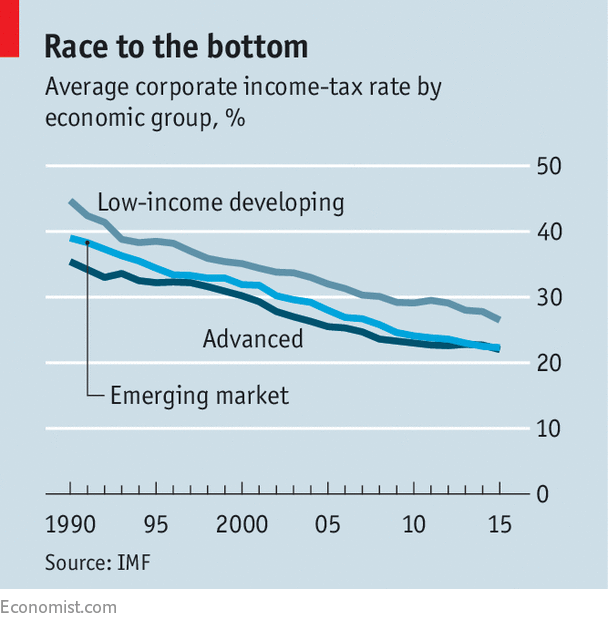
A new IMF report* looks at how fiscal policy can help tackle inequality. In advanced economies, taxation already has an impact. The Gini coefficient (a standard measure of income inequality) is around a third lower after taxes and transfers than it is before them. But whereas such policies offset around 60% of the change in market inequality between 1985 and 1995, they have had barely any impact since.
That is because of a change in policy direction. Across the West, taxes on higher incomes have generally fallen. This could be for a number of reasons, the IMF says. The tax take from high earners could have become more “elastic” (ie, sensitive to rate changes); in a mobile…Continue reading
Companies that burn up $1bn a year are sexy, dangerous, and statistically doomed

YVES SAINT LAURENT, Lady Gaga, David Bowie. Some people do not operate by the same rules as everyone else. Might the same be true of companies? Most bosses complain of being slaves to short-term profit targets. Yet a few flout the orthodoxy in flamboyant fashion. Consider Tesla, a maker of electric cars. This year, so far, it has missed its production targets and lost $1.8bn of free cashflow (the money firms generate after capital investment has been subtracted). No matter. If its founder Elon Musk muses aloud about driverless cars and space travel, its shares rise like a rocket—by 66% since the start of January. Tesla is one of a tiny cohort of firms with a licence to lose billions pursuing a dream. The odds of them achieving it are similar to those of aspiring pop stars and couture designers.
Investing today for profits tomorrow is what capitalism is all about. Amazon lost $4bn in 2012-14 while building an empire that now makes money. Nonetheless, it is rare for big companies to…Continue reading