
Tag: Approved
A firm that shares a name with its founder earns higher profits

A GOOD business name can be pricey. An entrepreneur looking for the perfect one can hire a naming agency to offer ideas, but that can cost tens of thousands of dollars. That may explain why many founders follow the example set by the American President and name their businesses after themselves. A recent article* by academics from the Fuqua School of Business at Duke University in North Carolina suggests that doing so does not just save money—it can also boost profits.
The study looked at small businesses in western Europe. It relied on a sample of almost 2m firms, data for which are contained in a commercial database called Amadeus. The database includes information about owners, managers and financial performance from 2002 to 2012. Firms in the sample tended to be, on average, fairly young, with few shareholders and employees. Checking against the surnames of the largest shareholders, the authors found…Continue reading
Investment in American infrastructure is falling

IT IS not a number to tweet about. President Donald Trump plans to plough $1trn of spending into America’s crumbling infrastructure. And a dearth of capital is not a problem: investors are keen on such assets. But investment seems to be falling.
Government infrastructure spending in the second quarter fell to 1.4% of GDP, the lowest share on record (see chart). According to Thomson Reuters, investment by American municipalities in the first seven months of this year, at $50.7bn, was nearly 20% below the same period in 2016. Private-sector infrastructure funds show a similar trend, according to Preqin, another data provider: deal volume in the first half of 2017 fell by 7.5%, year on year, to $36.6bn; the number of deals fell by a quarter.
Not long ago optimists were expecting an infrastructure-spending boom. In May Blackstone, a private-equity firm, announced with much fanfare a new $40bn fund for American infrastructure, with a $20bn investment from one of Saudi Arabia’s…Continue reading
Investors are not great at predicting politics
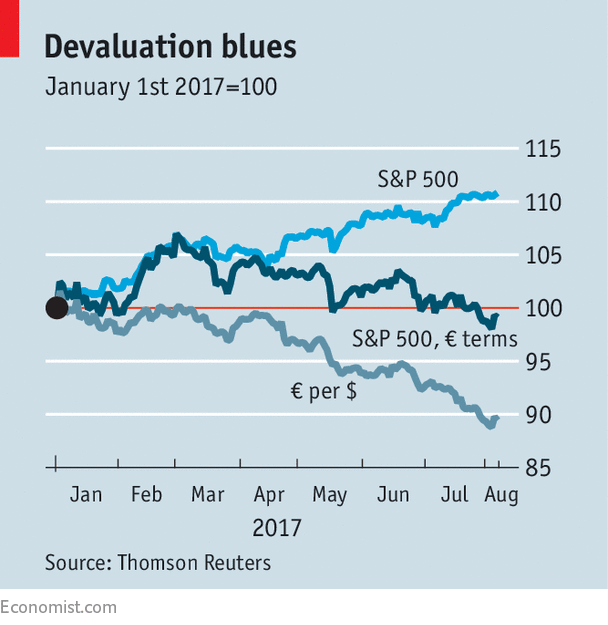
FINANCIAL markets are supposed to be the font of all wisdom, weighing up the information available and condensing it into a set of prices. Investors are presumed to have an insight into the future—falling bond yields are seen as a sign that the economy is slowing, for example.
But are investors that clever when it comes to politics? Gambling markets show how they assess political risk. They expected the Remain campaign to win the Brexit referendum and Hillary Clinton to become America’s president, and were proved wrong. Indeed, on Brexit, the mass of gamblers (the general public, in other words) backed Leave, but the odds were skewed by some wealthy punters who favoured Remain. Those rich gamblers were probably people who trade in financial markets; the plunge in the pound after the result suggests that most investors were caught on the hop.
Before the presidential election, most people on Wall Street to whom Buttonwood spoke thought that a victory for Donald Trump would be…Continue reading
Chasing higher yields, investors pile into risky countries
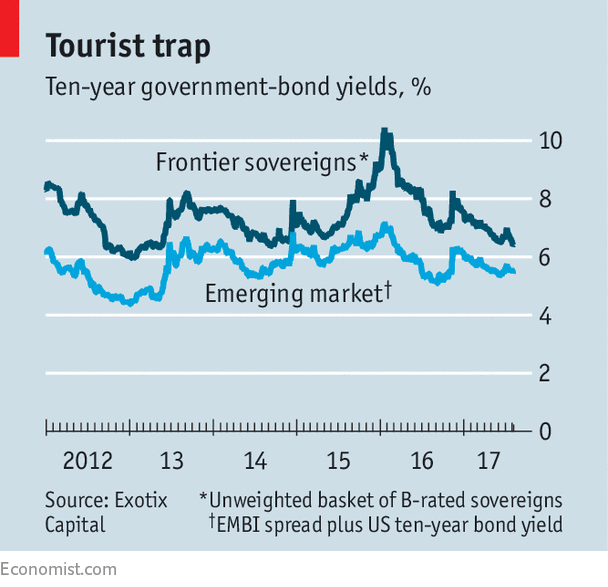
WHERE can you find a 7% interest rate on a sovereign dollar-bond? You would have to take a time-machine to the mid-1990s to find such a yield on a ten-year American Treasury. Alternatively, you could slip back a few days to August 2nd and bid for the $1bn of five-year bonds sold by the government of Iraq. The yield was expected to be 7%, but it was trimmed to 6.75% once orders rose above $6bn.
Such eagerness for hard-currency debt from a country still reeling from a civil war shows just how far bond investors will now go to get a decent yield. Oversubscribed issues for risky sovereign bonds have become almost normal. The Iraqi sale came just a week after Greece (whose privately held debt was partly written off in 2012) raised €3bn ($3.5bn) in its first bond sale for three years. In June Argentina was inundated with bids for its 100-year eurobond, as dollar-denominated bonds are known. Sceptics noted that Argentina had defaulted on its debts six times in the previous century, with the most…Continue reading
Why the world’s best footballers are cheaper than they seem

FOR football clubs, August is often the costliest month, when they make vast bids for each other’s players. This year has been particularly lavish. On August 3rd Paris Saint-Germain (PSG), a French team, signed Neymar da Silva Santos Júnior, a Brazilian forward, from Barcelona for €222m ($264m), more than double the previous record price for a footballer.
With three weeks of the transfer “window” left, teams in Europe’s “big five” leagues—the top divisions in England, Spain, Germany, Italy and France—have paid €3.2bn, just short of the record of €3.4bn set last year. The €179m splurged by Manchester City, an English club, on defenders outstrips 47 countries’ defence budgets. Arsène Wenger, a veteran manager of Arsenal, a London team, and an economics graduate, describes the modern transfer market as “beyond calculation and beyond rationality”.
Airline profits: ready to depart

WHEN Heathrow airport opened, in 1946, the only retail facilities were a bar with chintz armchairs and a small newsagent’s. The first terminal was a tent, a far cry from the four halls, resembling vast shopping malls, at the London airport today. Retail spending per passenger is the highest of any airport. This summer’s consumer crazes include Harry Potter wands and cactus-shaped lilos.
Heathrow’s journey from waiting room to retail paradise is the story of many airports. Before the 1980s, most income came from airlines’ landing and passenger-handling charges. Then “non-aeronautical” revenue—from shops, airport parking, car rental and so on—rose to around two-fifths of their revenues, of $152bn worldwide in 2015. But amid signs that non-aeronautical income is peaking, especially in mature aviation markets such as North America and Europe, the industry fears for its business model.
When airports were state-owned, and run not for profit but for the benefit of the…Continue reading
Australia’s CommBank is accused of abetting money-laundering
WHEN the Commonwealth Bank of Australia on August 9th reported its profit for the year to June—above forecasts and just shy of A$10bn ($7.9bn)—it faced questions about cashflows of another sort. Six days earlier the Australian Transaction Reports and Analysis Centre (AUSTRAC), a regulator charged with gathering financial intelligence to combat money-laundering and terrorism, had launched proceedings against it for “serious and systemic non-compliance”. Citing “collective responsibility” for the bank’s reputation, Catherine Livingstone, its chairwoman, has announced cuts to bonuses for Ian Narev, the chief executive, and others.
Founded 106 years ago, CommBank, as it is known, is one of Australia’s biggest banks. AUSTRAC traces its case to 2012, when the bank started installing “intelligent deposit machines”. They accept cash, let depositors stay anonymous and allow money to be switched to other accounts in Australia and overseas straight away. CommBank sets…Continue reading
An Israeli pharma champion sickens

THE headlong plunge of shares in Teva, a pharmaceutical giant—down by over 40% since August 2nd—is causing consternation beyond the firm’s shareholders and employees. The company was founded in Jerusalem in 1901, is the largest in Israel and is the country’s only multinational with its headquarters still at home. Since beginning its rapid expansion abroad in the early 1980s it has been called “the nation’s share” by Israelis, whose pension funds have invested heavily in its success.
That prosperity came chiefly thanks to the firm’s most popular proprietary drug, a bestselling medication for multiple sclerosis called Copaxone. Over the past two decades its sales paid for a global spree of buying generic-drugs competitors. Last year Teva completed its most ambitious purchase, of Actavis Generics, an American generics manufacturer, for $40.5bn; financing the deal took its debt to $35bn. But Teva’s transformation into the…Continue reading
Who will be the next chair of the Federal Reserve?
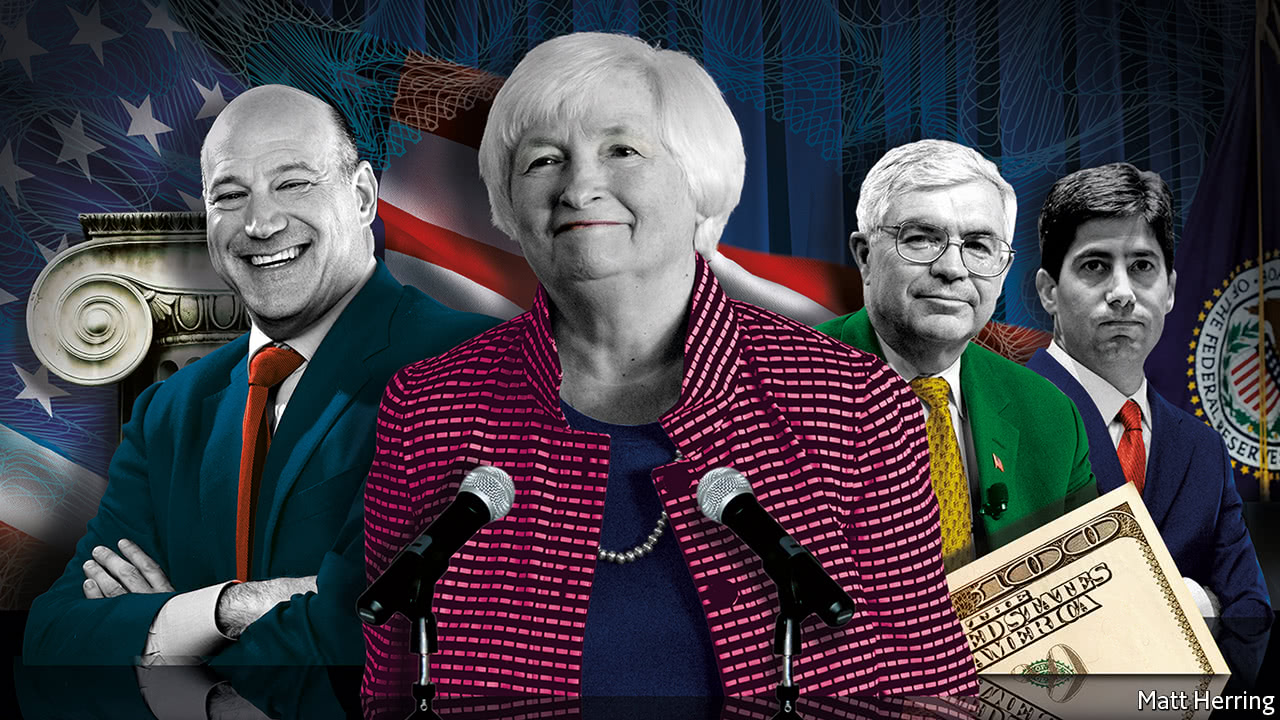
LOOK only at unemployment and inflation, says Peter Conti-Brown, a historian of the Federal Reserve, and Janet Yellen is the Fed’s most successful boss of all time. The second indicator may be below target, but that is a blip compared with the recessions most Fed chairmen have endured. So it is perhaps not surprising that President Donald Trump is openly considering retaining Ms Yellen, a Democrat installed by Barack Obama, after her term ends in February 2018. Nor by historical standards is it odd: the Fed’s past three leaders were all reappointed by presidents from the other party. Yet Ms Yellen, whom Mr Trump criticised on the campaign trail, is not the leading candidate. PredictIt, a betting site, gives her a 28% chance of staying put. In front of her, with a 36% chance of appointment, is someone else Mr Trump is publicly weighing up: Gary Cohn (on the left above).
Mr Cohn was until January the chief operating officer and president of Goldman Sachs. He left that role to become the…Continue reading
Rupert Murdoch’s bid for Sky hits more obstacles

RUPERT MURDOCH’S penchant for mass-market media has made him billions of dollars. It also gets in the way of empire-building. In 2011 News Corp’s bid to take full ownership of Sky, a European pay-TV giant, fell apart amid public rancour over phone hacking by journalists at the News of the World, one of his tabloids (since closed). Now a renewed Murdoch family takeover attempt for Sky, a bid of £11.7bn ($15.2bn) by 21st Century Fox, faces yet more scrutiny over concerns about alleged scurrilous reporting at Fox News, Mr Murdoch’s American cable-news channel.
On August 8th Karen Bradley, Britain’s culture secretary, asked Ofcom, the media regulator which had already reviewed the bid, to take another look to determine whether 21st Century Fox meets Britain’s broadcasting standards. Ms Bradley’s request followed fresh complaints about Fox News from members of parliament, including Ed Miliband, the former leader of the opposition Labour Party, and from…Continue reading