
Tag: Approved
Film piracy is changing. Pirates now want ransoms

RIPPING off films still reaps riches: the business model holds even in the internet age. Someone makes a digital file of a film, either with a camera in a theatre or by copying a DVD, then sells the file to operators of dodgy websites, many of whom make millions a year from online advertising and customer subscriptions—illegal versions of Netflix.
This year pirates introduced an entrepreneurial plot twist. They have begun asking Hollywood studios for ransoms. In several cases the rogues have told leading makers of films or television programmes that if they do not pay up, digital copies will appear online before the official release date. It is Hollywood’s version of WannaCry, the ransom malware.
No one has been seen to pay up so far, but the threats are not all idle. Netflix, one victim, saw certain episodes of its new season of the show “Orange is the New Black” released by a pirate who goes by the alias “thedarkoverlord” (who had demanded payment in…Continue reading
Sweden’s economy is thriving, so why is monetary policy so loose?
ON A recent balmy day, people thronged the parks and promenades of central Stockholm. Swedes have much to feel sunny about. Real economic growth, at a heady 3.2% in 2016, has averaged 2.8% annually since 2009, compared with the euro area’s 1.1% per year. In April, Swedish inflation was close to the target of 2% aimed at by the Riksbank, Sweden’s central bank. Yet it decided not only to maintain the main policy rate at -0.50%, where it has been since February 2016, but to increase the amount of asset purchases under quantitative easing (QE) by a further SKr15bn ($1.7bn) during the second half of 2017.
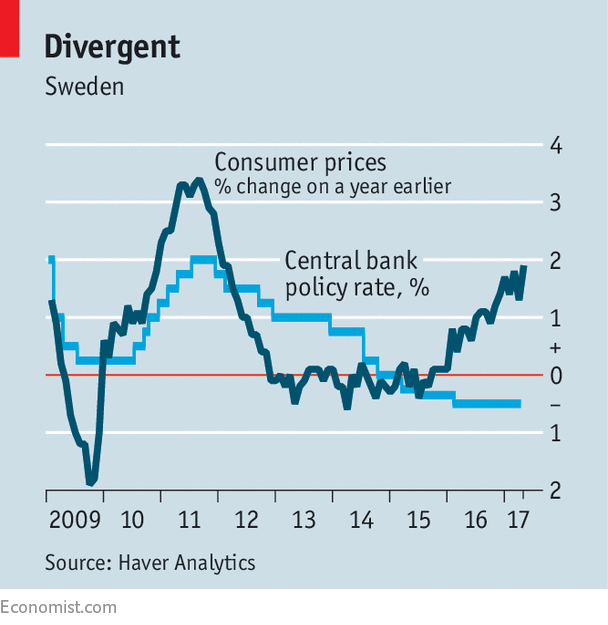
One explanation for keeping policy so loose is that the inflation figure is deceptive. Johan Javeus of SEB, a bank, points out that some of the increase was driven by one-off factors, such as rises in air fares and energy prices. After raising rates prematurely in 2010 and 2011, the Riksbank is loth to do so again.
But also, it is hemmed in by the European Central Bank (ECB). The…Continue reading
China’s new cyber-security law is worryingly vague
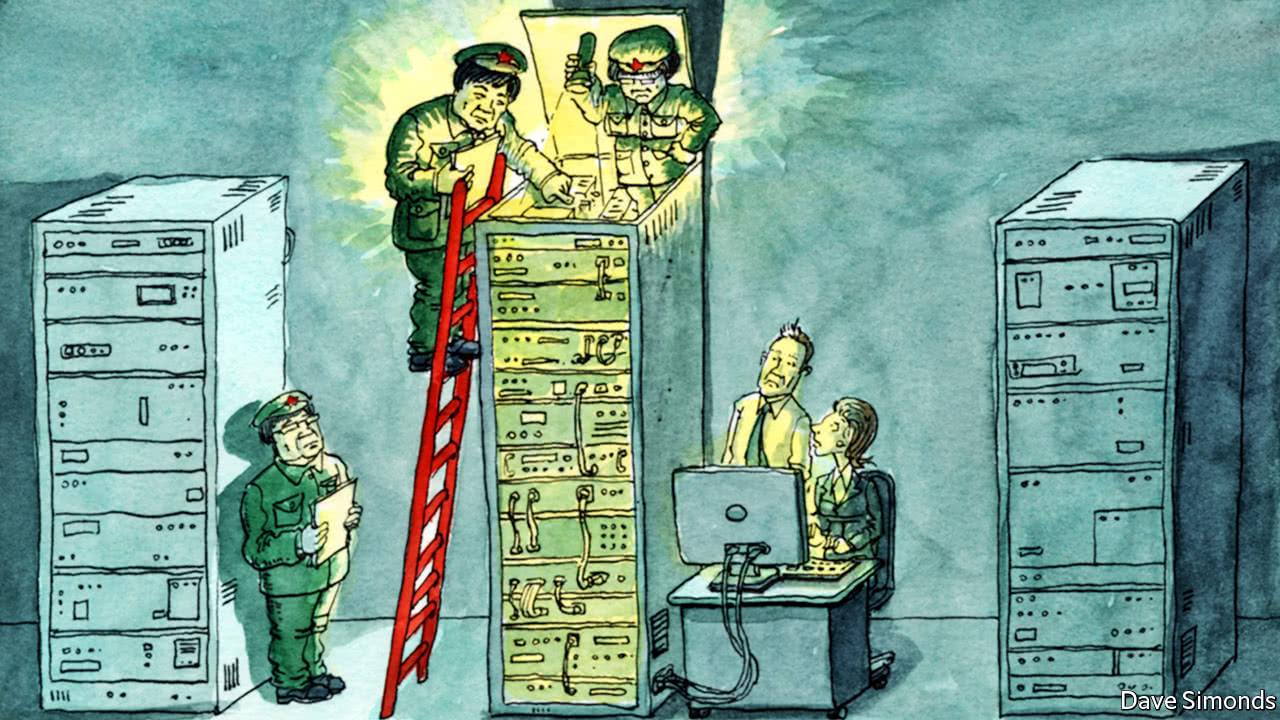
“IF YOU want to stay in China, you have to go all in.” So says James Fitzsimmons of Control Risks, a consultancy, of the impact China’s new cyber-security law will have on multinational companies (MNCs). These firms have moaned for months about the law’s intrusive and vague provisions and asked for a delay in its implementation, but to no avail. It came into force on June 1st, and foreign firms are now scrambling to figure out its implications. Mr Fitzsimmons, for one, is convinced that they must take the costly step of separating their local IT systems from their global networks.
At first blush, the law seems a reasonable effort at tackling two areas of policy in need of reform. The first is cyber-security. Companies in industries deemed to be critical must now ensure that their technology systems are “secure and controllable.” They must store important data locally, and will be subject to audits by official inspectors. Susan Ning of King & Wood Mallesons, a Chinese law…Continue reading
Global monetary policy is not tightening as expected
AT ITS outset, 2017 seemed likely to mark a turning-point for global monetary policy. The Federal Reserve had just raised its main interest rate by a quarter-point and was expected to add three such increases this year—or perhaps even more, if a new Republican Congress could agree on tax cuts with a new Republican president. In that case, low interest rates would no longer be the “only game in town” in terms of policy stimulus. The European Central Bank (ECB) would begin to wind down its programme of quantitative easing, or QE, probably by mid-year. The Bank of Japan would cut back on QE, too. In September it set a target yield for ten-year bonds, of 0.0%, which would probably require fewer asset purchases. Of the global giants, only China seemed likely to keep its policy settings as loose as in 2016.
In this context, the ECB’s meeting on June 7th and 8th was not long ago eyed as pivotal. The bank’s staff would produce new, upbeat economic forecasts. Many ECB-watchers (and maybe…Continue reading
Taiwan’s economy has defied the pessimists

TAIWAN’S president, Tsai Ing-wen, has had a tough first year in office. Her popularity has plummeted as she has struggled to find a path through thorny policy debates. Hope that she might have a staunch ally in Donald Trump has receded. China has ratcheted up pressure, leaving Taiwan more isolated internationally. Less noticed is that Ms Tsai has, for now, won over one important group: investors. Cash inflows from abroad have made Taiwan’s stockmarket and currency among Asia’s best performers. Foreign direct investment in the electronics industry has also surged.
The government, to be sure, cannot take too much credit. A revival in global trade is the main reason for Taiwan’s improved fortunes. Exports rose 15% in the first quarter, the fastest rate in six years. The big gains for Taiwan’s stockmarket—up 40% in dollar terms since Ms Tsai’s inauguration—are about the same as those in South Korea, another economy whose growth is…Continue reading
In Donald Trump’s America, the left rethinks its economics

DEMOCRATS thought they knew the boundaries of acceptable economic discourse. Then came Donald Trump, who trashed them, yet won the presidency. He upended Republican positions on trade, and exposed the vulnerability of the Democratic Party on its home economic turf: the well-being of American workers. He also seems to have liberated the left to think big ideas—and confront hard questions.
Since 1992 Democratic economic policy has been rooted in technocratic centrism, meant to smooth the rough edges of the market. “We reject both the do-nothing government of the last 12 years and the big-government theory that says we can hamstring business and tax and spend our way to prosperity,” read the party platform in 1992. “Instead we offer a third way.” This was a desperate effort to escape the political wilderness. Yet it also reflected intellectual trends in economics. Inflation and falling productivity in the 1970s seemed to bear out the views of economists such as Milton Friedman, that…Continue reading
Tech firms hoard huge cash piles
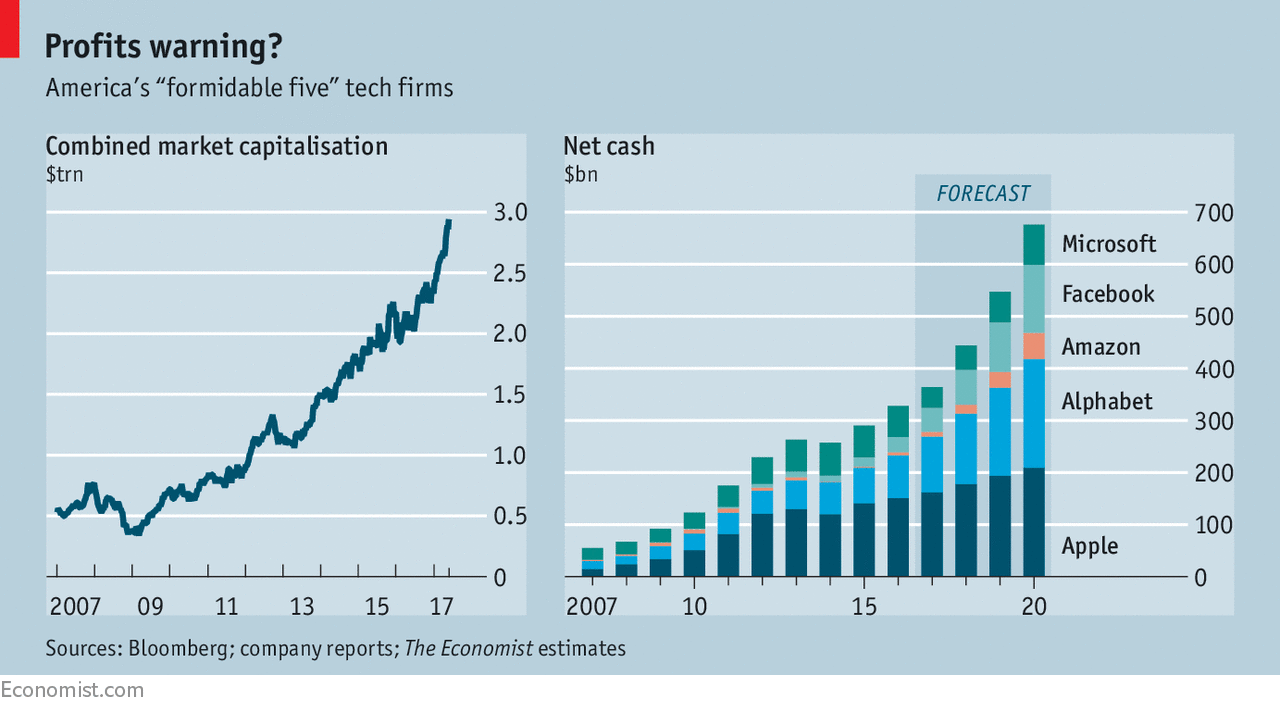
Elevated tech valuations used to be a sign of hysteria. Today’s investors believe they are making an ice-cold judgment that these firms are the dominant oligopolies of the 21st century and will extract a vast, rising, flow of profits. There is one gnawing doubt, however: the formidable five’s cash-rich balance-sheets, which are built as if they expect a crisis, not to dominate the world.
Machine-learning promises to shake up large swathes of finance
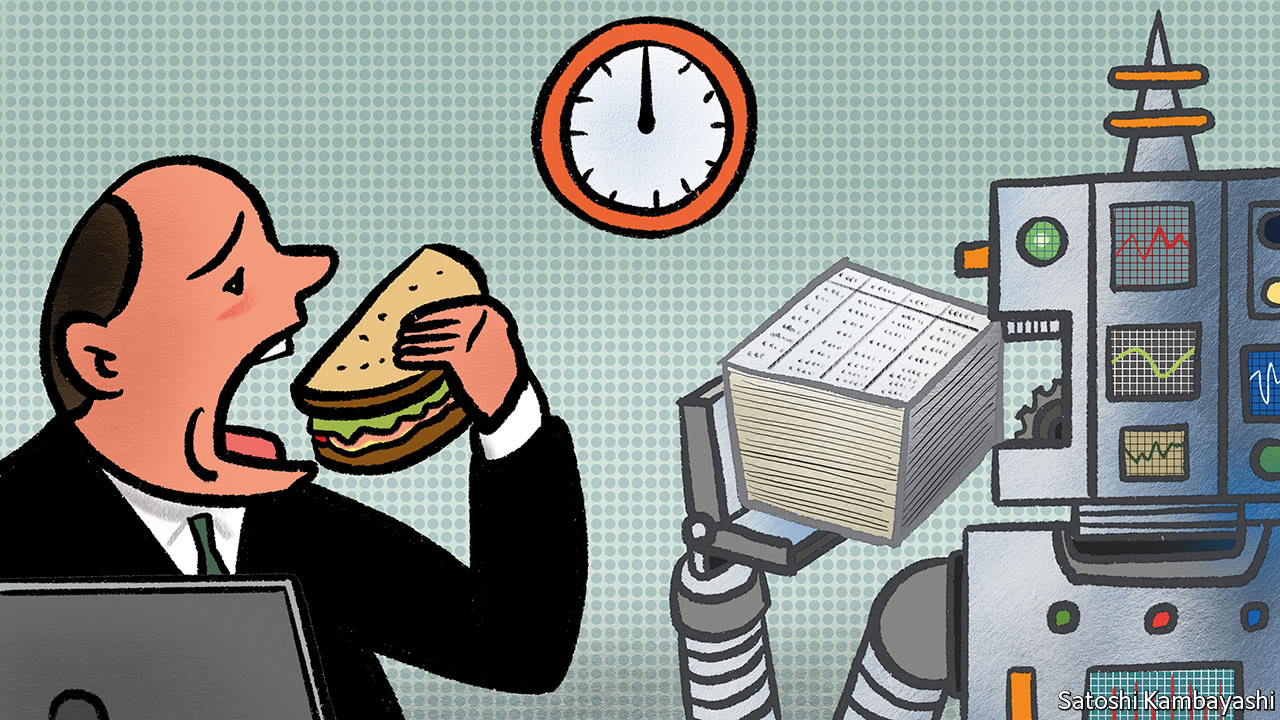
MACHINE-LEARNING is beginning to shake up finance. A subset of artificial intelligence (AI) that excels at finding patterns and making predictions, it used to be the preserve of technology firms. The financial industry has jumped on the bandwagon. To cite just a few examples, “heads of machine-learning” can be found at PwC, a consultancy and auditing firm, at JP Morgan Chase, a large bank, and at Man GLG, a hedge-fund manager. From 2019, anyone seeking to become a “chartered financial analyst”, a sought-after distinction in the industry, will need AI expertise to pass his exams.
Despite the scepticism of many, including, surprisingly, some “quant” hedge funds that specialise in algorithm-based trading, machine-learning is poised to have a big impact. Innovative fintech firms and a few nimble incumbents have started applying the technique to everything from fraud protection to finding new trading strategies—promising to up-end not just the humdrum drudgery of the back-office,…Continue reading
A trade deal between the EU and east Africa is in trouble
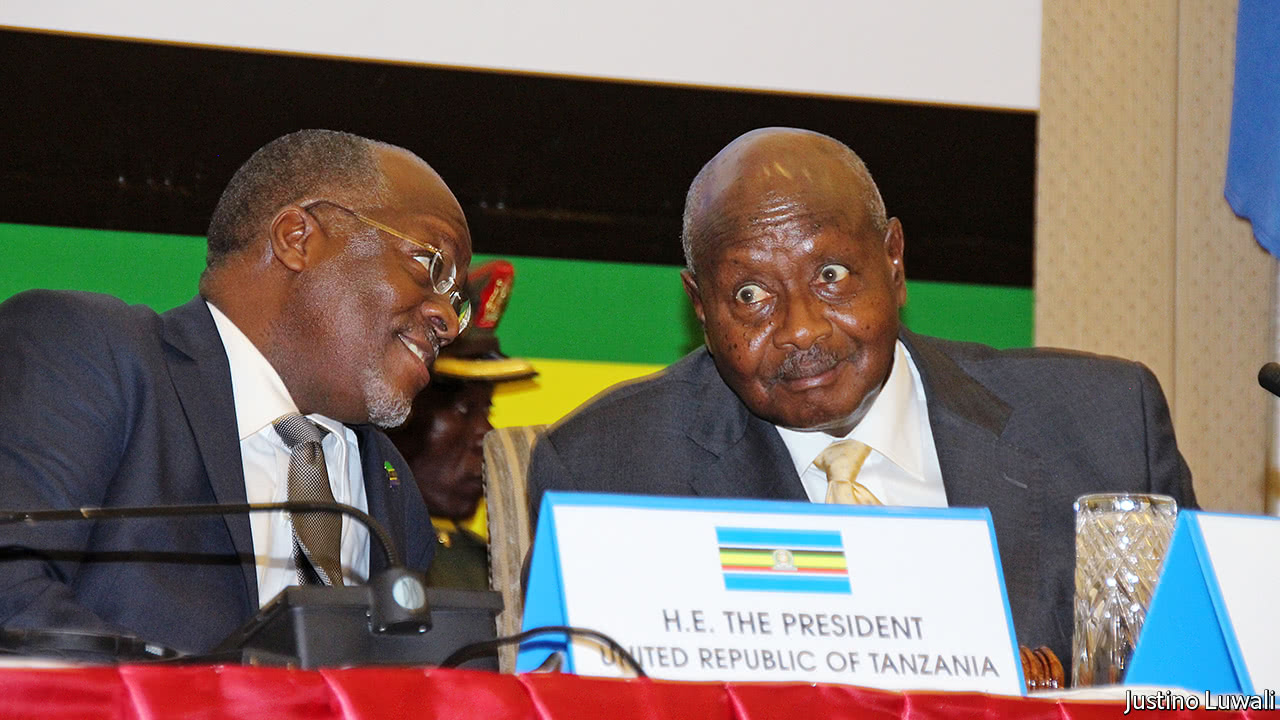
THE winds that waft along the Swahili coast change direction with the seasons, a boon to traders in times past. Shifts in the political winds are harder to predict. Last July a proposed trade deal between five countries of the East African Community (EAC) and the EU was thrown into disarray when Tanzania backed out at the last minute. An EAC summit, scheduled for months ago, was meant to find a way forward. Held at last on May 20th in Dar es Salaam, after many postponements, only two presidents showed up. The deal is in the doldrums.
The pact is one of seven “Economic Partnership Agreements” (EPAs) the EU wants to sign with regional groups in Africa, the Caribbean and the Pacific. The first was agreed with the Caribbean in 2008; southern Africa followed suit last year. But progress in west Africa has also stalled, with Nigeria raising objections. The EPAs were promoted as a new breed of trade deal, and…Continue reading
A new code aims to clean up the foreign-exchange market
FINANCIAL-MARKET traders have earned a pretty shocking reputation in recent years. From manipulating LIBOR, a benchmark interest rate, to rigging the daily fix of foreign-exchange (FX) rates, traders have shown themselves ready not just to stretch the rules, but to collude in outright illegality.
A global code of conduct for the FX market, unveiled on May 25th, aims to put things on a sounder footing. Drawn up over the past two years by a coalition of central bankers, known as the FX Working Group (FXWG), and supported by a panel of industry participants, the code’s 55 principles lay down international standards on a range of practices, from the handling of confidential information to the pricing and settlement of deals.

Such standards seem long overdue in the massive FX market. Roughly $5trn is traded every day (see chart). Many companies, pension funds and money managers depend on banks to hedge their exposure to currency fluctuations. Yet in the past traders colluded with one another…Continue reading