
Tag: Approved
Green bonds channel private-sector funding to the climate
WHEN Donald Trump announced America’s withdrawal from the Paris climate agreement on June 1st, he spelled out that it would no longer contribute to the Green Climate Fund. This is a UN initiative to use rich countries’ money to bring climate finance to developing ones. But even if the fund were going swimmingly, public-sector finance would only be able to provide a small part of the cash needed by poor countries, and indeed the world.
Private markets, however, are mobilising—notably that for “green bonds”, which tie the proceeds of bond issues to environmentally friendly investments. The market started a decade ago with issues from municipalities and multilateral development banks, worth just a few hundred million dollars annually.
By 2016 issuance had grown to $97bn, of which $32bn came from China alone; SEB, a Swedish bank, reckons volumes may hit $125bn this year. Public-sector issuers together accounted for only around 30% of the total last year. The largest portion, over 35%, was issued by financial institutions; around 20% came from other companies. Investor demand, too, is booming. Zurich Insurance, a Swiss insurer, has already invested over $1.2bn in green bonds, with plans to reach $2bn; BlackRock and other asset managers have set up dedicated green-bond funds.
As for the proceeds, over 40% is used to finance clean energy; nearly…Continue reading
Four BRICs don’t quite make a wall

EMERGING markets have been through a lot over the past four years. The “taper tantrum” in 2013 (prompted by fears of a change in American monetary policy); the oil-price drop in 2014; China’s botched devaluation of its currency in 2015; and India’s botched “demonetisation” of much of its own currency in late 2016 (removing high-value banknotes from circulation). But 2017 has started more brightly. Indeed, for the first time in two and a half years, the world’s four biggest emerging economies (Brazil, Russia, India and China, known as the BRICs) are all growing at the same time.
Russia’s GDP bottomed out at the end of 2015 (using seasonally adjusted figures) after the longest recession since the 1990s. It has expanded at a gathering pace for the past three quarters. Higher oil prices have helped, though Russia cannot profit fully from the improved market by ramping up sales without violating the production limits that caused the market’s recovery.
During the…Continue reading
In praise of America’s third-party debt collectors

FEW cheer the rising levels of America’s household debt, which reached a record $12.7trn at the end of the first quarter. Nearly 5% of the total, or $615bn, was in some stage of delinquency. One group, however, can barely hide its glee: third-party debt-collection firms, which try to recover mostly consumer loans on behalf of creditors without the resources to chase down bad borrowers themselves.
Business is expanding “at a robust rate”, says Keith Kettelkamp, the boss of Remex, a debt collector based in New Jersey whose clients include banks, utilities and musical-instrument sellers. Across the country more than 6,000 collection firms contact debtors more than 1bn times a year. One in eight Americans has an account with a third-party collector. The average amount outstanding is just over $1,300.
Third-party collectors have, it is fair to say, a dubious reputation: they are the target of more complaints from consumers than…Continue reading
British Airways botches its response to its latest technical woes
IT IS easy to blame infrastructure when things go wrong, as they did on May 27th when British Airways (BA) grounded planes across the globe after a global IT systems crash. More than 1,200 flights, booked to carry over 75,000 passengers, were cancelled over three days; hundreds of thousands more miserable travellers had their trips ruined by delays, lost luggage and missed connections. Analysts estimate that the total cost to BA of refunds, plus compensation of up to €600 ($675) for each delayed passenger, could climb as high as £150m ($192m).
But such calamities are also man-made, and a trail of incompetence led to this one. Alex Cruz, the chief executive, is better known as a cost-cutter than a communicator, and it showed. Though he was quick to apologise in public, in private he muzzled his employees and offered vague explanations, linking the computer failure to a “power-supply issue”. Others pour scorn on this interpretation.
His staff, though often trying their best, were ill-prepared. They had no clear plan to deal with passengers caught up in the chaos. For flight delays and cancellations, the television bulletins broadcast at London’s Heathrow and Gatwick airports, BA’s two main hubs, were more helpful than its stewards on the ground. Without working backup systems, airline representatives were unable to prioritise customers in most…Continue reading
The super-rich are different: they pay less tax
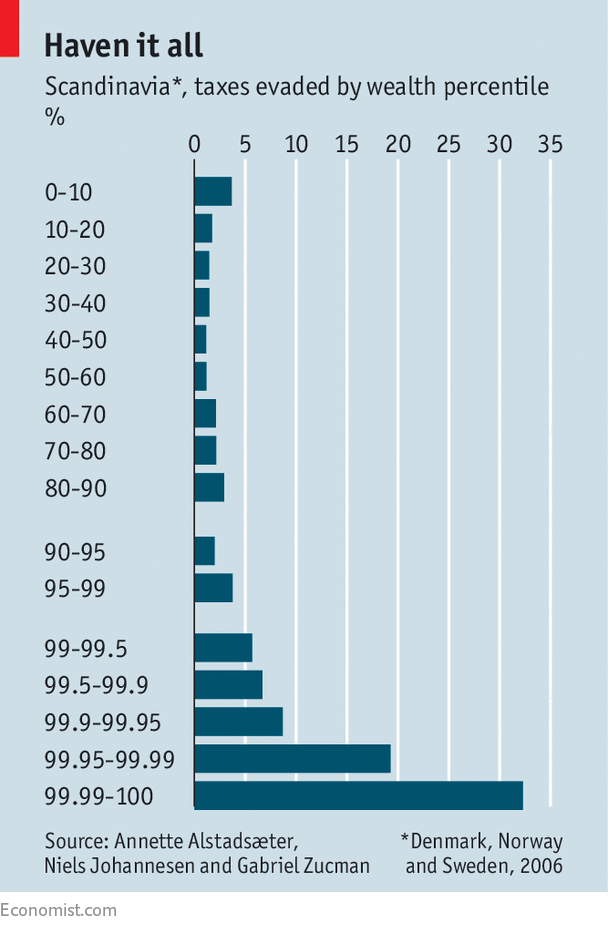
OF LIFE’s two certainties, death cannot be dodged even by the well-to-do. Taxes are another matter. Quantifying quite how much they manage to keep from the taxman, however, has always been tricky. One common approach governments take is to conduct randomised audits of tax returns. This methodology can give regulators a rough sense of overall tax revenues lost. But it is far from ideal. For instance, studies based on randomised tax audits are usually both too small and too crude to reflect accurately the financial shenanigans of the most egregious tax-dodgers: the super-rich.
A new study by Annette Alstadsæter, Niels Johannesen and Gabriel Zucman, three economists, tackles this problem by investigating two recent financial-data hoards: the “Swiss leaks”, a record of bank accounts held at HSBC in Switzerland; and the “Panama papers”, files that document the use of offshore accounts and shell companies by clients of Mossack Fonseca, a law firm in Panama. By matching the leaked information with wealth data from Denmark, Norway and Sweden, the authors are able to construct the most detailed estimate to date of the extent of tax evasion.
The race to become Islamic banking’s fintech hub

FOR all the sophistication of some of its financial centres, and despite the ubiquity of smartphones, the Middle East has been a late adopter of financial technology, or fintech. Of more than $50bn in fintech investment globally since 2010, according to Accenture, a consultancy, only 1% has gone to the Middle East and north Africa.
Khalid Al Rumaihi, head of Bahrain’s Economic Development Board, blames institutional foot-dragging and a lack of infrastructure and venture capital. Yet he insists innovation is inherent to Islamic financial tradition. The modern cheque derives from an Arabic instrument, a written vow to pay for goods on delivery, to avoid carrying money on dangerous journeys. “In the 9th century”, he says, “a Muslim businessman could cash a cheque in China drawn on his bank in Baghdad.”
Several cities are now jockeying to establish themselves as fintech hubs. Last year Cairo launched two “accelerators”—schools to nurture startups. Abu…Continue reading
America’s community banks hope for lighter regulation

A FEW weeks ago Standard Financial, a bank with assets of just $488m and a mere nine branches, merged with Allegheny Valley Bancorp, a slightly smaller neighbour in the suburbs of Pittsburgh. The main reason for the deal, says Tim Zimmerman, Standard’s chief executive, was the rising cost of regulation—though competition from PNC, a $371bn colossus based in the city, also played a part. “Without the regulatory overreach…since the crisis,” Mr Zimmerman says, “we’d probably both have gone along on our own, I think.”
Standard is one of America’s 5,400 community banks: local lenders, funded chiefly by deposits, who pride themselves on knowing their turf by the inch and their customers by name. Their size can range up to $10bn in assets, but most are much smaller: over 5,000 banks and savings institutions have less than $1bn and more than 1,500 under $100m. They account for 92% of federally insured banks. Though they make only 16% of all loans, they provide 43% of…Continue reading
Will President Trump rescue failing pension funds?
TO THE exasperation of budget hawks, Donald Trump has long made clear that he will not reform Social Security (public pensions). But maintaining these entitlements does not fully protect workers’ retirement income. For many, pension promises from their employers are more important. These can shrink or vanish when firms fail. And, like Social Security, the programme that protects retirees against such losses—the Pension Benefit Guaranty Corporation—is going bust.
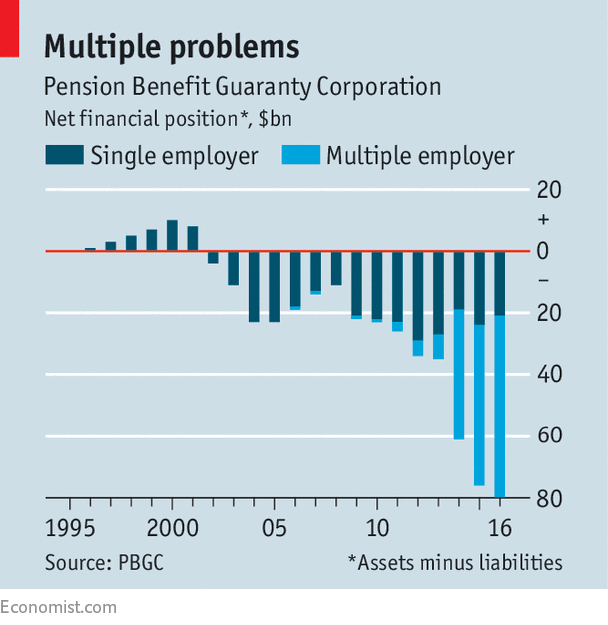
The PBGC levies premiums on defined-benefit pension plans in order to bail out those that fail (up to a maximum payout per worker). On current trends, one of its insurance schemes will probably run dry by 2025. The problem is so-called “multi-employer” funds (see chart). These involve multiple firms, usually under an agreement with an industry-wide union. They cover about 10m Americans, roughly 1m of whom are in a plan that admits it is probably broke. The biggest struggler is the Central States fund, which covers about 400,000…Continue reading
Eastern Bank: a 199-year-old lender becomes a tech pioneer

LIKE other local bankers, Bob Rivers is counting the cost of red tape. At the end of 2015 and 2016 Eastern Bank, a Boston lender of which he is the chief executive, held its balance-sheet below $10bn by briefly parking some deposits elsewhere. Now Eastern—America’s oldest and largest mutual bank, founded in 1818—has crossed the threshold. It will thus become subject to a limit on the debit-card fees retailers pay to bigger banks, and lose $9m of revenue, Mr Rivers says. Other rules will also kick in, costing $6m. The $15m total is one-sixth of Eastern’s pre-tax earnings.
At least, unlike America’s many much smaller lenders, Eastern has the wherewithal to tackle another costly burden: information technology. It is just small enough to be called a “community bank”, but also just big enough to invest in IT. Being a mutual is essential too, Mr Rivers says: he does not have to answer to shareholders about quarterly profits.
In 2014 Eastern set up an…Continue reading
Goldman Sachs is criticised for buying Venezuelan bonds

BONDS are bought and sold every second of every day without attracting attention. But it is not often that the seller is the central bank of a brutal, cash-strapped regime faced with protests; the buyer, a bulge-bracket American investment bank; and the size of the deal in the billions of dollars. A report in the Wall Street Journal on May 28th that Goldman Sachs had bought bonds with a face value of $2.8bn issued by Venezuela’s state-owned oil company, PDVSA, for 31 cents on the dollar (ie, for $865m) caused a stink.
Julio Borges, an opposition politician and president of the National Assembly, lambasted Goldman on May 29th in an open letter to its chief executive, Lloyd Blankfein, for its decision to “aid and abet Venezuela’s dictatorial regime”. For all its sins, that regime has met its obligations to bondholders. Mr Borges vowed to advise future Venezuelan governments not to repay the bonds in question. Protesters gathered outside Goldman’s…Continue reading