
Tag: Approved
The battle for territory in digital cartography

IN THE 1940s Jorge Luis Borges, an Argentine writer, wrote a short story about mapping. It imagines an empire which surveys itself in such exhaustive detail that when unfolded, the perfectly complete 1:1 paper map covers the entire kingdom. Because it is unwieldy and thus largely useless, subsequent generations allow it to decay into tatters. Great scraps are left carpeting the deserts.
In their capacity for up-to-the-minute detail, modern maps surpass even Borges’s creation. By using networks of sensors, computing power and data-crunching expertise, digital cartographers can produce what are in effect real-time simulations of the physical world, on which both humans and machines can base decisions. These maps show where roadworks are blocking traffic or which street corners are the most polluted. Innovative products will make new demands of them. Drones need to know how to fly through cities; an augmented-reality game might need to know the exact position in London of Nelson’s…Continue reading
A state bail-out of Monte dei Paschi draws near

HELP is at hand for the world’s oldest bank. On June 1st the European Commission said it had agreed in principle to a bail-out by the Italian government of Monte dei Paschi di Siena, founded in 1472. For years Monte dei Paschi, Italy’s fourth-biggest bank by assets, has lurched from crisis to crisis. Last July it flunked a test by European supervisors of its capital strength. In December a private-sector restructuring scheme came to naught and the state decided to step in.
The details, including the size of the bail-out, have yet to be hammered out. In December the European Central Bank (ECB) estimated that Monte dei Paschi would need €8.8bn ($9.2bn) in capital to withstand the “adverse scenario” in last summer’s test. The Bank of Italy reckoned that the state’s share would be €6.6bn.
That included €2bn to compensate retail investors in the bank’s junior bonds, many of them ordinary customers….Continue reading
Bangladesh worries about falling remittances
IT IS a mystery. Last year Bangladesh’s army of migrant workers abroad increased by a record 750,000, to reach 8m-odd. They travel to earn money for their families. Yet the statistics suggest they are sending less money home. In the fiscal year that ends this month, recorded remittances will have fallen for the second consecutive year, this time by more than 10%, to $12bn (see chart). To explain the puzzle, look to the places they work, to technology and to the growing popularity of a fiddle used by Bangladeshi importers.
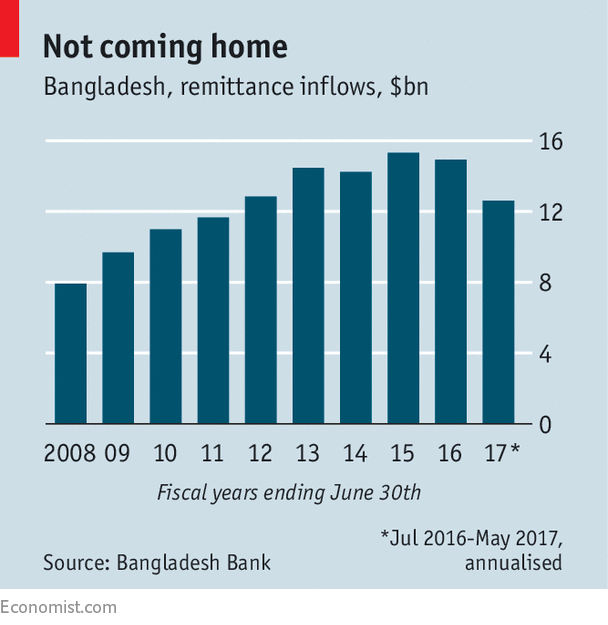
The abrupt cancellation last November by the Indian government of most banknotes by value was one factor: monthly inflows crashed, as the millions of Bangladeshis working in India were strapped for cash. In the Gulf, the source of 60% of Bangladesh’s remittances, the economy has been relatively sluggish.
But even without these shocks, remittances were falling—and fewer were being counted. Bangladesh is not unique in suffering such a downturn: for the first…Continue reading
America’s number two ride-hailing firm

ONE firm’s bad news is often another’s good fortune. For years Lyft, an app that offers on-demand rides, was outdone by its seemingly unstoppable rival, Uber, which zoomed into new markets and grabbed a near-$70bn valuation, the largest of any private American tech firm in history. Uber does not report a share price that would register its recent troubles, which include one investigation into alleged intellectual-property theft and another into its workplace culture. But that Lyft’s market share in America has risen from 18% five months ago to 25% now (according to TXN Solutions, a data provider) is a gauge of the larger firm’s crisis.
Lyft is far from a typical Silicon Valley company. Unlike Uber, it does not lust for world domination and it operates only in America. Nor does it take itself especially seriously. For years it identified its drivers by pink, fuzzy moustaches fastened to the front of cars, and encouraged riders to fist-bump their drivers and sit in the front seat…Continue reading
A wind pioneer is sceptical about batteries

ONE of Ignacio Galán’s early jobs as an engineer was to design lead-acid batteries for the milk floats that used to trundle around Britain’s streets. So the 66-year-old Spaniard, who heads Iberdrola, one of the world’s largest utilities, claims he has been thinking about the storage of electricity for his whole career. That is useful, because for the second time since he took over Iberdrola in 2001, the industry faces a fork in the road. This time round, the big debate in energy is about batteries and storage.
The first time, Mr Galán blazed the right trail. He made a prescient bet on renewable energy, turning Iberdrola into one of the world’s biggest providers of onshore wind while at the same time underpinning returns with relatively safe, regulated electricity networks in America (Avangrid) and Britain (ScottishPower). Some European peers, such as Germany’s E.ON and RWE, took the opposite approach, prioritising…Continue reading
Chinese companies’ weak record on foreign deals

CONSIDERING the size of China’s economy, it seems inevitable that its firms will eventually play a huge role on the world stage. Yet China Inc’s adventures abroad in the past 15 years have been a mixed bag. Thousands of small deals have taken place, some of which will succeed. But of the mergers and acquisitions that have been worth $1bn or more, it is a different story. There have been 56 abandoned deals, 39 state-backed acquisitions of commodities firms at frothy prices, and, lately, wild sprees by tycoons scooping up trophies such as hotels and football clubs.
Some deals defy any conventional logic. Last month HNA, an airlines-and-tourism conglomerate from Hainan, said it had bought a 10% stake in Deutsche Bank, having earlier considered buying a Landesbank. The Chinese firm, which runs a beach-volleyball tournament in Beijing, appears to think it can consolidate Germany’s fragmented banking industry—the financial equivalent of bringing peace to the Middle East. If China Inc is…Continue reading
How sham food became big business in Japan

GUESTS to the factory of Tsuyoshi Iwasaki are presented with a rasher of bacon. The succulent marbled sliver is branded with his name, title and e-mail address—an apt introduction to the owner of Japan’s biggest manufacturer of replica food. At the headquarters of Iwasaki Co on the outskirts of Tokyo, racks of golden-brown gyoza jostle for attention with boat-shaped dishes of lustrous raw tuna, bowls of creamy ramen and a dozen pinkish scallops in iridescent shells. The acrid smell of resin and paints is the only hint that everything on show is utterly tasteless.
Most of these Japanese sampuru, from the word “sample”, will go on display in restaurant windows, from fast-food outlets to izakaya (bars), throughout the east of the country, in the hope of luring hungry customers. A sister company, managed by Mr Iwasaki’s brother, covers the western half of Japan. Together they make over ¥5bn ($46m) in annual…Continue reading
How retailers are watching shoppers’ emotions

FOR eight months up to this April, a French bookstore chain had video in a Paris shop fed to software that scrutinises shoppers’ movements and facial expressions for surprise, dissatisfaction, confusion or hesitation. When a shopper walked to the end of an aisle only to return with a frown to a bookshelf, the software discreetly messaged clerks, who went to help. Sales rose by a tenth.
The bookseller wants to keep its name quiet for now. Other French clients of the Paris startup behind the technology, Angus.ai, are testing it in research shops that are not open to the public. They include Aéroports de Paris, an airport owner; LVMH, a luxury conglomerate; and Carrefour, a chain of hypermarkets. In a test at a Mothercare shop in Tallinn, Estonia, software from Realeyes, an emotion-detection firm based in London, showed that shoppers who entered smiling spent a third more than others.
Simple video yields a lot of insight. But…Continue reading
To err is human; so is the failure to admit it

A NEWSPAPER cannot publish for 174 years without some mistakes. This one has made its share. We thought Britain was safe in the European exchange-rate mechanism just weeks before it crashed out; we opined, in 1997, that Indonesia was well placed to avoid financial crisis; we noted in 1999 that oil, at $10 per barrel, might well reach $5, almost perfectly timing the bottom of the market; and in 2003 we supported the invasion of Iraq. For individuals, like publications, errors are painful—particularly now, when the digital evidence of failure is both accessible and indelible. But they are also inevitable. The trick, then, is to err well: to recognise mistakes and learn from them. Worryingly, humanity may be getting worse at owning up to its goofs.
Few enjoy the feeling of being caught out in an error. But real trouble starts when the desire to avoid a reckoning leads to a refusal to grapple with contrary evidence. Economists often assume that people are rational. Faced with a new fact,…Continue reading
Why government-bond yields have been falling again
EVERY year it seems that analysts and investors play a ritual game. They begin by asserting that government bonds are terrible value and that, accordingly, this must be the year when yields will rise (and prices fall). And then they get mugged by reality.
The same pattern seems to be playing out in 2017. Back in December, a poll of fund managers by Bank of America Merrill Lynch (BAML) found that pessimists on global bonds outnumbered optimists by 58 percentage points. Investors believed in a “reflation trade”, with tax cuts from Donald Trump’s administration leading to faster American growth, to which the Federal Reserve would respond with higher interest rates.
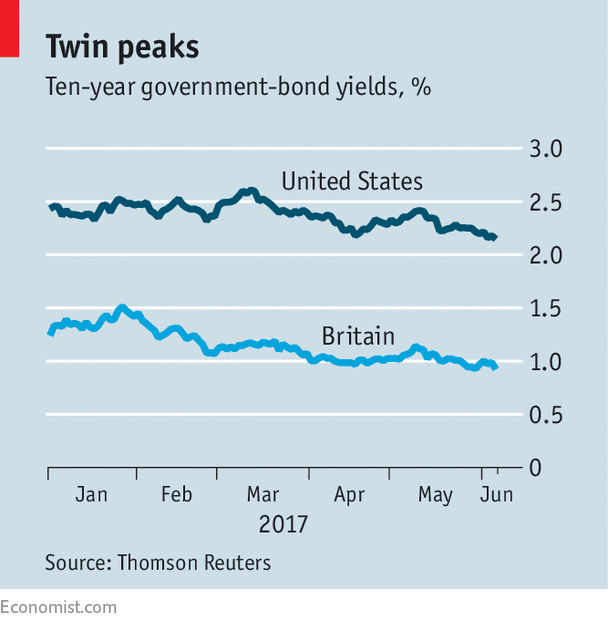
For a while, such forecasts seemed to be on the money. The yield on the ten-year Treasury bond picked up to 2.63% by March 13th (see chart). But since then the trend has changed. The Treasury-bond yield recorded a low for the year of 2.13% on June 6th. In Britain the yield on the ten-year gilt dipped below 1% on June 6th…Continue reading