
Tag: Approved
Death pools can bring financial security for the long-lived

WHEN members of a private club in Manhattan suddenly start dropping dead at an alarming rate, Matt Scudder, a private detective, suspects more might be at play than bad luck to explain the bizarre series of suicides and violent accidents. If this sounds like the back-flap of a murder mystery, your deduction skills are as sharp as Mr Scudder’s. In Lawrence Block’s “A Long Line of Dead Men,” the cunning detective eventually uncovers the motive for the killing spree: the club of 31 men were all part of a tontine.
These ancient financial instruments are built on members paying money into a pool, which is invested and then pays out dividends once they reach a pre-agreed age. Those who live longest will see their income increase as others die; the last one standing receives the most. They are essentially a form of insurance against an unexpectedly long life.
Although most people will know them from the works of Agatha…Continue reading
Getting the most out of business taxes
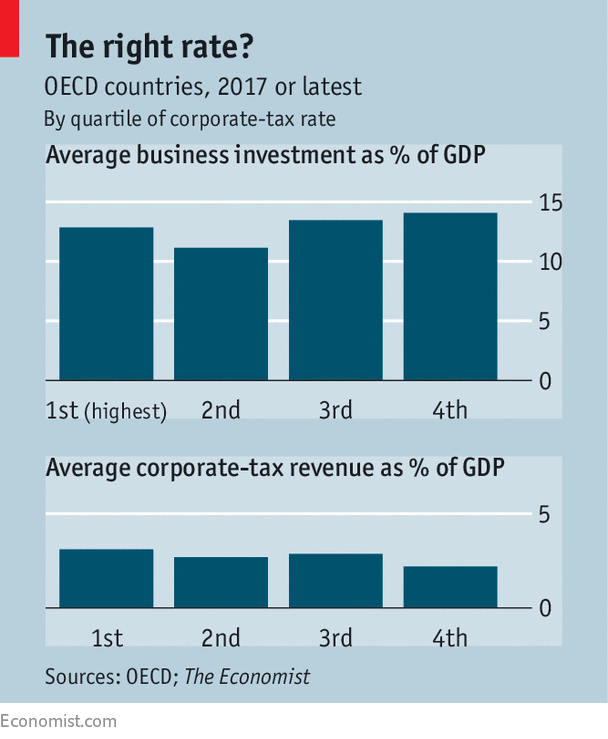
ONE of the hottest debates in economic policy at the moment is how to ensure companies are paying the optimal amount of tax. On the right, politicians think that a lower corporate-tax rate will lead to more business investment and thus faster economic growth. Hence the initial stockmarket enthusiasm after President Donald Trump was elected on a platform that included cuts in business taxes. On the left, the belief is that business is not paying its “fair share” of tax and that it can be further squeezed to pay for spending commitments. Hence the promise of the Labour Party in Britain’s recent election campaign to push the corporate-tax rate up to 26% (from 19%).
How do these theories translate into practice? To find out the effect on business investment, The Economist took the corporate-tax rates in OECD countries and divided them into quartiles from highest (1st) to lowest. Then we calculated the five-year average in each quartile for gross…Continue reading
The EU wants to supervise London clearing-houses after Brexit
THE Brexit devils will be in the details. That much is clear from the European Commission’s latest plans for euro-denominated clearing, a crucial bit of financial plumbing. Clearing-houses sit in the middle of a securities or derivatives transaction, and make sure that deals are honoured even if one side defaults. Clearing has become a much bigger business in the wake of the financial crisis, after which the G20 group of large economies mandated that over-the-counter derivatives should be cleared: 62% of a notional $544trn global market is now settled in this way.
London houses have an outsize role, clearing 97% of dollar interest-rate swaps and 75% of those in euros. Britain’s largest clearing-house, LCH, owned by the London Stock Exchange, alone clears over 50% of interest-rate swaps across all currencies. This has long had EU regulators worried about systemic-risk implications, and led them to consider their post-Brexit options. On June 13th the commission proposed a law that would set up a new system of direct supervision for clearing-houses that handle transactions in euros or other EU currencies, but are located outside the EU, as those in London will be.
Under this proposal, the European Securities and Markets Authority (ESMA), a regulator, would have direct oversight over non-EU clearing-houses deemed systemically important. Such oversight…Continue reading
The Treasury publishes proposals to cut red tape

TEN days after he became America’s 45th president in January, Donald Trump vowed to “do a big number on Dodd-Frank”, the elephantine law that recast financial regulation after the crisis of 2007-08. Soon after, he asked his treasury secretary, Steven Mnuchin, to measure all America’s rules (not just Dodd-Frank) against seven broad principles, including the prevention of bail-outs by the taxpayer and making regulation more efficient.
On June 12th Mr Mnuchin gave the first part of his answer, in a 147-page report on banks. Later instalments will cover capital markets, insurance and asset management, and non-bank institutions and financial technology. Banks of all sizes will be cheered by its proposals to ease regulation, make “stress tests” of their resilience less onerous and tame the Consumer Financial Protection Bureau (CFPB), a watchdog born of the Dodd-Frank act. To allay the confusion caused by America’s many regulators, Mr Mnuchin wants to give co-ordinating power to the…Continue reading
How Chinese overcapacity hits American workers

ALUMINIUM smelting is sweaty work. Inside the Hawesville plant of Century, an American aluminium producer, it can get so hot that the workers lie outside in the blazing summer sun to cool off. Dennis Harbath, the plant manager, oversees operations. He is worried about the workers. “They have mental fatigue,” he says.
The source of the stress is a number scrawled on a wall in white chalk. That is the dollar price of a tonne of aluminium, set on the London Metal Exchange (LME). The workers keep track of it on their smartphones. Their wives ask about it, too. “It’s hard to stay on the LME rollercoaster when trying to support a family,” says one.
A few years ago, they weren’t particularly aware of the price, says Andy Meserve, the local union president. That changed after 2015, when the price plunged to below $1,500 per tonne, prompting Century to shut down 60% of the plant’s capacity and lay off hundreds of…Continue reading
What history says about inequality and technology

ONE factor behind the rise of income inequality in America over the past four decades is that the labour market has increasingly favoured the well-educated. Real wages for college graduates have risen by over a third since 1963, whereas wages for those without high-school diplomas have dropped. As more of the economy becomes automated, doomsayers worry that the gap between the haves and the have-nots will only grow. History shows, however, that this need not be so.
The recent rise in earnings for skilled workers is a rare historical phenomenon. Compiling records from churches, monasteries, colleges, guilds and governments, Gregory Clark, an economist at the University of California, Davis, has put together a comprehensive dataset of English wages that stretches back to the 13th century. Mr Clark notes that in the past the skilled-wage premium, defined as the difference in wages between craftsmen, such as carpenters and masons, and unskilled labourers has been fairly stable, save for two sharp…Continue reading
The IMF is back in Africa
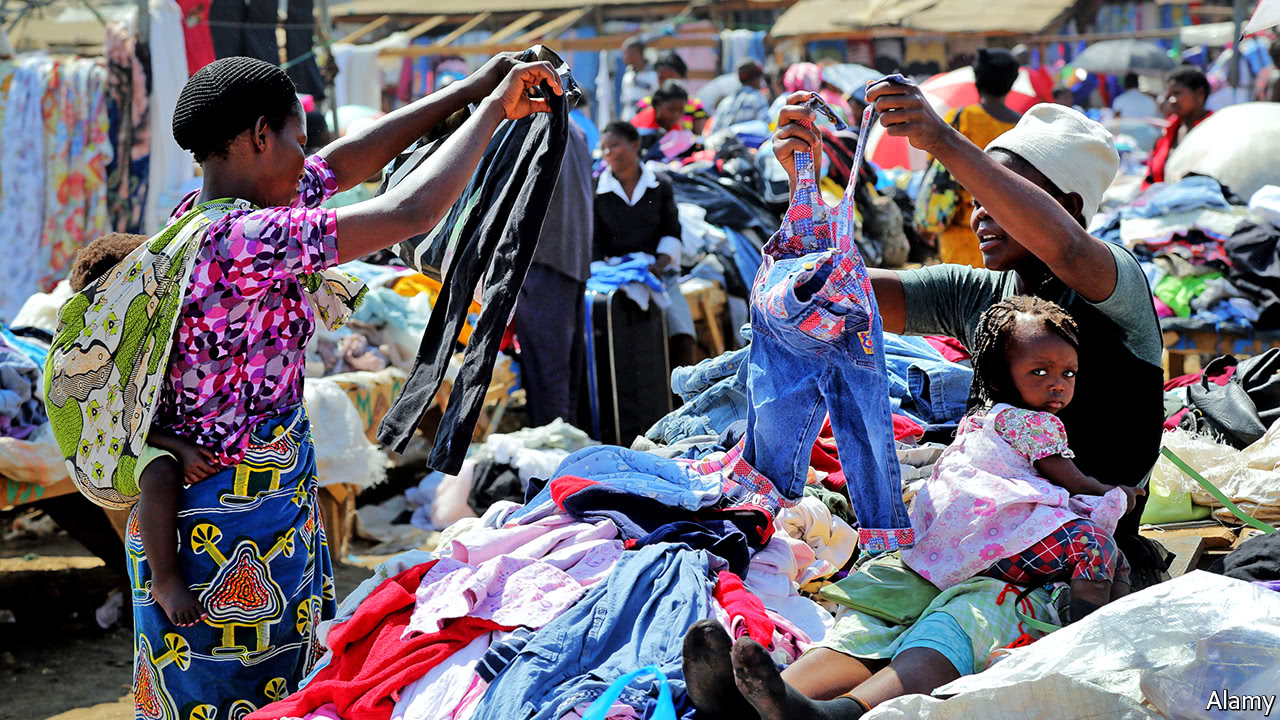
ZAMBIANS have good reason to distrust the IMF. In the 1990s, under the fund’s guidance, their government cut spending, scrapped subsidies, liberalised the exchange rate and privatised over 200 state-run firms. This “structural adjustment” was painful: employment shrivelled and, by the end of the decade, income per person had shrunk by 8%. In the words of Binwell Sinyangwe, a novelist, “they were the years of money first or else no friendship”.
So it was with some trepidation that Zambia welcomed an IMF mission, which concluded on June 10th. As in the 1990s, Zambia has been hit by plummeting prices for copper, its main export. The proposed package, which is likely to be finalised over the coming months, could be worth $1.3bn, which would be the country’s biggest with the fund in two decades.
The retro feel extends across Africa, where GDP grew last year by 1.4%, the slowest rate this century. Ghana agreed on a…Continue reading
General Electric picks a new boss

JEFF IMMELT looks like he was born to be a chief executive. Tall, affable and energetic, he was selected to run General Electric (GE) in 2001 after an interminable and mildly sadistic selection process run by GE’s then CEO Jack Welch, at the time America’s most celebrated boss. After 16 years at the top, on June 12th Mr Immelt said he would retire, to be replaced by John Flannery, who runs the firm’s health-care arm. The departing boss has reshaped GE radically but his legacy as the boss of the world’s most important industrial company is a mixed one.
Part of that reflects what he inherited. GE was not in nearly as good shape as Mr Welch liked to pretend. Its share price was significantly overvalued, pumped up by hype about Mr Welch’s talents, while its profits were inflated by gains from its pension scheme and its financial arm,…Continue reading
Big business sees the promise of clean energy

PITY America’s big businesses. For years their efforts to reduce their carbon footprint were dismissed by environmentalists as “greenwashing”. Now, after months trying to persuade a supposedly pro-business new president, Donald Trump, of the merits of staying in the Paris climate accord, he practically laughed in their faces by withdrawing on June 1st.
Executives fear the exit will do no good to America’s—and by implication their—reputation. Not for nothing have more than 900 American firms and investors, including Amazon, Twitter, Target and Nike, put their names this week to a “We are still in” open letter to the UN. Its signatories pledge to help reduce the country’s carbon emissions by 26% by 2025, in keeping with America’s Paris pledge. That may be quixotic but is a rallying cry nonetheless.
Indeed, some American firms are taking climate change so seriously that they are surprising even former critics. Alongside energy-efficiency measures, the…Continue reading
Banco Popular fails and is bought by Santander

EVEN a bank failure can be presented as a triumph. This week Banco Popular, a big Spanish lender, endured a run. Depositors were said to be withdrawing €2bn ($2.2bn) a day. The bank lost half its stockmarket value in four days, as a self-imposed deadline to find a saviour loomed. On June 6th, it was declared by the Single Resolution Board (SRB), an independent agency of the European Central Bank formed in 2015 and charged with winding down banks, to be “failing or likely to fail”. The next morning, Santander, Spain’s biggest bank, announced its purchase for the symbolic sum of €1 ($1.10). It is to raise €7bn in capital to help absorb Popular’s property-related losses.
Spain’s government, the European Commission and Santander all cheered the outcome as a model European response to a bank crisis. Shareholders and junior bondholders in Popular have been wiped out. Spanish ministers pointed out that taxpayers would not have to pay for a rescue of the sort arranged for Bankia, a giant savings bank nearing collapse, when…Continue reading