
Tag: Approved
Investors in aircraft should get set for turbulence

AIR shows are where the aerospace business shows off. At this year’s Paris show, the world’s largest, which opened at Le Bourget airport on June 19th, the military types are most ostentatious. Aeronautical party tricks include helicopters that ascend into the sky tail-first and stealth fighters that fly backwards.
But no one is keener to strut their stuff than Airbus and Boeing, the world’s two biggest makers of airliners. At the 2015 show the pair sold 752 planes worth around $107bn. But the party atmosphere at that event—with copious food and wine laid on for customers and journalists alike—has given way this year to a more sober mood, weaker sales and a bring-your-own-lunch policy. This should give pause to investors in one of the world’s fastest-growing asset classes: aircraft.
Airbus and Boeing still booked plenty of orders. But for the first time, most came from lessors, which lease them to operators, rather than from the airlines that use them….Continue reading
A trendy Asian lifestyle chain opens in North Korea

WHEN Miniso said in January that its stores would “bring the happiness of stress-free shopping to the Koreans”, you would be forgiven for thinking they were referring to emporium-loving Seoulites. In fact, the home-goods store, co-founded by a Chinese entrepreneur and a Japanese designer, was announcing that it would be taking its capitalist trinkets into (ostensibly socialist) North Korea. In a joint-venture deal with one of the country’s state-owned enterprises, it agreed to establish the first foreign-branded chain store in Pyongyang, the destitute country’s showcase capital.
The first Miniso store opened there in April, eight months after its first shop in South Korea began operating, and just before it launched in America. Its arrival is remarkable in a place where displays of branding are rare (the exception is a handful of billboards advertising a local car firm, Pyeonghwa Motors).
Miniso’s coup in the secretive…Continue reading
Hong Kong’s stock exchange proposes a controversial reform
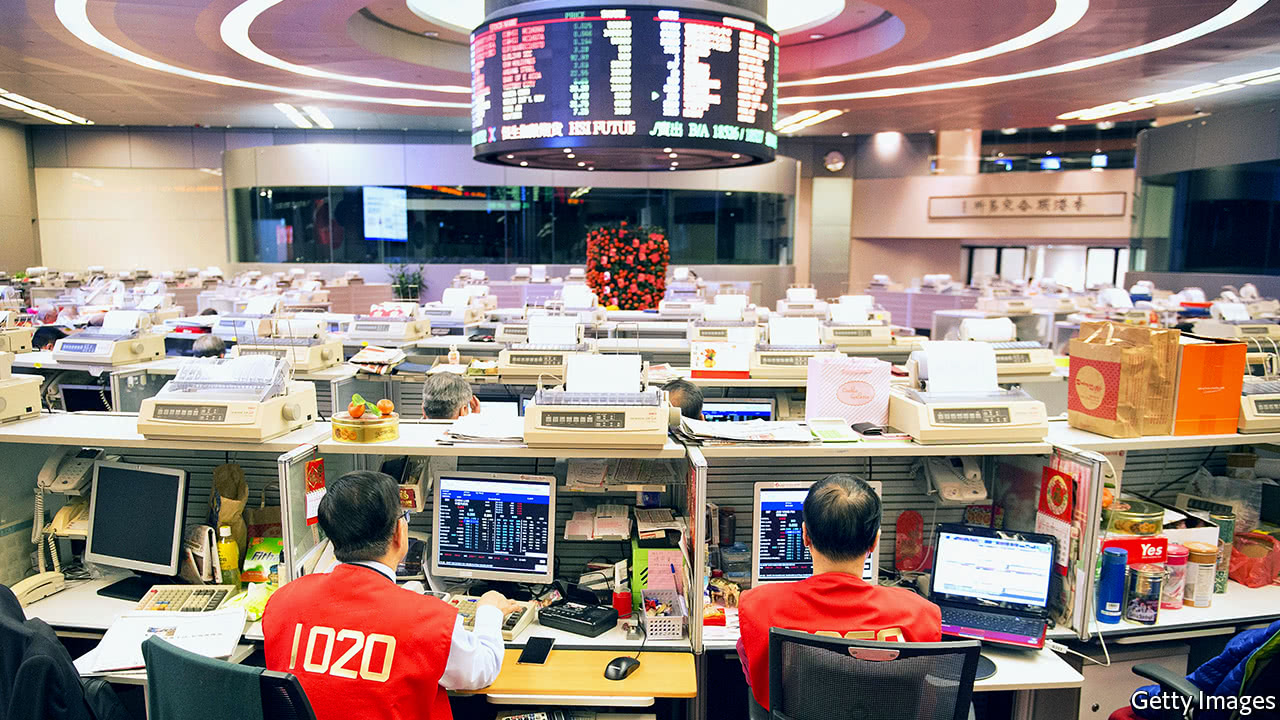
BOSSES at Hong Kong Exchanges and Clearing (HKEX) ought to be feeling smug. In five of the past eight years it has been the world’s leading exchange for initial public offerings (IPOs). Chinese companies have swarmed to list on its comparatively mature, open and transparent capital market, generating over 90% of the funds raised there in the past five years. Yet, launching a long-awaited consultation on reforms on June 16th, HKEX warned of “stagnation” if it does not change. It has one eye on its regional rivals. Last year Singapore knocked it into fourth place in a prominent ranking of financial centres. As Shenzhen and Shanghai, where trading volumes dwarf Hong Kong’s, open up, they could eat Hong Kong’s lunch.
Besides tinkering with the rules on Hong Kong’s main board and its second one, the Growth Enterprise Market, the proposed changes include, most contentiously, a third board. This would be designed to attract fizzy “new…Continue reading
A hybrid startup offers AI services to business

BOSSES are more likely to groan than feel giddy about advances in artificial intelligence (AI). They need a strategy, but few companies can hope to own a unit like Google’s DeepMind, whose algorithms not only beat the world’s best Go players but made a 40% improvement in the energy efficiency of its parent’s data centres. A Canadian startup, Element AI, wants to let all businesses tap into the world’s best AI minds.
The brain behind the new firm is Yoshua Bengio, a pioneer in “deep learning”, a branch of AI. As firms such as Google and Facebook lured dozens of AI academics, some in the field expressed fears about a brain drain from academia. In 2015, for example, Uber, a ride-hailing startup, poached 40 researchers from Carnegie Mellon University. Mr Bengio meanwhile stayed at the University of Montreal (though in January he became an adviser to Microsoft).
Element AI will let researchers stay in their university…Continue reading
Barclays and four former executives are charged with fraud

IN 2008, as banks cracked on both sides of the Atlantic, Britain’s government prepared to shore up tottering lenders. It eventually poured £45bn ($71bn) into the Royal Bank of Scotland (RBS) and £20.3bn into Lloyds, which ministers coaxed into buying the stricken HBOS. Barclays, however, needed no such help: the bank raised enough equity from private investors, notably in Qatar, to meet higher capital targets set by regulators as the crisis deepened, and thus escape a taxpayer rescue.
However, for five years Britain’s Serious Fraud Office (SFO) has been investigating Barclays’ dealings with the Qataris. On June 20th those inquiries yielded criminal charges. These include (remarkably, some will say) the first such charges to be levelled at the head of a big international bank as a result of the crisis. John Varley is a pillar of London’s financial establishment. Save for one short break he spent 28 years at Barclays, more than six in the top job, before standing down…Continue reading
China enters the big leagues of global markets
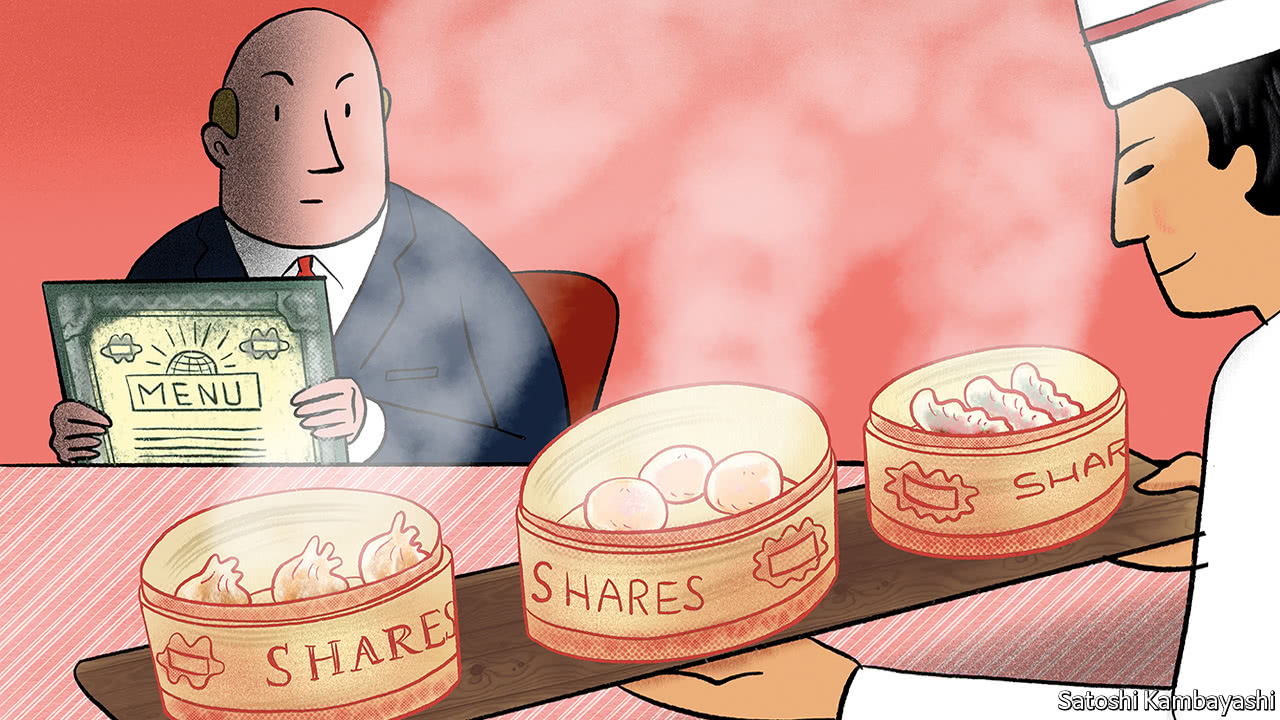
FROM shoes to shirts and phones to fridges, made-in-China goods have blanketed the globe over the past three decades, entering every country and just about every home. But one kind of Chinese good few abroad dare touch: its financial assets. Outsiders own less than 2% of its shares and bonds, far below the levels of foreign ownership seen in other markets. Capital barriers and financial risks have put investors off. This, however, is changing. The globalisation of China’s capital markets is slowly gathering steam, as symbolised by the inclusion of Chinese stocks and bonds in global indices.
MSCI, a company that designs stockmarket indices, announced on June 20th that it will bring Chinese equities into two of its benchmarks: one that covers emerging markets; and another that follows stocks around the world. To begin, it will include a small number of shares, just 222 of the more than 3,000 listed in China. But its decision matters to asset managers who track their performance against…Continue reading
India’s huge buffalo-meat industry is in limbo
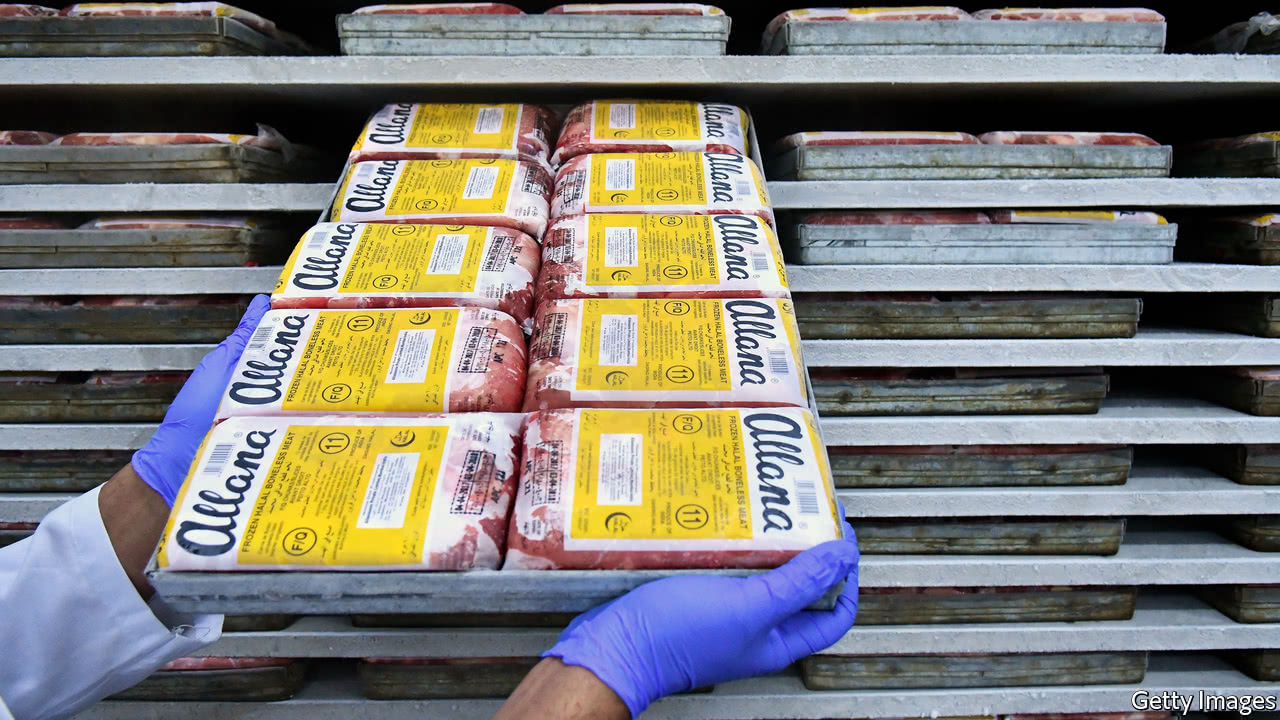
IN A corner of the state of Uttar Pradesh (UP) stands a gleaming building dedicated to animal slaughter on an industrial scale. Neatly mown lawns lead the way to a corral for hundreds of the curly-horned Murrah buffalo typical of the region. Nearby is a lorry-sized, stainless-steel machine in which the animals are killed. A Muslim cleric stands ready to oversee the incantation that ensures each carcass will be halal. Upstairs a microbiology lab monitors the progress of each beast through stages of chilling, deboning and deglanding. Each pile of disaggregated buffalo is then frozen solid and put into a loading chamber.
Such facilities are common in UP, although they do not advertise their whereabouts for fear of antagonising “cow vigilantes”, Hindu militants who harass and extort in the name of protecting cows, which a majority of Indians hold to be sacred. India earns around $4bn a year from exporting beef, and last year was the world’s biggest exporter of the product….Continue reading
Finland tests an unconditional basic income

JUHA JARVINEN, an unemployed young father in a village near Jurva, western Finland, brims with ideas for earning a living. “I’m an artist and entrepreneur. Sometimes I’m too active, I don’t have time to stop,” he says. He just agreed to paint the roofs of two neighbours’ houses. His old business, making decorative window frames, went bust a few years ago. Having paid off debts, he recently registered another, to produce videos for clients.
Mr Jarvinen says that for six years he had wanted to start a new business but it had proved impossible. The family got by on his wife’s wages as a nurse, plus unemployment and child benefits. Mr Jarvinen had a few job offers in the main local industries—forestry, furniture-making and metalwork. But taking on anything short of a permanent, well-paid post made no sense, since it would jeopardise his (generous) welfare payments. To re-enroll for benefits later, if needed, would be painfully slow. “It is crazy, so no one will…Continue reading
Finland tests a new form of welfare

JUHA JARVINEN, an unemployed young father in a village near Jurva, in western Finland, brims with ideas for earning a living. He has just agreed to paint the roofs of two neighbours’ houses. His old business, making decorative window frames, went bust a few years ago. Having paid off debts, he recently registered another, to produce videos for clients.
Mr Jarvinen says that for six years he hoped to start a new business but it was impossible. The family got by on his wife’s wages as a nurse, plus unemployment and child benefits. He had a few job offers from local businesses, which are mainly in forestry, furniture and metalwork. But anything less than a permanent, well-paid post made no sense, since it would jeopardise his welfare payments. To re-enroll for benefits later would be painfully slow.
Mr Jarvinen’s luck turned in January, when he was picked at random from Finland’s unemployed (10% of the…Continue reading
An industry shudders as Amazon buys Whole Foods for $13.7bn
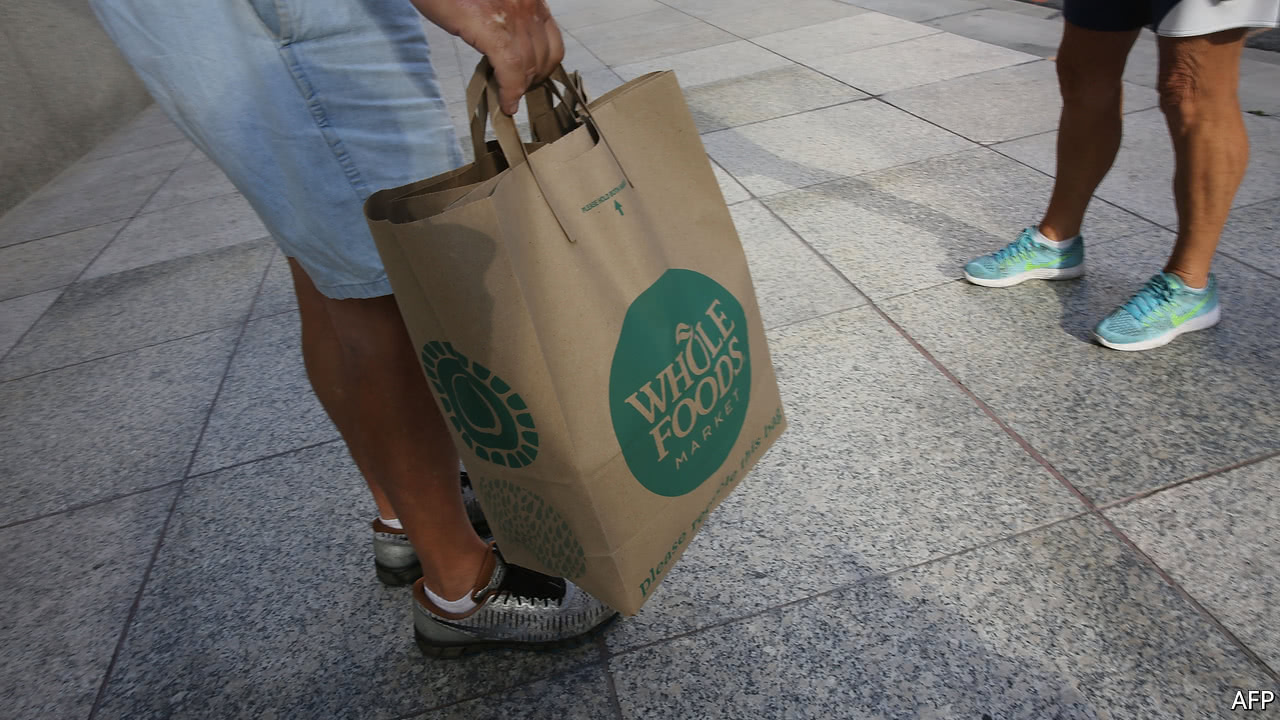
AMAZON announced on June 16th that it would pay $13.7bn to buy Whole Foods, a grocer known for its organic produce. On the face of it, the purchase might not seem to upset the grocery cart, either for Amazon or for the supermarket business. Amazon controls a measly 0.2% of America’s grocery market; Whole Foods has just 1.2%, according to GlobalData, a research firm and consultancy. By Chinese standards, Amazon looks slow: Alibaba, another e-commerce titan, bought a 32% stake in a Chinese grocer last year.
Nor is Whole Foods a juggernaut. It has about 450 stores in America, Britain and Canada, but American shoppers are now buying a wide range of organic foods at other grocers, without having to put up with Whole Foods’s steep prices or its hipster clientele.
Nevertheless, the deal marks a new era for Amazon. It has run a few experiments in physical retail, including bookstores in Chicago and in New York. In Seattle it is testing a small grocer, Amazon Go, where…Continue reading