
Tag: Approved
Developing countries rebel against the credit-rating agencies

EARLIER this year, a crowd of patriotic Indian students bristled when Arvind Subramanian, the government’s chief economic adviser, showed them a slide with two charts. One showed India’s steady economic growth and flat debt-GDP ratio; the other China’s slowing growth and fast-rising debt. Yet India’s credit rating from S&P Global Ratings (formerly Standard and Poor’s), has been stuck at BBB-. China, on the other hand, was upgraded from A+ to AA- in 2010 even as its debt shot up. The slide was pithily titled “Poor Standards”.
Rating government debt is always controversial. And India v China is often a grudge match. But many emerging-market governments agree with Mr Subramanian, who has contrasted the rating agencies’ treatment of India with that of the rich world in the 2008 crisis, when they “closed the stable doors after the horses bolted”.
In frustration, the BRICS grouping—Brazil, Russia, India, China and South Africa—plans to set up an…Continue reading
Pakistan’s old economic vulnerabilities persist
THE IMF, claims Pakistan’s government, is surplus to requirements. Ministers in its business-minded ruling party, the Pakistan Muslim League-Nawaz (PML-N), boast of a record that means the country can pay its own bills. “We will not go back to the IMF programme,” declared Ishaq Dar, the finance minister, in May, almost a year after the completion of Pakistan’s most recent, $6.6bn bail-out. In a country that mistrusts Western assistance and where protesters portray the IMF as a bloodthirsty crocodile, such words have a heady appeal. But they ring hollow.
On June 16th the IMF warned of re-emerging “vulnerabilities” in Pakistan’s economy. It praised GDP growth of above 5% a year, but noted missed fiscal targets and a ballooning current-account deficit. The fund’s own projections a year ago for the fiscal year ending this June underestimated this deficit by about half the final total of $9bn. And based on trends in early April it overestimated the fiscal-year-end foreign-exchange reserves by $3bn.
Independent economists point out that, many times before, collapse has come on the heels of an IMF programme’s conclusion. Sakib Sherani, a former government economist, says that to avoid “egg on its face” for cheerleading Pakistan’s economic recovery just months ago, the IMF is slowly changing its story. By the end of 2018, many predict,…Continue reading
America’s banks pass the Federal Reserve’s tests
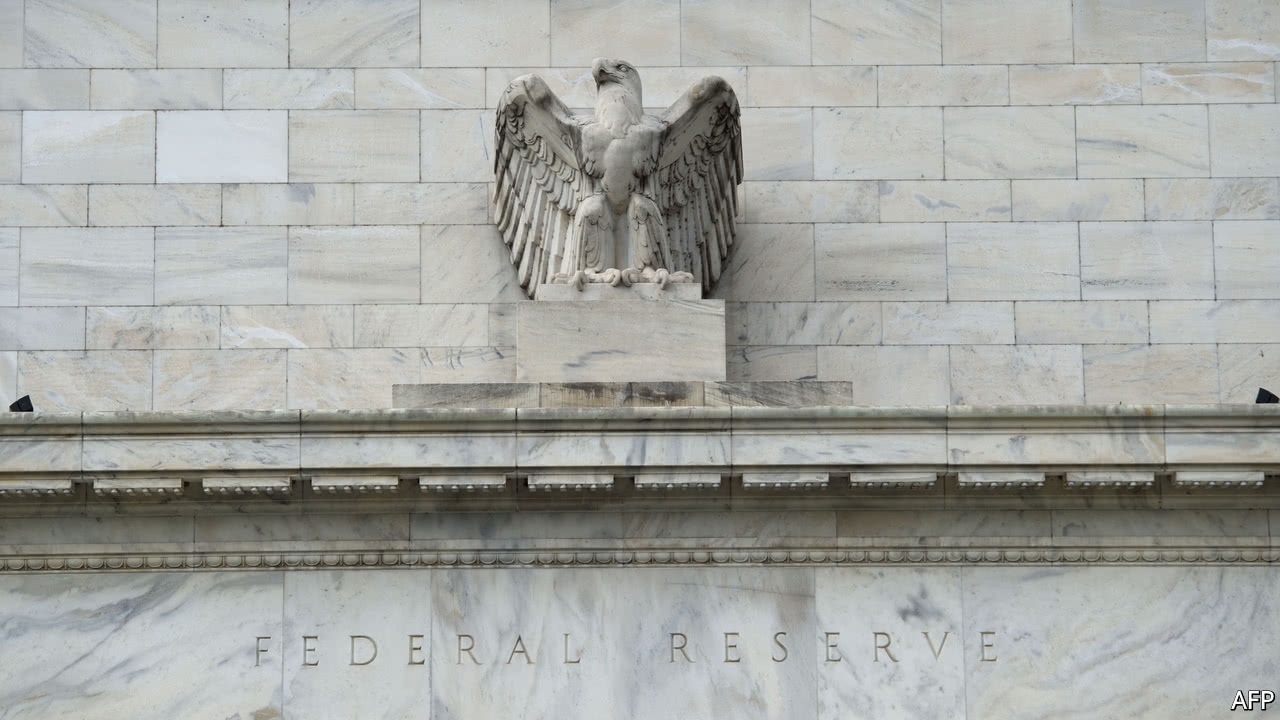
OVER the years, the grumbles have got louder. Since 2011 America’s big banks have undergone annual “stress tests” overseen by the Federal Reserve, along with scrutiny of their plans for paying dividends and buying back shares. A product of the post-crisis Dodd-Frank act, the tests are intended to make sure that lenders have enough equity on hand should catastrophe strike again. But banks say they are both opaque and burdensome. And because failure can mean a block on payouts, the tests have bred caution and ire.
The time for caution seems to be over. On June 28th the Fed said it had approved the dividend and buy-back plans of all 34 banks tested this year—plans which propose handing shareholders a pile of cash. All 34 also passed the first stage, results of which were revealed six days earlier and which assume no repurchases and unchanged dividends. Even under a “severely adverse” scenario involving a nasty recession, all would keep key capital ratios above the…Continue reading
China bulks up in cruise-ship construction
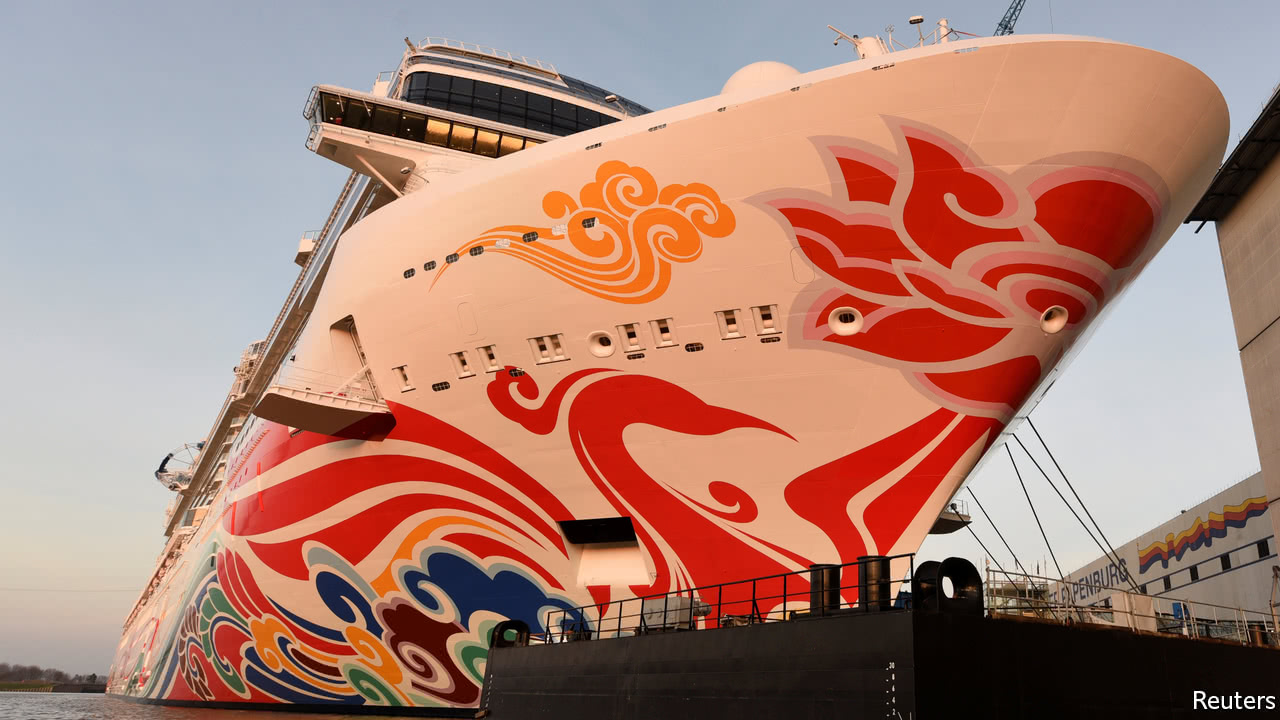
AT FIRST glance the balcony-lined silhouette of the Norwegian Joy, a new cruise ship, looks like any other Western liner moored in Shanghai. But a 333-metre-long Chinese artwork of a phoenix on its topsides signals its distinctive status as the first ship designed especially for China’s expanding cruise market. A pop star, Wang Leehom, christened it on June 27th.
Norwegian Joy was built by Meyer Werft in Germany, in response to a booming Chinese market for cruises. Over the past year the number of Chinese holidaying at sea has more than doubled, to 2.1m, according to the Cruise Lines International Association, a trade group. These numbers are likely to encourage other lines to build ships just for China, instead of using cast-offs from America and Europe. The Norwegian Joy has a much bigger casino than usual, to cater for the Chinese love of gambling. The shops are also twice as large as on Norwegian…Continue reading
Takata’s bankruptcy is a result of familiar failings
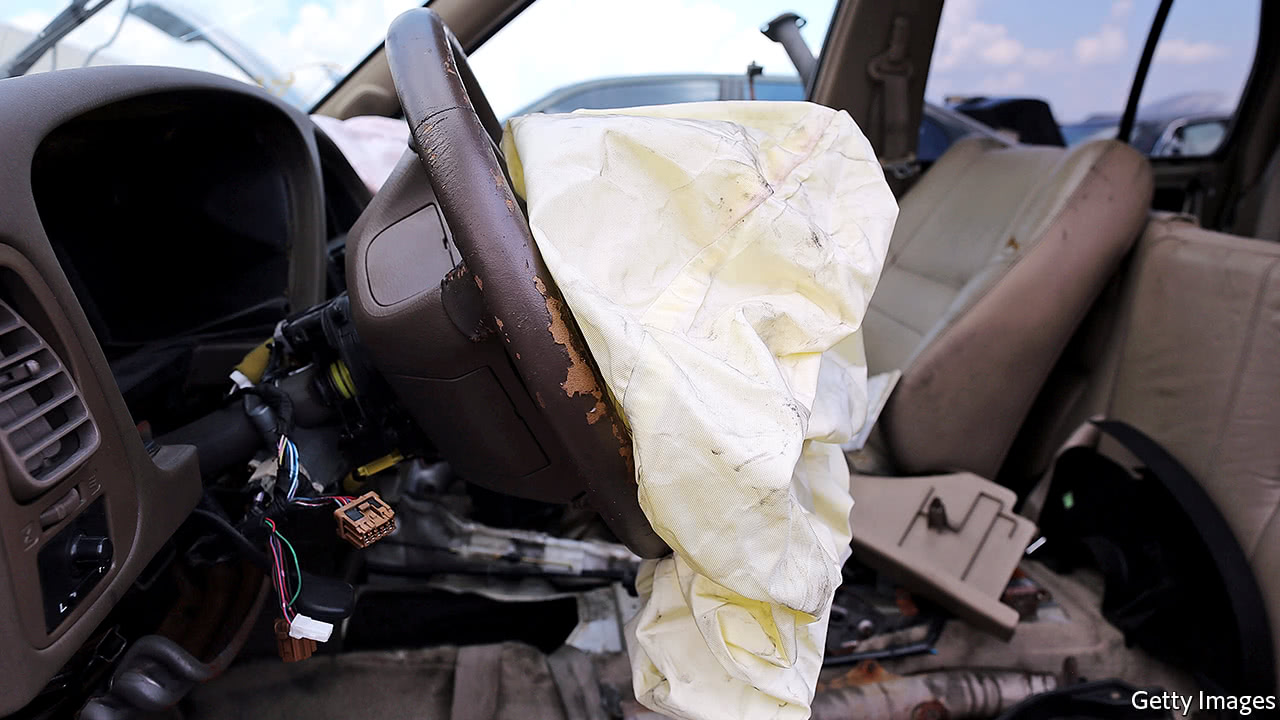
AIRBAGS are meant to make driving safer. But for years, some made by Takata, a Japanese firm, inflated with such vigour that shards of metal and plastic were launched at occupants of vehicles in even minor collisions, causing serious injury and in some cases death. The costs of the biggest-ever recall of vehicles, hauled back to correct the problem, and the associated lawsuits claimed another victim on June 26th. Takata itself filed for bankruptcy in America and Japan, and sold its surviving operations to a competitor, Key Safety Systems (KSS).
It is the latest in a series of self-inflicted wounds by Japanese corporate giants. Takata’s travails come on the heels of other disasters, including insolvency at Sharp, a formerly dominant consumer-electronics firm, and massive losses at Toshiba, a nuclear power and consumer-electronics empire. All suggest a recurring pattern of lack of transparency and leadership.
Takata’s bankruptcy is due to its airbags’ use of chemicals…Continue reading
Alarm grows about over-exuberance in corporate lending
WHEN the financial crisis was at its height in 2008, being a debtor was a dreadful experience. Banks and companies scrambled desperately to get the financing they needed.
But the balance of power in the financial markets can easily shift. In 2005 and 2006, credit had been easy to get on generous terms. Not only were loans cheap and plentiful; they also suffered from fewer restrictions. Until then, corporate loans had many covenants offering safeguards for lenders if the debtor’s financial position were to deteriorate. But 2005-06 saw the emergence of “covenant-lite” loans in which such restrictions were virtually non-existent.
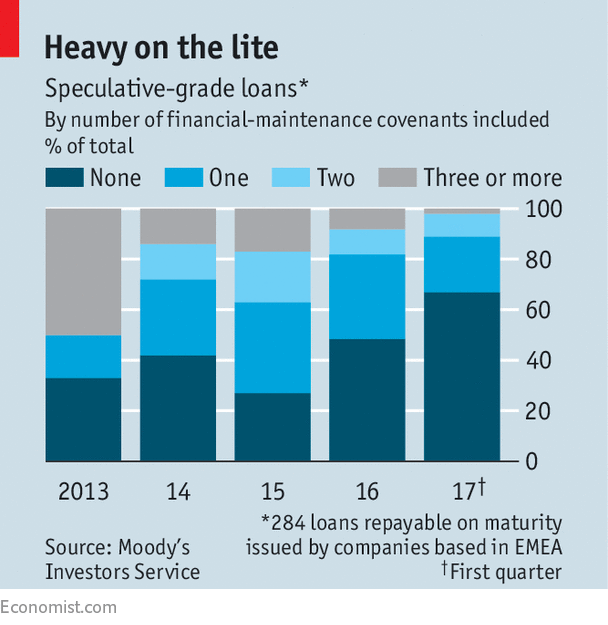
The cycle has turned again. Analysis by Moody’s, a ratings agency, shows that the proportion of the loan market that is “covenant-lite” has risen from 27% in 2015 to more than two-thirds in the first quarter of this year (see chart). Some loans even contain restrictions on the lender, not just the borrower. Private-equity firms demand a veto over…Continue reading
What Asia learned from its financial crisis 20 years ago
MUSEUM SIAM in Bangkok is dedicated to exploring all things Thai. Until July 2nd, that includes an exhibition on the Asian financial crisis, which began on that date 20 years ago, when the Thai baht lost its peg with the dollar. The exhibition features two seesaws, showing how many baht were required to balance one dollar, both before the crisis (25) and after (over 50 at one point). Visitors can also read the testimony of some of the victims, including a high-flying stockbroker who was reduced to selling sandwiches, and a businesswoman whose boss told her to “take care of the work for me” before hanging himself. (In Hong Kong, Japan and South Korea, 10,400 people killed themselves as a result of the crisis, according to subsequent research.) In Thailand the financial calamity became known as the tom yum kung crisis, after the local hot-and-sour soup, presumably because it was such a bitter and searing experience.
The exhibition’s subtitle, “Lessons (Un)learned”, seems unfair. The victims of the crisis (Thailand, South Korea, Malaysia, Indonesia and Hong Kong) took many lessons to heart. With the exception of Hong Kong, they no longer rely on a hard peg to the dollar to anchor inflation, giving their currencies more room to move. (The sandwich vendor’s chosen logo for his new business…Continue reading
The complicated failure of two Italian lenders
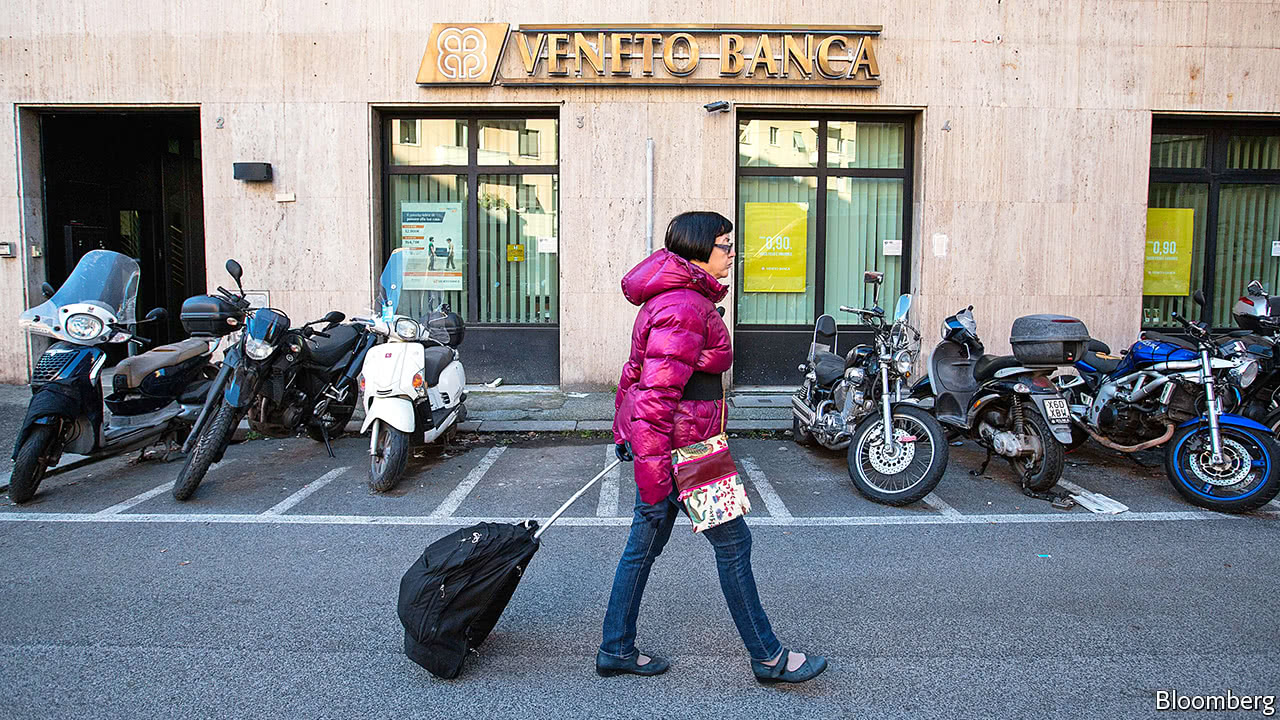
BANKS sicken slowly but die fast. For years Banca Popolare di Vicenza and Veneto Banca, in the prosperous Veneto, in north-east Italy, had been plagued by mismanagement. Even criminal investigations are under way. For months the Italian government had been wrangling with European authorities over the terms of a bail-out. For weeks it had seemed improbable that private investors would put in money alongside the state, as the European Commission insisted.
On June 23rd the European Central Bank (ECB) declared that the banks were “failing or likely to fail”. Two days later, after a frantic weekend, the Italian government pronounced them dead: their good assets were sold to Intesa Sanpaolo, Italy’s second-biggest lender, for a token €1 ($1.14), and their dud ones put into a “bad bank”. The operation may cost Italian taxpayers €17bn. This is the second call on Italy’s public purse this month. On June 1st the commission approved, in principle, the rescue of long-troubled Monte dei…Continue reading
How to Trump-proof your company

TO OUR management team: When I left the White House yesterday, after another two-hour round-table with the president, I knew in my gut that it was time to put in place “plan C” for this great company. The boxer, Mike Tyson, had a point when he said “everyone has a plan until they get punched in the mouth.” But so did Winston Churchill when he observed that “plans are of little importance, but planning is essential.” We owe it to our investors, customers and 131,000 employees globally, to have a reset.
A year ago we were pursuing plan A. We expected that Hillary Clinton would win the election and that American business would continue as it has since the subprime crisis, meaning slow growth and lots of red tape but open borders and record profits that we could return to shareholders as dividends and buy-backs. Together, our firm and fellow members of the S&P 500 index have been paying out $1trn a year, far more than we invest.
After November 8th, we…Continue reading
Kenya launches the world’s first mobile-only sovereign bond
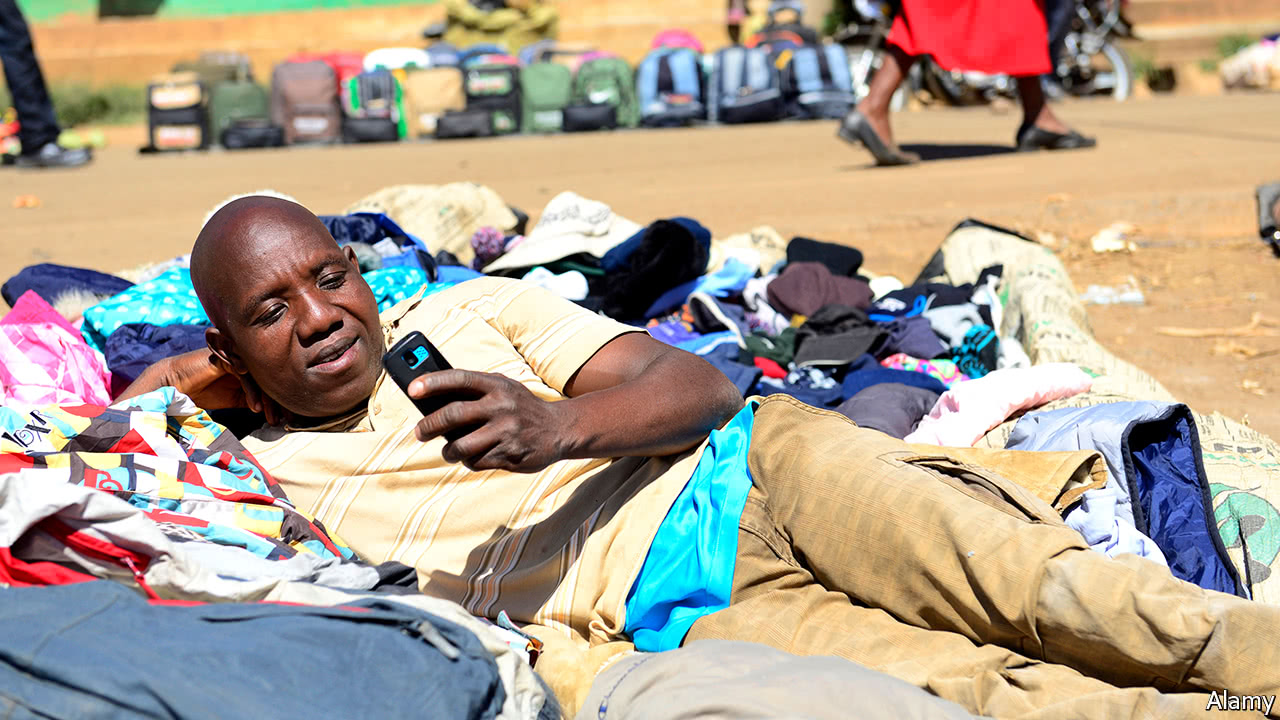
MOBILE money is ubiquitous in Kenya. Someone tapping on their phone might be paying school fees, sending money home or donating to a church. Soon they might be trading bonds. On June 30th the Kenyan government was due to launch M-Akiba, the world’s first sovereign bond to be sold exclusively through mobile platforms.
The bond is marketed at small investors, who will not need a bank account to take part. They can register on their phone in a few minutes and invest as little as 3,000 shillings ($29), far less than the 50,000 shillings needed to buy other treasury bonds. “Akiba” means savings in Kiswahili. The government is keen to promote thrift and is offering a juicy 10% annual return on the three-year bond, about three percentage points above deposit rates at commercial banks. Coupon payments are made through mobile money.
A pilot offer in March lured over 100,000 people to register. But only 5,692 of them went on…Continue reading