
Tag: Approved
How America’s two tech hubs are converging

WOULD your region care to be the next Silicon Valley? In most of the world’s technology hubs, local leaders scramble to say “yes”. But ask the question in and around Seattle, the other big tech cluster on America’s west coast, and more often than not the answer is “no”—followed by explanations of why the city and its surrounds are different from the San Francisco Bay Area. The truth may be more complex: in recent years the Seattle area has become a complement to the valley. Some even argue that the two regions, though 800 miles (1,300km) apart, are becoming one.
They have similar roots, notes Margaret O’Mara, a historian at the University of Washington (UW). Each grew rapidly during a gold rush in the 19th century. Later both benefited from military spending. Silicon Valley ultimately focused on producing small things, including microprocessors, and Seattle on bigger ones, such as aeroplanes (Boeing was for decades the city’s economic anchor). This difference in dimension…Continue reading
The EU ponders moving euro clearing from London after Brexit
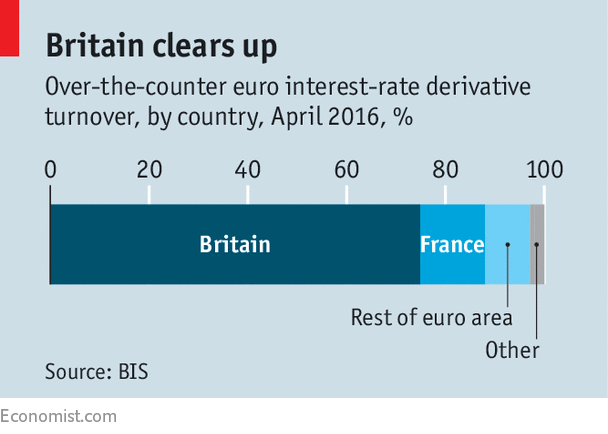
BREXIT has thrust a mundane, if crucial, bit of financial-market plumbing into the spotlight: the clearing of financial instruments. Clearing-houses sit in the middle of a securities or derivatives transaction, and ensure that deals are honoured even if one counterparty goes bust. In November a study commissioned by the London Stock Exchange (LSE) warned that if euro clearing was forced out of the City, 83,000 British jobs could be lost, and a further 232,000 affected. On May 4th the European Commission said it was looking into new rules for euro-denominated clearing. One option is relocation from London, an idea greeted in the City with a mixture of incredulity, disdain and fear.
In the wake of the financial crisis, the G20 group of big economies made it mandatory to settle most simple derivatives trades through clearing-houses. By 2016, 62% of the notional $544trn global over-the-counter derivatives market was settled in this way. Globally, London handles 37% of foreign-exchange derivatives…Continue reading
Africa’s informal economy is receding faster than Latin America’s
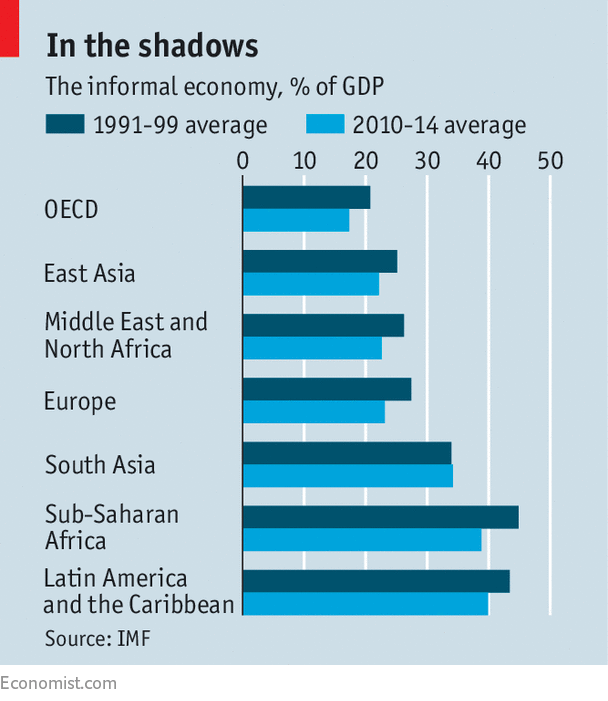
COMMON to all men, according to Adam Smith, is “the propensity to truck, barter and exchange”. Less common is a willingness to report all of this enterprise to the authorities (which have a propensity to register, regulate and tax). South Africa’s spaza shops (convenience stores often run from people’s homes), Kenya’s jua kali (a Swahili term referring to the “hot sun” under which craftsmen traditionally made and sold their wares) or Senegal’s tight-knit networks of Mouride street peddlers—all contribute to the informal economy. This shadow economy, which includes unregistered enterprises and off-the-books activity by registered firms, is difficult to measure, almost by definition. But this week the IMF released new estimates of its size.
The fund’s economists inferred the size of the informal economy indirectly, based on more visible indicators that either cause informality (heavy taxes, high unemployment and patchy rule of…Continue reading
A new sort of hedge fund relies on crowd-sourcing
“QUANT” hedge funds have long been seen as the nerdy vanguard of finance. Firms such as Renaissance Technologies, Two Sigma and Man AHL, each of which manages tens of billions of dollars, hire talented mathematicians and physicists to sit in their airy offices and develop trading algorithms. But what if such talent could be harnessed without the hassle of an expensive and time-consuming recruitment process? That is the proposition Quantopian, a hedge fund and online crowd-sourcing platform founded in 2011, is testing. Anyone can learn to build trading algorithms on its platform. The most successful are then picked to manage money. Last month the firm announced it had made its first allocations of funds to 15 algorithms it had selected.
Quantopian would appear to have one striking advantage over its competitors: sheer weight of numbers. The difficulty of hiring and a desire for secrecy limit even big quant funds to a full-time research staff in the low hundreds (Man AHL, for instance, has 120). Quantopian boasts 120,000 members on its platform.
These are amateurs, however, not full-time employees. John Fawcett, Quantopian’s CEO, says many sign up to…Continue reading
India needs to curb a borrowing spree by its state governments

WHICH Indian state sounds more likely to repay a loan: Bihar, the country’s poorest, with a budget deficit of nearly 6% of its state GDP last year and a hole in its finances after it banned alcohol sales; or Gujarat, a relatively prosperous coastal region with a deficit nearer to 2%? According to bond markets at least, both are equally good credits, and so pay the same interest rate. As welcome as such mispricing might be to the Bihari authorities, it is brewing trouble for the rest of the Indian economy.
The borrowing habits of Bihar, Gujarat, and India’s 27 other states used to be below the radar of all but the pointiest financial eggheads. The indebtedness of India, and its annual budget deficits—both high by emerging-market standards—could largely be blamed on the profligacy of the central government in Delhi. But an explosion in the net amounts borrowed by states over the past decade (see chart), from 154bn rupees in 2006 ($3.5bn then) to an estimated 3.9trn in the fiscal year…Continue reading
William Baumol, a great economist, died on May 4th

ON MAY 4th William Baumol, one of the great economists of the 20th century, died. Mr Baumol, who kept working into his 90s, published more than 500 papers across a dazzling array of topics; his best-known work, describing “cost disease”, was essentially a side-project. He was a scholar whose stray thought on a sleepless night could change how people see the world.
Mr Baumol was born in the South Bronx, attended New York public schools and took an undergraduate degree at the College of the City of New York. Shaped by his family’s left-wing views, in high school he read Karl Marx, which kindled an interest in economics. He did his PhD at the London School of Economics; he defended his dissertation “over whiskies and sodas at the Reform Club”. He spent most of his long career at Princeton University. He had long been on the shortlist for a Nobel prize; sadly, death means he cannot receive one.
His contributions will endure, however. Mr Baumol’s primary intellectual…Continue reading
The investment- management industry faces a big squeeze


MAKING money yourself from investing other people’s has been a good business for over a century. Asset managers established a key principle early on: they could charge an ad valorem fee on the amount they oversee. So when markets go up, their fees go up.
But as the title of a recent London Business School conference indicated, investment management is “an industry in disruption”. Abhijit Rawal of PwC, a consultancy, described the sector’s problems as the “four Rs”: returns are low; revenues are being squeezed; regulations are being tightened; and the robots are coming to take away business.
Plenty of potential for growth remains, as workers save for retirement. But the industry faces the same sort of cut-throat competition that technology has caused elsewhere. The oldest challenge comes from index trackers, funds that try simply to match the performance of a benchmark like the S&P 500. It took many decades for such “passive” funds to…Continue reading
Worries mount about car finance in America and Britain
THOUSANDS of second-hand cars, ranging from dented clunkers to Bentleys, glisten under the evening floodlights at Major World, a car dealership in Queens, a borough of New York. “Business has been good,” says a crisply-dressed salesman, scurrying between prospective customers. Almost everyone who wants to buy a car at Major World can get approved for a loan, he explains, regardless of their credit score, or lack of one: when banks turn buyers down, the dealership offers them its own in-house financing.
In both America and Britain new-car sales reached record levels last year (2.7m cars in Britain and 17.5m in America), as did second-hand-car sales in Britain. So too did car loans: £31.6bn ($42.8bn) in Britain and $565bn in America. Even folk with poor credit records (“subprime” borrowers) have been able to find financing. So some are asking whether this latest credit boom might have sown the seeds of a new crisis.
In America worries have centred on rising delinquencies in subprime asset-backed securities (ABSs) based on car loans. Bundling car-loan repayments into ABSs to sell on to investors represents an important source of financing, particularly for non-bank lenders. Cumulative net losses on subprime car-loan ABSs issued in 2015 are at levels not seen since 2008—over 6% after only 15 months.
Some hear echoes of the financial crisis….Continue reading
America’s Treasury ponders issuing 40-, 50- or 100-year bonds

HOW can governments borrow most cheaply? The answer matters hugely for taxpayers. Take America: it has $14trn in outstanding national debt, fully three-quarters of GDP. Interest payments alone are expected to reach $280bn this fiscal year—ie, more than three times the combined budgets of the Departments of Education, Labour and Commerce.
The problem largely comes down to deciding how much long, medium and short-dated debt to sell. Almost every country issues a combination of these maturities. In the current low interest-rate environment, however, many argue that governments should sell proportionately more long-dated bonds to make sure they are able to pay historically low rates for many decades to come, thereby saving taxpayers money in the long run.
Some countries have already ploughed ahead. In recent years Britain, Canada and Italy have sold 50-year bonds; Mexico, Belgium and Ireland have issued 100-year debt. The latest country to flirt with the idea is America: last month the Treasury sent out a survey to bond-dealers to gauge market appetite for 40-, 50- and 100-year bonds. On May 3rd officials said that Steve Mnuchin, the…Continue reading
America’s food-truck revolution stalls in some cities
 The burghers rise up
IT WAS in 2008 that an out-of-work chef named Roy Choi began selling $2 Korean barbecue tacos from a roaming kitchen on wheels, tweeting to customers as he drove the streets of Los Angeles. Mr Choi’s gourmet food truck has since inspired a reality-TV programme and a hit Hollywood film, and helped jumpstart a $1.2bn industry.
Within the food industry, the food-truck business, built on unique dishes, low prices and clever use of social media, is the fastest-growing segment. Restaurants fret about an army of trucks stealing customers but such concerns are unwarranted. According to the Bureau of Labour Statistics, counties that have experienced higher growth in mobile-food services have also had quicker growth in their restaurant and catering businesses.
Although many cities have treated food trucks as a fad, a nuisance, or a threat to existing businesses, others have actively promoted them. Portland, Oregon, known for its vibrant culinary scene, has had small food carts on its streets for decades. After a study in 2008 by researchers at Portland State University concluded that the carts benefited residents, the city…Continue reading