
Tag: Approved
Axel Springer’s digital transformation
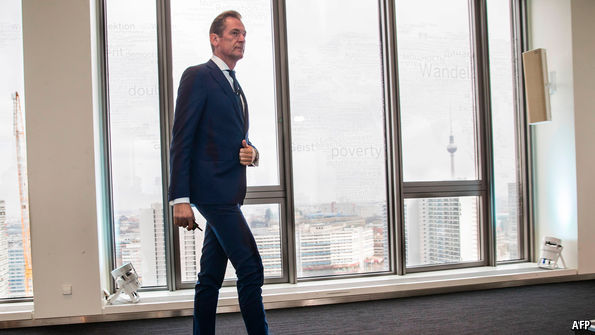
VISITING the top floor of Axel Springer’s tower in Berlin is like travelling back to a lost age. The German publisher’s Journalisten Club is a suite of wood-panelled rooms filled with antique books, leather armchairs and classical paintings. “It is a symbol,” says Mattias Döpfner, the publisher’s chief executive.
Whether it still makes sense as a symbol is unclear, for Axel Springer’s business has shifted rapidly away from print media (though it still owns Bild and Die Welt, two leading German dailies) towards an array of digital businesses. In 2000 it had almost no digital revenue; by the end of last year over 72% of its operating profit came from digital activities. Profits have increased by 37% over the past decade, from €434m ($473m) in 2006 to €596m last year.
Four years ago Axel Springer sold off several newspapers and magazines, including the Hamburger Abendblatt and the Berliner Morgenpost, for $1.2bn. In 2015 it nearly bought the Financial Times, a British paper with a strong online presence but…Continue reading
Harvard Business School risks going from great to good

YOU will all be aware that a book has just been published about our institution, Harvard Business School (HBS). Entitled “The Golden Passport”, by Duff McDonald, it makes a number of unflattering claims about the school’s ethics and its purpose. While often unbalanced, it is likely to galvanise hostility to HBS both inside Harvard University, of which we are a part, and among the public. This memorandum, circulated only to the most senior faculty members, assesses HBS’s strategic position.
Our school has been among the country’s most influential institutions since its foundation in 1908. Our forebears helped build America’s economy in the early 20th century and helped win the second world war. HBS educates less than 1% of American MBA students but case studies written by our faculty are used at business schools around the world. Our alumni fill the corridors of elite firms such as McKinsey. Many bosses of big American companies studied here. Even in Silicon Valley, where we are relatively weak, about a tenth of “unicorns”—private startups worth over $1bn—have one of our tribe as a founder.
We have a business model that monetises the Harvard brand…Continue reading
Cancer drugs are getting better and dearer

THE debate in rich countries about the high price of drugs is a furious and frustrating one. The controversy is already having an impact on spending on drugs, suggest new figures from the QuintilesIMS Institute, a research firm. The rate of growth in spending on prescription medicines in America fell to 4.8% in 2016, less than half the average rate of the previous two years (after adjusting for discounts and rebates). Michael Levesque of Moody’s, a rating agency, reckons that pressure over pricing is contributing to a deceleration in earnings growth at pharma firms. Public scrutiny constrains their flexibility over what they can charge and allows payers to get tougher.
In one area, however, earnings are expected to keep rising: cancer. Oncology is the industry’s bright spot, says Mr Levesque. The grim fact is that two-fifths of people can now expect to get cancer in their lifetime because of rising longevity. This is one of the reasons why the number of new cancer drugs has expanded by more than 60% over the past decade. The late-phase pipeline of new medicines contains more than 600 cancer treatments. New cancer drugs are being approved more quickly.
More are…Continue reading
Might legalising the rhino-horn trade actually help the rhino?
 Pricier than snake-oil, and deadlier
A DEAD rhino, with a bloody stump in place of its horn, means different things. For the species it is the danger of imminent extinction; for wildlife-lovers it is barbarism; for law-enforcers it is failure. For its poachers it means income; the horn will be exported illegally to fetch tens of thousands of dollars. For economists, it means market forces are at work.
South Africa is in the throes of a poaching epidemic. Official figures show poachers killed 1,054 rhinos in 2016, up from just 13 in 2007. In Kruger National Park, home to the world’s largest rhino population, numbers are dropping despite a fall in recorded poaching incidents. Tom Milliken of TRAFFIC, a wildlife-trade monitoring network, worries that poachers have become better at hiding the carcasses.
The problem is international. The rhino-horn supply-chain sprawls from South Africa, home to nearly three-quarters of the world’s rhinos, to Asia, and in particular to Vietnam, where rhino horn is coveted as medicine, prescribed for fevers, alcohol dependency and even cancer.
Prohibitionists call for better law-enforcement. Demand for…Continue reading
Warren Buffett has many fans in China but few true followers

AS THE second-richest person in the world, and with a half-century record of investing success, Warren Buffett is a household name worldwide. But in China, he is something more: a celebrity. In March a special edition of Cherry Coke, featuring a cartoon image of the 86-year-old investor, hit Chinese shop shelves (Mr Buffett not only loves the sugary beverage; he is Coke’s largest shareholder). On May 6th thousands of Chinese investors will descend on Omaha for the annual meeting of Berkshire Hathaway, his holding company, and many more will tune into a live-stream of the event. Mandarin is the only foreign language into which the proceedings will be simultaneously translated. Those who miss the broadcast can pick up one of the hundreds of Chinese books about his approach to minting money.
Mr Buffett’s stature in China stems partly from good timing. China’s modern stockmarket was launched in 1990. Just as neophyte investors grappled with earnings reports and trend lines, the Oracle of Omaha’s reputation as the world’s best stock-picker was blossoming. Compared with the regular booms and busts of the Chinese stockmarket, the steady returns of Berkshire Hathaway…Continue reading
Investors are both bullish and skittish about share prices

TEN years ago this month investors were pretty confident. True, there were signs that problems in the American housing market would mean trouble for mortgage lenders. But most people agreed with Ben Bernanke, the Federal Reserve chairman, that “the impact on the broader economy…seems likely to be contained.” The IMF had just reported that “overall risks to the outlook seem less threatening than six months ago.”
That was reflected in market valuations. In May 2007 the cyclically-adjusted price-earnings ratio (CAPE), a measure that averages profits over ten years, was 27.6 for American equities (see chart). That ratio turned out to be the peak for the cycle. As the problems at Bear Stearns, Lehman Brothers and others emerged, and as the world was gripped by recession, share prices plunged. By March 2009 the CAPE had fallen by more than half.
Central banks then kicked into action, slashing interest rates and buying assets via quantitative easing (QE). The stockmarkets recovered rapidly and the S&P 500 is now more than 50% higher than it was ten years ago. And the American stockmarket’s CAPE, at 29.2, is also higher than it was…Continue reading
Puerto Rico declares bankruptcy at last

THE government of Puerto Rico said in 2015 that the island could not pay its debts. Yet it was only on May 3rd that it kicked off the biggest bankruptcy case in America’s history. Public-sector debts total almost $74bn (around 100% of GNP). The drawn-out fiscal crisis has both imperilled Puerto Rico’s economy and upended the island’s politics.
Something akin to bankruptcy is possible only because of a federal law passed in 2016. Until then, the island’s legal status as a territory afforded it no escape from its debts (were Puerto Rico a state, its public utilities could have declared bankruptcy). The law established a “financial oversight board”, appointed in Washington, with the task of reaching a deal with bondholders. But it also allowed for bankruptcy-like proceedings should negotiations fail.
A two-thirds majority of bondholders would have forced all of them to accept a reduction in the value of their debt. Yet agreement was always unlikely. Puerto Rica’s constitution says payments to holders of so-called “general obligation” bonds have priority over all other expenditure. But another group of creditors have first dibs on revenue from the sales…Continue reading
Euro-area GDP growth outpaces America’s
THE enduring appeal of GDP is that it offers, or seems to, a summary statistic that tells people how well an economy is doing. On that basis, the euro-area economy is in fine fettle, indeed it is improving at a faster rate than America’s. Figures released today show that GDP in the currency zone rose by 0.5% in the first quarter of 2017, an annualised rate of around 2%. That is quite a bit faster than the 0.7% rate reported in the same period for America’s GDP.
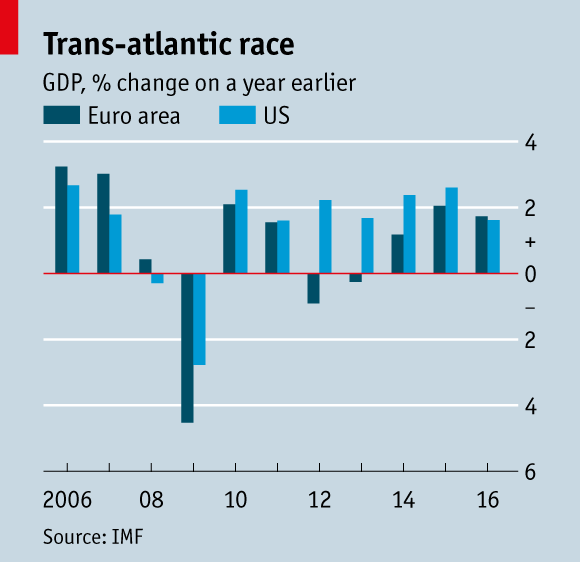
These figures probably overstate the gap between the two economies. In recent years, first-quarter estimates of GDP growth in…Continue reading
India's Patanjali takes on Western consumer-goods firms

EXECUTIVES at firms selling consumer staples like to think of themselves as “marketing gurus”. But how many could actually contort themselves into the lotus position, let alone attempt a headstand? Such feats are nothing for the top brass at Patanjali, an Indian purveyor of toothpaste, cooking oil, herbal concoctions and much else. Fronted by a bona fide guru, the firm’s marketing strategy—play up the benefits of natural products, then paint foreign multinationals as latter-day imperialists—delivers over $1bn in annual sales, up tenfold in four years. Having dismissed the firm as a fad, the likes of Colgate-Palmolive and Unilever are emulating it.
Baba Ramdev (pictured), an ascetic yogi who is the public face of the brand, makes for an unconventional capitalist symbol. But with Acharya Balkrishna, a devotee of his who serves as the firm’s boss and majority-owner, he has built a consumer-goods powerhouse that is vying with the business-school graduates at the multinationals. Starting out two decades ago as an apothecary of traditional Ayurvedic potions, Patanjali has expanded into personal care, home products, packaged food and more. Mr Ramdev’s beard and saffron…Continue reading
A giant cement firm may have unwittingly funded Islamic State

KEEPING cool in the heat of war is not easy. That might help explain why LafargeHolcim, a French-Swiss cement-maker, blundered so badly while running operations in Syria as fighting raged. On April 24th the firm said that its chief executive, Eric Olsen, will go, a casualty of a growing scandal over its activities in the country.
The board of the world’s biggest cement producer stated only last month that Mr Olsen was not responsible for, nor aware of, wrongdoing by the firm in Syria. But public pressure has been increasing, notably after Jean-Luc Mélenchon, a left-wing candidate in France’s presidential election, attacked the firm and its “damned cement” in a television debate on April 4th. François Fillon, a pro-business rival, agreed the firm should be punished if allegations against it proved to be true.
At issue is the activity of Lafarge before the firm’s merger with its Swiss rival, Holcim, in 2015. In 2010 Lafarge had built a cement factory of 240 workers for $680m near Kobane, a north Syrian town. Operations there continued until 2014, long after the violence began in 2011. The firm evacuated foreigners in 2012; local workers fled in…Continue reading