
Tag: Approved
Donald Trump’s review of trade deficits is a blast from the past

“WE are in a trade war,” said Wilbur Ross, Donald Trump’s commerce secretary, on March 31st. That day Mr Trump duly loosed off a couple of warning shots, announcing two trade-related executive orders. (He forgot to sign them in the ceremony itself.) As tactics go, this was hardly shock and awe. Rather, it was supposed to suggest that nastier weaponry is on the way.
The first executive order was aimed at making trade rulebreakers “face the consequences”. Some bits were vague: officials have 90 days to develop and implement a plan to combat customs violations. Others seemed trivial. The government has lost $2.3bn of revenue over 14 years from importers going bankrupt before paying duties; almost half of this relates to imports of fresh garlic and preserved mushrooms.
The second executive order seemed more in keeping with Mr Trump’s (trade) warmongering. Officials have 90 days to produce an “omnibus” report, naming the trading partners with which America had a “significant” trade deficit in goods in 2016 and shaming them if the reasons for that deficit are “unfair”. Based on what it finds, Mr Trump promised to “take necessary and lawful…Continue reading
Japan's labour market is tight. So why aren’t wages rising?

TRIMLY DRESSED deliverymen, polite and punctual, are ubiquitous in Japan. So it was shocking to see one of them kicking his parcels and hurling his trolley outside a block of Tokyo flats after apparently finding no one at home. Captured on a camera phone last December, this incident of “parcel rage” went viral, forcing Sagawa Express, one of Japan’s biggest delivery companies, to say sorry to its customers. Many Japanese will have felt sympathy, though, for the video’s frazzled star.
Over 10% of the country’s firms admit that some workers frequently put in more than 100 hours of overtime in a month. A manager at a nuclear plant in Fukui prefecture worked twice that long in February 2016 before killing himself two months later. The problem is especially acute in low-skilled service industries. Over the past two decades, e-commerce has vastly increased the number of parcels handled by firms like Sagawa. Last year, one employee committed suicide after being violently bullied by his boss.
In a survey in 2015 by the Japan Institute of Labour Policy and Training, some workers blamed their own lack of ability for why they put in so many extra hours. Others…Continue reading
Looking good can be extremely bad for the planet

STYLE is supposedly for ever. But the garments needed to conjure up eternal chic are spending less time on shop racks and in homes than ever before. Global clothing production doubled between 2000 and 2014, as apparel firms’ operations became more efficient, their production cycles became quicker and fashionistas got more for their money. From just a few collections a year, fast-fashion brands such as Zara, owned by Spain’s Inditex, now offer more than 20; Sweden’s H&M manages up to 16.
Dressing to impress has an environmental cost as well as a financial one. From the pesticides poured on cotton fields to the washes in which denim is dunked, making 1kg of fabric generates 23kg of greenhouse gases on average, according to estimates by McKinsey, a consultancy. Because consumers keep almost every type of apparel only half as long as they did 15 years ago, these inputs go to waste faster than ever before. The latest worry is shoppers in the developing world, who have yet to buy as many clothes as rich-world consumers but are quickly catching up.
Most apparel companies know that sooner or later, consumers’ awareness of this subject will rise. That is a…Continue reading
America’s disproportionate weight in global stockmarket indices

THE aims of a stockmarket index are threefold. First, to reflect what is actually going on in the market; second, to create a benchmark against which professional fund managers can be judged; and third, to allow investors to assemble well-diversified, low-cost portfolios. On all three counts, there are reasons to worry about the MSCI All-World Country Index, one of the most widely used gauges of the global stockmarket.
That is because the American market has a weighting of 54% in the index, as high as it has ever been (it reached the same level in 2002). In other words, anyone using the index to monitor the market is seeing a picture heavily distorted by Wall Street. The relative performance of international fund managers against the index will largely depend on how much exposure to America they are willing to take on. And anyone buying a tracking fund is making a big bet on the American market. Things are even worse if investors track the MSCI World Index, which covers only developed markets. In that benchmark, America’s weight is 60.5%.
Westinghouse files for bankruptcy
 Who will see it through?
THERE are few more storied innovators than Westinghouse. Founded in 1886, it is the company that brought electricity to the masses. When you plug in your toaster or flip your light switch, you have George Westinghouse’s alternating-current system to thank. In the 21st century the firm seemed poised to unleash a new revolution in nuclear energy. Its AP1000 pressurised water reactor was supposed to make nuclear plants simpler and cheaper to build, helping to jump-start projects in America and around the world.
But those nuclear ambitions have gone awry. On March 29th the firm filed for Chapter 11 bankruptcy in New York. Its troubles have been a running sore at Toshiba, its Japanese parent, a headache for its creditors, and the latest bad tidings for a nuclear industry beset with problems.
Toshiba was triumphant in 2006 when it paid $5.4bn for Westinghouse after a bidding war, beating out General Electric (founded by George Westinghouse’s archrival, Thomas Edison). Around the same time, Southern and SCANA, two big utilities based in Georgia and South Carolina, respectively, chose the AP1000 design for new nuclear…Continue reading
Luxury-goods companies in the digital era

IT TAKES at least a month to wash, comb, spin and otherwise prepare fine mohair to become cloth that is stitched into suits by Ermenegildo Zegna, a 107-year-old Italian brand. In Trivero, an Alpine village west of Milan, 150 artisans in an elegant factory work at carding, dying, weaving and warping. As looms rattle, bespectacled women stretch cloth over illuminated screens and check for imperfections. Others use a rack crammed with dried Spanish thistles to remove excess hair from fabric.
Zegna, run by its fourth generation of family owners, is distinctive in many ways. Big corporate successes are rare in Italy, which tends to nurture smaller firms. Sales from Zegna’s 500-odd shops worldwide, plus earnings from selling to other producers, amount to an annual €1.2bn ($1.3bn) or so. It controls its entire supply chain, which is unusual even in an industry that cherishes raw materials. Three years ago it bought a 6,300-acre farm with 10,000 sheep in Australia. A spokeswoman brags that vertical integration at Zegna runs “from sheep to shop”.
The company is also unusual because it has stayed independent of the few swaggering giants that bestride the luxury-goods…Continue reading
The nominee to run America’s drug regulator is a sound choice

WHEN the names of potential candidates for the new head of America’s regulatory agency for drugs, the Food and Drug Administration (FDA), were first circulated, you could almost hear the sound of jaws hitting desks throughout the pharmaceuticals industry. One contender was Jim O’Neill, head of Mithril Capital Management, an investment firm, who is such a libertarian that he doesn’t think the FDA should insist that medicines have to work. Another was Balaji Srinivasan, an entrepreneur from Silicon Valley, who thought roughly the same.
Removing such a core regulation might seem appealing to business. In fact, the idea of not approving drugs for efficacy is as unwelcome to the industry as it is to doctors and patients. It spends billions of dollars every year on research to deliver better treatments; this would be impossible to justify if drugs had merely to be safe. Patients, meanwhile, would face the awful prospect of having to identify which life-saving medications worked.
So, when the name of the FDA nominee was announced in March, there was widespread relief. Scott Gottlieb (pictured) a resident fellow at the American Enterprise Institute, a conservative…Continue reading
Luxury-goods companies are belatedly trying to go digital
IT TAKES at least a month to wash, comb, spin and otherwise prepare fine mohair to become cloth that is stitched into suits by Ermenegildo Zegna, a 107-year-old Italian brand. In Trivero, an Alpine village west of Milan, 150 artisans in an elegant factory work at carding, dying, weaving and warping. As looms rattle, bespectacled women stretch cloth over illuminated screens and check for imperfections. Others use a rack crammed with dried Spanish thistles to remove excess hair from fabric.
Zegna, run by its fourth generation of family owners, is distinctive in many ways. Big corporate successes are rare in Italy, which tends to nurture smaller firms. Sales from Zegna’s 500-odd shops worldwide, plus earnings from selling to other producers, amount to an annual €1.2bn ($1.3bn) or so. It controls its entire supply chain, which is unusual even in an industry that cherishes raw materials. Three years ago it bought a 6,300-acre farm with 10,000 sheep in Australia. A spokeswoman brags that vertical integration at Zegna runs “from sheep to shop”.
The company is also unusual because it has stayed independent of the few swaggering giants that bestride the luxury-goods…Continue reading
Banks’ equity-research operations are in decline
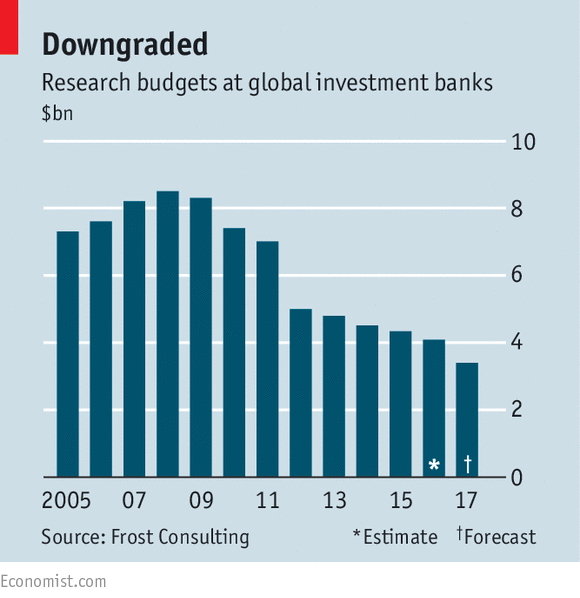
EQUITY research, the business of providing analysis of companies’ financial performance, may be a stodgy industry but it is not a simple one. Regulators fret about the sector’s Byzantine payment structure: investment banks dominate the market, but do not charge for it. They dole it out free to clients in the hope of future trading business. The understandable fear is that this set-up produces conflicts. Banks may be wary of issuing reports critical of companies; fund managers may end up choosing banks because of their research rather than the efficiency of their brokerage services. New regulations will overturn this model entirely.
MiFID 2, an ambitious set of European financial rules coming into effect next January, will force asset managers to disclose how much they spend on research. So banks will have to “unbundle” their services, billing clients for research and trading separately. Although the rules are being introduced by European regulators, banks across the world will have to change their pricing practices to comply.
These rules will be hugely, and beneficially, disruptive to a grossly inefficient industry. At present, banks blast…Continue reading
Masayoshi Son goes on a $100bn shopping spree

IF YOU want to find a spectacular vision of the future, Silicon Valley is not the only place to look. In Tokyo Masayoshi Son, the boss of SoftBank, a Japanese telecoms group, is starting an investment fund worth $100bn which, he hopes, will make him the Warren Buffett of technology. “Masa” is no stranger to risky bets: SoftBank was an early investor in Alibaba, a Chinese e-commerce company, and has sunk $22bn in Sprint, a struggling American telecoms firm. Now he has been seized by the kind of Utopian fever that would make the Sage of Omaha choke on his Cherry Coke.
Mr Son, who is 59, believes that the world will soon encounter what is known as the Singularity, the point at which artificial intelligence exceeds the human kind. The brains of people and machines will become enmeshed (see article). Every person will have over 1,000 devices linked by a seamless global network, with the data analysed by machines in the cloud. As well as smart glasses, people will wear smart shoes and every car and washing machine will…Continue reading