
Tag: Approved
YouTube highlights problems with digital advertising
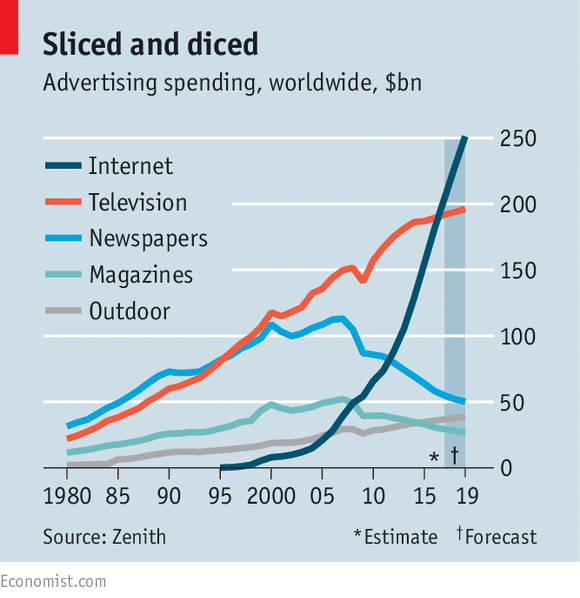
EVEN advertisers can be seduced by slick marketing. Google and Facebook have built huge businesses by promising that online ads are more effective and easily measured than traditional media, such as television, radio and print. This year the amount spent on internet advertising, globally and in America, is forecast to surpass television advertising for the first time (see chart). But a controversy at YouTube, an online-video site owned by Google, shows how digital advertising still has problems to sort out before it lives up to the dazzling sales pitch.
A slew of advertisers, including stalwarts such as Coca-Cola, Walmart and General Motors, have announced plans to suspend usage of, or move ad spending away from, YouTube because ads (in some cases their own) were appearing alongside offensive content, including videos by jihadist and neo-Nazi groups. Google’s own brand has suffered: the damage to the firm’s sales could be as much as $1bn in 2017, or around 1% of its gross advertising revenue. Shares of its parent company, Alphabet, have fallen by around 3% owing to the controversy.
It is not the first time that brands have fretted about where…Continue reading
Ameerpet, India’s unofficial IT training hub
 Eat your heart out, Stanford
UNIVERSITY campuses can take a while to get going in the mornings, as students recover from extra-curricular antics. Contrast that with Ameerpet, a squeezed neighbourhood of Hyderabad that has become India’s unofficial cramming-college capital. By 7.30am the place is already buzzing as 500-odd training institutes cater to over 100,000 students looking to improve their IT skills. If there are ivory towers here, they are obscured by a forest of fluorescent billboards promising skills ranging from debugging Oracle servers to expertise in Java coding to handling Microsoft’s cloud.
Expertise in the IT industry erodes fast as software programs are upgraded or become obsolete. Indian outsourcing giants such as Infosys and Wipro spend heavily to keep employees’ skills up to date. But staff looking to change their career paths—to say nothing of those who didn’t crack the interview in the first place—need rapid systems upgrades of their own. Training courses authorised by software providers exist but cost up to 375,000 rupees ($5,765). Fees at Ameerpet’s informal institutes are typically below 25,000 rupees for classes…Continue reading
Swiss watchmakers try to keep pace

BASELWORLD, a giant watch fair that ended this week, usually runs like clockwork. Companies show off new products; buzz and higher sales follow. However, something seems to have jammed. Exports of Swiss watches sank by a tenth in 2016, the worst performance since the financial crisis. Swatch, the world’s biggest watch company, saw profits plunge by 47%. In February exports were 10% lower than they had been a year earlier.
Swiss watchmakers have been around for long enough not to panic: Blancpain, owned by Swatch, dates back to 1735; Vacheron Constantin, owned by Richemont, a Swiss luxury conglomerate and Swatch’s closest rival, was founded 20 years later. In La Chaux-de-Fonds, a watch-manufacturing hub, workers toil much as they always have, at chin-high desks, using slim instruments to assemble springs, wheels, jewels and other tiny parts. But swings in demand have of late been particularly extreme.
The period from around 2004 to 2012 saw high growth. Chinese shoppers accounted for about half of Swiss watch sales during that time, reckons Thomas Chauvet of Citi, a bank. Manufacturers introduced pricier products and raised the cost of existing ones. The financial…Continue reading
Lacklustre power demand in Asia throws a cloud over coal

THE Hazelwood power station in Australia’s state of Victoria started generating electricity 52 years ago. The stark symbol of an era when coal was king, Hazelwood was one of Australia’s dirtiest: its fuel was the Latrobe valley’s brown coal, a bigger polluter than the black sort. The station was due finally to close on March 31st. Days earlier, chimney stacks were demolished at Munmorah, a black-coal station north of Sydney, already closed. Australia has shut ten coal-fired power stations over the past seven years, yet coal still generates about three-quarters of its electricity.
This fits a pattern across much of Asia, which accounts for two-thirds of the world’s coal demand. The biggest economies besides Japan, which hopes to replace nuclear with “clean” coal, are either closing down old plants or rethinking plans to build new ones. This is casting a deepening cloud over the coal industry.
Two reasons explain the looming overcapacity in countries ranging from China and India to Australia (South-East Asia remains hooked on coal). Firstly, electricity demand is stagnant, falling or growing less strongly than expected, which has put considerable financial…Continue reading
Indonesia’s tax amnesty passes its deadline

LAST year Indonesia’s finance minister, Sri Mulyani Indrawati, invited chief executives, directors and shareholders from the country’s leading industries to banquets at her ministry. As they munched, she would give presentations setting out who among them had—and, by omission, who had not—signed up to the government’s tax amnesty. “This may be the most expensive dinner in your lifetime,” the 54-year-old economist recalls telling them.
Indonesia’s tax amnesty, which began in July 2016, ended on March 31st. More than 800,000 evaders declared 4,700trn rupiah ($350bn) in assets previously hidden from the authorities. That is a staggering sum, equivalent to 40% of Indonesia’s GDP and 90% of the money supply, and revealing of the epic scale of tax-dodging.
The willingness of tax cheats to come clean partly reflects the generous terms on offer. Assets declared in the first three months were taxed at just 2-4%, compared with the individual income-tax rate of up to 30%. Those declared in the next three months were taxed at 3-6%, and those in the final three months at 5-10%. The government collected additional revenue of 125trn rupiah, equivalent to less than…Continue reading
The life and times of an Italian non-performing loan

MARIO (not his real name) from the pretty Italian city of Vicenza opened an account at a local bank in 1992. It afforded him an overdraft of the equivalent of €10,000. He needed it to pay the bills of his wholesale textiles company. Over the years his firm’s cash problems worsened. In 2013, after Mario had exceeded his overdraft limit by €7,000 ($9,300), the bank gave him an unsecured loan of €50,000.
The first repayment was due in January 2014, yet by June Mario had filed for voluntary bankruptcy. The bank—now owed €70,300—presented itself to the court as a creditor. It entered into an arrangement, but in December sold the loan for 5% of its book value to Banca IFIS, an Italian lender building a portfolio of soured debts. Banca IFIS employed an external debt collector and by the following April, Mario had repaid €17,000. Having made a tidy profit on its investment, Banca IFIS told the bankruptcy court the debt had been cleared.
It seems puzzling that Mario was granted a loan after being overdrawn for so long. Andrea Clamer, head of Banca IFIS’s bad-loans division, says such mysteries are central to understanding Italy’s bad-loan…Continue reading
An improbable global shortage: sand

INDIA’S “sand mafia” is doing a roaring trade. The Times of India estimates that the illicit market for sand is worth around 150bn rupees ($2.3bn) a year; at one site in Tamil Nadu alone, 50,000 lorryloads are mined every day and smuggled to nearby states. Gangs around the country frequently turn to violence as they vie to continue cashing in on a building boom.
Much of the modern global economy depends on sand. Most of it pours into the construction industry, where it is used to make concrete and asphalt. A smaller quantity of fine-grade sand is used to produce glass and electronics, and, particularly in America, to extract oil from shale in the fracking industry. No wonder, then, that sand and gravel are the most extracted materials in the world. A 2014 report by the United Nations Environment Programme (UNEP) estimates they account for up to 85% by weight of everything mined globally each year.
With house-building in the West yet to recover fully from the 2007-08 crisis, Asia has been, by far, the main source of demand. Figures from the Freedonia Group, a market-research firm, suggest that, of the 13.7bn tonnes of sand mined…Continue reading
Stockmarkets give up some of their Trump bump
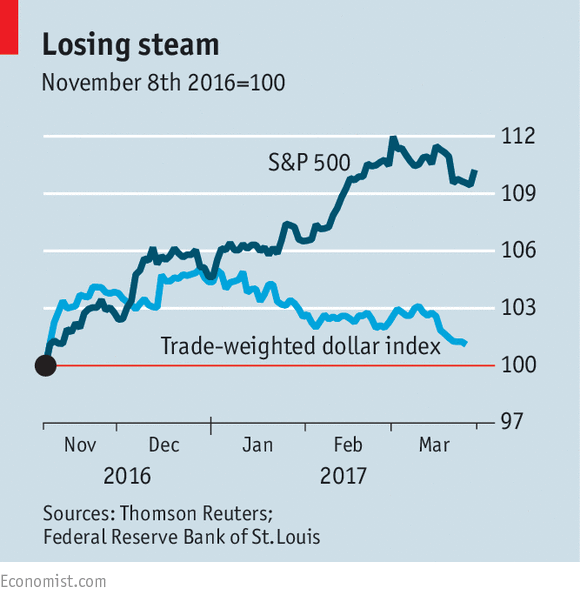
HONEYMOONS don’t last for ever. Having been a reluctant bride to President Donald Trump when courted in the run-up to November’s election, the American stockmarket quickly melted into a mood of romantic euphoria. Shares rose by 12% between election day and March 1st (see chart). But in recent days, sentiment has dimmed. There is talk of the “Trump-disappointment trade”.
For the markets to experience some kind of sell-off is hardly a surprise. The S&P 500 index had gone more than 100 days without a 1% decline, the longest such streak since 1995. And the setback should not be exaggerated. The S&P 500 remains well above its pre-election level, compared with the dollar, which has given up around half its gains. The ten-year Treasury-bond yield, which hit 2.62% on March 13th, has dropped back to 2.38%.
The immediate cause of the retreat seemed to be the failure of Mr Trump to repeal his predecessor’s health-care bill. That logic was hardly a great advertisement for capitalism, implying that the fewer Americans had access to health insurance, the happier investors would be. But the broader rationale seemed to be that, if the Republicans…Continue reading
Will robots displace humans as motorised vehicles replaced horses?

IN THE early 20th century the future seemed bright for horse employment. Within 50 years cars and tractors made short work of equine livelihoods. Some futurists see a cautionary tale for humanity in the fate of the horse: it was economically indispensable until it wasn’t. The common retort to such concerns is that humans are far more cognitively adaptable than beasts of burden. Yet as robots grow more nimble, humans look increasingly vulnerable. A new working paper concludes that between 1990 and 2007, each industrial robot added per thousand workers reduced employment in America by nearly six workers. Humanity may not be sent out to pasture, but the parallel with horses is still uncomfortably close.
Robots are just one small part of the technological wave squeezing people. The International Federation of Robotics defines industrial robots as machines that are automatically controlled and re-programmable; single-purpose equipment does not count. The worldwide population of such creatures is below 2m; America has slightly less than two robots per 1,000 workers (Europe has a bit more than two). But their numbers are growing, as is the range of tasks they…Continue reading
Will robots displace humans as motorised vehicles ousted horses?

IN THE early 20th century the future seemed bright for horse employment. Within 50 years cars and tractors made short work of equine livelihoods. Some futurists see a cautionary tale for humanity in the fate of the horse: it was economically indispensable until it wasn’t. The common retort to such concerns is that humans are far more cognitively adaptable than beasts of burden. Yet as robots grow more nimble, humans look increasingly vulnerable. A new working paper concludes that, between 1990 and 2007, each industrial robot added per thousand workers reduced employment in America by nearly six workers. Humanity may not be sent out to pasture, but the parallel with horses is still uncomfortably close.
Robots are just one small part of the technological wave squeezing people. The International Federation of Robotics defines industrial robots as machines that are automatically controlled and re-programmable; single-purpose equipment does not count. The worldwide population of such creatures is below 2m; America has slightly fewer than two robots per 1,000 workers (Europe has a bit more than two). But their numbers are growing, as is the range of tasks they can tackle, so…Continue reading