
Tag: Approved
Companies are racing to add value to water

PRESENTED in an unusually-shaped heavy glass bottle with outsized black lettering, it could be a fine vodka. On sale for £80 ($99) in Harrods, an upmarket department store in London, it has a price tag to match. In fact, it is a bottle of water. Harvested directly from Norwegian icebergs that are up to 4,000 years old, Svalbardi is one of hundreds of water brands that are sourced from exotic places and marketed as luxury products.
From the basic to the expensive, the market for bottled water is an attractive place to be. According to Zenith Global, a consulting firm, the global market has grown by 9% annually in recent years and is worth $147bn. The main reason is changing lifestyles. People are spending more time, and eating more of their meals, away from home. They are also switching from soft drinks and alcohol to healthier fare. Data from Beverage Marketing Corporation (BMC), another consultancy, show that consumption of bottled water overtook that of sugary soft drinks in America in 2016 (see chart).
An earthquake in European banking

IN BRITAIN alone millions of people make formal complaints each year about their banks. For them, Sebastian Siemiatkowski, founder of Klarna, a Swedish payments startup, brings good news. New European rules, he says, will open the door to a host of innovative services that analyse transactions, so “an app could tell you there’s a cheaper mortgage available and start the switching process for you.” Apps could warn account-holders if they spend more than a predetermined amount or are about to become overdrawn, or even nudge them to save more. Customers need barely ever interact with their bank.
To date, despite dire warnings, European retail banking has been remarkably unscathed by technology-driven disruption. Customers stay loyal, and banks still do the most of the lending. Financial-technology (“fintech”) companies are beginning to mount a challenge, most conspicuously in the online-payments industry in northern Europe: Sofort, iDEAL and other fintech firms conduct over half of online transactions in Germany and the Netherlands, for example. But their reach is more limited elsewhere in Europe. Physical payments are still overwhelmingly made with cash or bank…Continue reading
Uber is facing the biggest crisis in its short history

AS A teenager, Travis Kalanick’s first job was to knock on strangers’ doors and sell them knives. Now he is trying to dodge the daggers aimed at him and at Uber, a ride-hailing firm that is the world’s most valuable startup. On March 19th Jeff Jones, the company’s president, stepped down after six months, declaring that “the beliefs and approach to leadership that have guided my career are inconsistent with what I saw and experienced at Uber.” At least six key executives and high-ranking employees have left in the past nine weeks. They include Uber’s head of mapping, a former head of self-driving car technology, and an artificial-intelligence (AI) expert who had been put in charge of the firm’s AI research lab only three months ago.

Aggressive and unrelentingly ambitious, Mr Kalanick built his eight-year-old company into America’s largest privately owned technology firm by treading on the toes of different groups, including traditional taxi drivers, other…Continue reading
The Trump administration will review all of America’s trade deals

ACCORDING to a document crafted by the Trump administration, a model trade agreement has 24 elements. Second on the list is “trade-deficit reduction”, giving a hint as to why Mr Trump wants to review America’s existing agreements. In January Sean Spicer, his press secretary, said the administration would “re-examine all of the current trade deals.” A presidential order to do just that is reported to be in the offing.
America boasts 14 bilateral and regional free-trade agreements (FTAs). Mr Trump seems to blame these agreements for America’s large trade deficit. Most economists disagree, seeing it as reflecting macroeconomic imbalances. The FTAs are in any case with countries representing just two-fifths of America’s two-way trade in goods, and less than 10% of its goods-trade deficit (see chart). Most (77%) of America’s deficit stems from trade with China, the European Union and Japan. None has an American FTA.
A focus on trade deficits means that tiddly deals such as those with Jordan and Oman will not face much heat. NAFTA (an agreement with Mexico and Canada), and KORUS (South Korea), will face more scrutiny because of chunky…Continue reading
The unusual gap between American and European bond yields

AMERICA may be the world’s largest economy, but these days its government pays more than many others to borrow money. Its ten-year bond yields are higher than those in Britain, France, Singapore and even Italy.
The gap between American and German ten-year yields has been above two percentage points. For much of the past 25 years, it was very rare for the difference to exceed a single percentage point. On occasions, American yields fell below German levels (see chart).
Go back a generation and you might have expected the country with the higher bond yields to be the one with the weaker currency; investors would demand a higher yield to compensate for the risk of future depreciation. But that is not the case today. The dollar has been strong, relative to the euro, and many people expect it to strengthen further. Indeed, the higher yield on American government debt is one reason why investors might want to buy the dollar.
Instead, the gap may reflect differences in both monetary and fiscal policy. In America the Federal Reserve stopped buying Treasury bonds a while ago and has raised interest rates three times since December 2015; the European…Continue reading
China’s growing clout in international economic affairs
THE IMF “systematically impoverishes foreigners”, and the World Bank’s advice has “negative value to its best clients”. These harsh words were voiced not by lefty critics of the Washington Consensus, but by two men (David Malpass and Adam Lerrick, respectively) whom Donald Trump has picked to lead his Treasury’s dealings with the rest of the world, including the international financial institutions (IFIs), such as the World Bank and IMF, and the G20 group of leading economies.
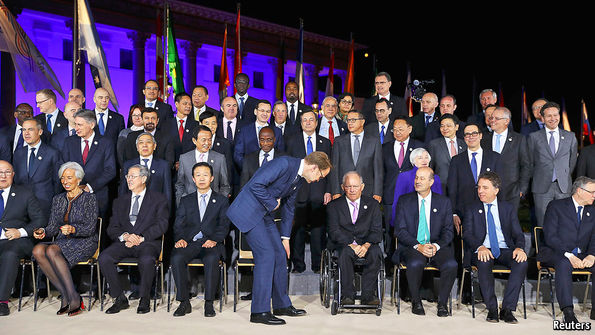
Their future boss, Steven Mnuchin, America’s treasury secretary, is not much more reassuring to the global financial establishment. At his first G20 meeting, in Baden-Baden in Germany on March 17th-18th (pictured), he vetoed a long-standing pledge to “resist all forms of protectionism”. It had often been breached. But hypocrisy is the tribute vice pays to virtue.
To veterans of international economic affairs, this combative stance is baffling. America’s government now seems to disdain a set of institutions it nurtured into life—institutions that are more commonly criticised for following America’s will too closely. “The United States is just handing the leadership over…Continue reading
A philanthropic boom: “donor-advised funds”
 …and remember to claim the tax deduction
JEFF POWERS was raised as “a good Catholic boy”. So when he sold his wall-fastener business in 2012 for $225m, he wanted to give back. And, like many philanthropists, he started close to home. He donated to the hospital where his son had spent months recovering from a car accident. He helped pay for a swimming pool at his children’s school. Today he supports all sorts of causes, from scholarships in Florida to soup kitchens in New York.
The way Mr Powers finances these projects would strike old-school charitable types as odd. Traditionally, a budding philanthropist would either give directly to a charity or set up a foundation. But Mr Powers uses a donor-advised fund (DAF), a type of account held by a non-profit entity, in this case Bank of America Charitable Gift Fund, an arm of the bank. DAFs are taking root in Britain and Canada, but they are primarily an American phenomenon.
DAFs are way-stations for donor dollars. Mr Powers deposits some money into his DAF and, while he ponders where it should go, Bank of America invests it for him. At some point he will suggest a beneficiary and, as…Continue reading
The battle to build Donald Trump’s wall

FEW slogans were chanted with as much passion by Donald Trump’s supporters in the presidential campaign as “Build that wall!”. The construction industry is almost as enthusiastic. Last week America’s Customs and Border Protection agency (CBP) issued two invitations for companies to bid to build the wall on the border with Mexico, which is expected to cost anywhere between $12bn and $25bn. The deadline for designs falls on March 29th. One request is for a solid concrete border wall, and the other for a wall using “alternatives” to reinforced solid concrete, suggesting the government has yet to decide what the barrier should be made of.
More than 700 companies, from big general contractors to firms selling materials to niche providers of lighting and surveillance systems, have registered to try to become suppliers. To the surprise of some, about one in ten of the firms bidding are local ones with Hispanic owners, drawn by the scale of the earnings on offer. Cemex, a Mexican cement giant that has plants on both sides of the border, said it would not sell cement for the project, though it had earlier expressed interest in joining the bidding. Another, tiny, Mexican firm…Continue reading
The investigation into the Bangladesh Bank heist continues

A YEAR after one of the most spectacular robberies of modern times, the authorities in Bangladesh are still trying to crack the case. Hackers into the country’s central bank sent instructions through SWIFT, a messaging network for cross-border payments, to transfer funds from the bank’s account with the New York Federal Reserve to private accounts in Sri Lanka and the Philippines. Much of the stolen $101m has yet to be retrieved; the masterminds are yet to be identified. But the probe reveals the strikingly sophisticated, and international, nature of the crime.
After sifting 60 hard drives and thousands of pieces of paper, and interviewing dozens of people, investigators, talking anonymously in Dhaka, say they are confident about some details of the heist. They believe foreign hackers acted with inside help. The attackers’ coding style has raised suspicions of involvement by North Korea. This week the New York Times reported that American federal prosecutors were examining this possibility.
Egregious violations of the bank’s security procedures have also been uncovered. On the day of the robbery, its security cameras were…Continue reading
Big tyremakers are regaining their grip

CARS can be objects of desire and the bonnet badge an indicator of wealth and status. Yet the four small patches of rubber that do the vital job of attaching them to the road stir little emotion. A third of drivers cannot name the make of tyre on their car. Nor do they know that the dominant global brands have been fighting a losing battle for 15 or so years against Chinese competitors and now have a chance of winning back ground.
The established tyremakers have advantages over the industry they serve. They have margins that outstrip even Germany’s luxury carmakers. Supplying manufacturers accounts for only a third of revenues of a typical tyre firm and even less of the profits. The rest comes from replacing tyres on vehicles on the road, which wear out every four years or so.
The expansion of the global vehicle fleet, forecast to grow by around 3.5% a year, helps gradually to reduce firms’ dependence on the cyclical market for new cars. Tyremakers also benefit by selling most of their wares to thousands of distributors. They are fragmented and weak compared with carmakers, and less inclined to drive hard bargains.