
Tag: Business and finance
India floats the idea of a universal basic income
 Basic needs
NOVEMBER 8th was not just the day of Donald Trump’s election. It was also when Indians found out most banknotes would lose all value unless promptly exchanged. Ever since, many have expected their patience in enduring the ensuing chaos to be rewarded in some way. Might scrapped cash unredeemed by presumed tax-dodgers be recycled into a lump-sum payment to each and every citizen? Or would the annual budget, presented on February 1st, be full of giveaways ahead of a string of state elections? In the event, the budget was restrained to the point of dullness. But the government’s closely-watched “economic survey”, released the previous day, hinted at a much bigger giveaway in the works: a universal basic income (UBI) payable to every single Indian.
The idea of a cash payment made to citizens irrespective of their wealth is centuries old. It has become newly fashionable in some rich countries, among both left-wing thinkers (who like its redistributive aspects) and their right-wing foes (who think it results in a less meddlesome state). The idea has had its fans in India: a small UBI scheme was launched as a pilot…Continue reading
The custodian-bank business

NO ACTOR has ever sat nude in a bathtub to explain the intricacies of the bank-custody business, as Margot Robbie did for mortgage-backed securities in “The Big Short”, a successful film. The blame lies with the custody business’s virtues, not its flaws.
Instead of the 2% fees Ms Robbie mentions for offloading rubbishy securities onto suckers, bank-custody fees are tallied in hundredths of a percentage point. Custody bankers are generally neither glamorous nor crooked. They are accountants and software engineers catering to well-informed clients: the owners and managers of huge amounts of financial assets. The services they offer include: holding, valuing and transferring securities; receiving interest and dividends; and providing notice of corporate actions. The business grows with the financial markets, but more slowly. Years of almost seamless and scandal-free performance have made the business well-nigh invisible. But not quite.
Custody has habitually been “sticky”: the loss of a large account is unusual. But on January 25th BlackRock, a gargantuan asset manager, announced that it was moving custody assets worth $1trn from State…Continue reading
What if interest expenses were no longer tax-deductible?
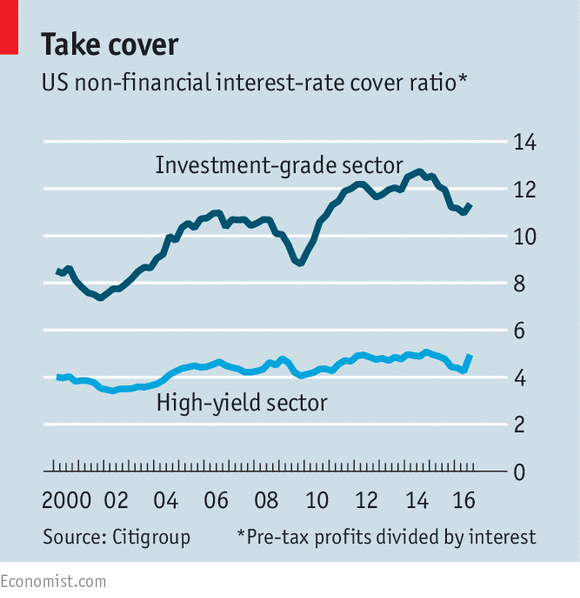
ONE reason why the American equity market has rallied since the election of Donald Trump is the hope that taxes on corporate profits will be cut. But that measure has to be paid for, and analysts are only just starting to figure out where the burden might fall.
The initial focus has been on the idea of border-adjustment taxes. But another way of raising revenue is to remove companies’ right to deduct their interest expenses from their taxable income. That proviso has been in place since 1918, when it was introduced to help firms struggling with the impact of the first world war—evidence that tax breaks, once granted, are hard to remove.
Allowing interest payments, but not dividends, to be deducted from corporate profits before tax is paid is a huge distortion to the system. It is a perk worth around 11% of the value of corporate assets. It has tended to encourage companies to take on more debt. By doing so, it may make the economy more risky at the margin: in a recession, highly-indebted companies are likely to go bust more quickly, whereas companies with lots of equity capital can ride out the storm. As a result, this…Continue reading
“Alt-beta” funds offer hedge-fund-like investments more cheaply

INVESTORS love to complain about hedge funds, which have delivered measly returns for the past several years and are notorious for their high fees. Yet so far, most have stuck with them. One reason is that the hedge funds’ mission—to provide returns uncorrelated with overall market performance—has been hard to replicate. But a fast-growing hedge-fund-like product, known as the “alternative beta” fund, allows investors much cheaper access to a similar style of investment.
“Alt-beta”, as it is usually called, is a bit of a misnomer. The word “beta” is typically used to mean broad market returns, which can be bought into through index-tracking funds. “Alpha” is the term used to describe the premium added by a skilled fund manager. The idea driving both “alt-beta” funds and longer-established “smart-beta” ones, is that, just as “beta” can be distinguished from “alpha”, so returns can be ascribed to identifiable, predictable factors. One example is the “value” effect: ie, that undervalued companies tend to outperform the market.
Smart-beta and alt-beta funds are close cousins, but differ in their…Continue reading
Ethiopia’s state-of-the-art commodity exchange
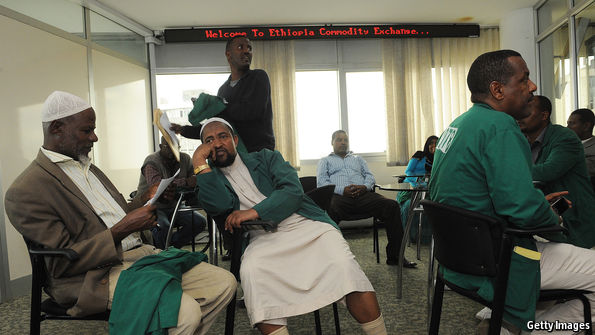
ON THE walls of the Ethiopia Commodity Exchange (ECX) in Addis Ababa, the capital, hang glossy black-and-white photographs of provincial market towns and rustic life. For the merchants and brokers striding across its high-tech trading floor they serve as a reminder that the ECX, sub-Saharan Africa’s most modern commodity exchange outside Johannesburg, exists for a simple, practical purpose: to transform Ethiopian agriculture.
It has some way to go. By connecting smallholder farmers to global markets, the exchange, launched with a fanfare in 2008, was supposed to help reduce hunger. The hope was it would reduce price volatility and incentivise farmers to plant crops. But staple foods such as haricot beans today account for less than 10% of its trade. Its annual turnover—worth about $1bn—is dominated instead by two export crops, coffee and sesame seeds. In 2015, despite a dire drought, Ethiopia did avoid famine, but the ECX played little role: its maize and wheat contracts had lapsed by then because of concerns that exports would jeopardise domestic food supplies. Cutting out middlemen seems not to have done much for smallholders: studies suggest…Continue reading
Why even win-win trade deals are tough

IN THE wee hours of December 7th 2013, after weeks of haggling, exhausted trade representatives stood to applaud. Agreement had been reached on the first trade deal in the history of the World Trade Organisation (WTO). No longer could it be accused of being a talking shop, crimped by consensus. “For the first time in our history, the WTO has truly delivered,” said Roberto Azevêdo, the body’s chief. The deal is tantalisingly close to coming into force, needing just two more national ratifications. Chad, Jordan, Kuwait and Rwanda are competing to take it over the line.
In theory, the Trade Facilitation Agreement (TFA) is a beacon of hope on the trade landscape. It was unanimously agreed to by rich and poor countries. If fully implemented, it could have an even bigger impact than slashing all tariffs. It is an example of a win-win deal, in which peer pressure pokes governments into making life easier and more prosperous.
The agreement shies away from slashing subsidies or toppling tariffs, and instead hacks at the thicket of regulatory trade barriers. The red tape is stickiest in poorer countries; in sub-Saharan Africa…Continue reading
In defence of NAFTA

THE North American Free Trade Agreement (NAFTA) has long been a populist punchbag. In the American presidential campaign of 1992, Ross Perot—an oddball Texas billionaire and independent candidate—claimed to hear a “giant sucking sound” as Mexico prepared to hoover up American jobs. Since its enactment, right-wing conspiracy theorists have speculated that NAFTA is merely a first step towards “North American Union”, and the swapping of the almighty dollar for the “amero”. Donald Trump, who plans to renegotiate (or scrap) the deal, mined a rich vein of anti-NAFTA sentiment during his campaign, calling it “the single worst trade deal ever approved in this country”. Even NAFTA’s cheerleaders (a more reticent bunch) might concede that the deal has fallen short of their expectations. But it is in none of the signatories’ interests to rip it up or roll it back.
America and Canada opened talks on a free-trade area with Mexico in 1990, shortly after securing their own bilateral deal, and it was bringing in Mexico that proved so contentious in America. When NAFTA took effect in 1994, it eliminated tariffs on more than half of its…Continue reading
India flirts with a UBI
 Basic needs
NOVEMBER 8th was not just the day of Donald Trump’s election. It was also when Indians found out most banknotes would lose all value unless promptly exchanged. Ever since, many have expected their patience in enduring the ensuing chaos to be rewarded in some way. Might scrapped cash unredeemed by presumed tax-dodgers be recycled into a lump-sum payment to each and every citizen? Or would the annual budget, presented on February 1st, be full of giveaways ahead of a string of state elections? In the event, the budget was restrained to the point of dullness. But the government’s closely-watched “economic survey”, released the previous day, hinted at a much bigger giveaway in the works: a universal basic income (UBI) payable to every single Indian.
The idea of a cash payment made to citizens irrespective of their wealth is centuries old. It has become newly fashionable in some rich countries, among both left-wing thinkers (who like its redistributive aspects) and their right-wing foes (who think it results in a less meddlesome state). The idea has had its fans in India: a small UBI scheme was launched as a…Continue reading
Silicon Valley’s criticism of Donald Trump

EARLY in 2016 Schumpeter went to a dinner with one of Silicon Valley’s luminaries, a man of towering intelligence and negligible humility. Asked about the upcoming election, he scoffed: it didn’t matter who America’s president was. Politics had become irrelevant, he said. Technology firms, and their leaders, would carry on fashioning brilliant products and generally carrying out God’s work on Earth, regardless of who occupied the White House. Cue smirks and more Hawaiian Kampachi all round.
Now Silicon Valley has thrust itself into a presidential stink. Technology groups were the first among big firms to slam Donald Trump’s executive order of January 27th, which temporarily bans people from seven mainly-Muslim countries in the Middle East from entering America. Tim Cook, Apple’s boss, criticised it to employees. Mark Zuckerberg at Facebook said he was “concerned”. Sundar Pichai, CEO of Google, told staff he was “upset” on the day of the order, and a day later the firm’s co-founder, Sergey Brin, was spotted among hundreds of protesters at San Francisco airport.
Just a month earlier all these technology firms and more…Continue reading
Hotels are placing more emphasis on loyalty schemes

FREQUENT travellers can become obsessed by loyalty schemes. Road warriors search out «points gurus», who pass on wisdom about how to wring out every last air mile and hotel upgrade from a programme, whether by signing up for a new credit card or booking a particular flight. The biggest airline scheme, American Airlines’ AAdvantage, has an estimated 100m elite members; the largest hotel programme, IHG’s Rewards Club, almost as many. But hotels and airlines have historically used such schemes in slightly different ways.
Air travel is often seen as a commodity. A flight is the miserable part of a trip that must be endured to reach somewhere exciting. True, there are degrees of torture. But carriers’ economy-class service is similar enough that it does not really matter whether a flyer boards a United or Delta plane. Hence the best way to ensure that a customer continues to patronise your airline, rather than an equally…Continue reading