
Tag: Business and finance
Taking the dollar down, or is it up?

IF THERE was a consensus view at the start of the year, it was that the dollar would rise. Fund managers surveyed by Bank of America Merrill Lynch were overweight the currency (even though they worried that it was a crowded trade).
The stars seemed aligned in the greenback’s favour. The Federal Reserve was set to raise rates, while other major central banks were keeping monetary policy loose; that should boost the dollar’s attractiveness in terms of yield. The new Trump administration was set to unveil a fiscal stimulus and boost growth; that should encourage those who wanted to buy American equities or invest in American factories. And tax proposals were designed to persuade American companies to repatriate overseas profits, giving the dollar a further lift.
So why has the dollar retreated to hit a 12-week low? The main reason is the rhetoric of the new administration. Mr Trump told the Wall Street Journal that
Our companies can’t compete with them (Chinese companies) now because our…Continue reading
Talking the dollar down, or is it up?
IF THERE was a consensus view at the start of the year, it was that the dollar would rise. Fund managers surveyed by Bank of America Merrill Lynch were overweight the currency (even though they worried that it was a crowded trade).
The stars seemed aligned in the greenback’s favour. The Federal Reserve was set to raise rates, while other major central banks were keeping monetary policy loose; that should boost the dollar’s attractiveness in terms of yield. The new Trump administration was set to unveil a fiscal stimulus and boost growth; that should encourage those who wanted to buy American equities or invest in American factories. And tax proposals were designed to persuade American companies to repatriate overseas profits, giving the dollar a further lift.
So why has the dollar retreated to hit a 12-week low? The main reason is the rhetoric of the new administration. Mr Trump told the Wall Street Journal that
Our companies can’t compete with them (Chinese companies) now because our…Continue reading
A new boss at the helm of Exxon Mobil
With Exxon Mobil’s former chief executive now Trump’s Secretary of State, what challenges will face the new man in charge of the world’s largest private oil company? India’s annual economic survey includes an idea for a Universal Basic Income (UBI). What could a UBI mean for India’s poor? And a Harvard economist examines the pay gap afflicting women in employment.
Chaos at airports as America introduces a travel ban

BARELY a week into his presidency, Donald Trump has thrown global travel into tumult with his executive order barring travellers from seven majority-Muslim countries from entering the United States. A fellow Gulliver has posted about the potential long-term implications of the ban for the travel industry. But in the short run, one thing is already clear: President Trump’s action has sown chaos in American airports.
Clear to everyone but Mr Trump himself, that is. In a series of tweets, he denied that his action had caused any disruption at airports, instead blaming a Delta Air Lines computer glitch, protesters, and Democratic Senate leader Chuck Schumer, whom he accused of producing “fake tears” in support of people denied entry to the country.
Only 109 people out of 325,000 were detained and held for questioning. Big problems at airports were caused by Delta computer outage,…..
— Donald J. Trump (@realDonaldTrump) January 30,…Continue reading
How Donald Trump’s immigration edict will affect American tourism

THERE are many ways to look at Donald Trump’s decision to ban travellers from seven countries with predominantly Muslim populations. Whether Mr Trump’s order is legal, moral or self-defeating has been discussed at length elsewhere on this site. Here on Gulliver, however, we are mostly concerned with what the move means for the future of travel to America.
The executive order which the president signed on January 27th restricts immigration from Iran, Iraq, Sudan, Syria, Libya, Somalia and Yemen. Mr Trump says the aim of the edict is to thwart terrorism. It affects travellers on all types of visas (other than diplomatic and UN ones) and refugees and will be in force for 90 days (indefinitely in the case of Syrian refugees). It is still unclear exactly what it means for dual nationals or those with green cards, although Reince…Continue reading
Making protectionism unpopular again

BACK in 1906, an insurgent politician called Joseph Chamberlain (once known as Radical Joe, he had switched to the Conservatives over home rule for Ireland*) lured the government into a campaign in favour of tariffs. The result was a devastating defeat for the Conservatives. The opposition Liberal party recognised that tariffs were a tax on the goods bought by the poor, particularly on food, and warned that the policy would lead to a «smaller loaf». They portrayed tariffs as «stomach taxes».
A hundred years ago, then, it was easy to make protectionism unpopular. Despite the prosperity brought by 70 years under a more open trading system, it now seems that opinion may have changed: tariffs are favoured by «populist» politicians.**
The trick for modern populists has been to focus on the positive benefits to American workers in terms of jobs, rather than the adverse impact on consumers. In fact, protectionism is highly unlikely to restore American manufacturing jobs, which are under threat from automation as well as globalisation, as our
Formula One’s new American owner gives Bernie Ecclestone the heave-ho

FOR nearly 40 years, he showed skill and stamina at the wheel of Formula One (F1). But this week Bernie Ecclestone ran out of track. The sport’s new owner, Liberty Media, was at pains to portray its replacement of him as chief executive (by Chase Carey, a former president of Rupert Murdoch’s 21st Century Fox) as smooth. But the straight-talking octogenarian has never been one to stick to the script: he complained he had been “forced out”.
Liberty, which is controlled by John Malone, a billionaire, agreed to buy the sport last year, in a deal worth $8bn; the deal was completed on January 23rd. That provided an exit for CVC, a private-equity group which had purchased control in 2006. Mr Ecclestone gets the title of “chairman emeritus” as a sop—he said he doesn’t know what the title means—and will, said Liberty, “be available” to advise the board.
His exit was not a total surprise, though the timing had been unclear; he had talked about remaining involved in running F1 for another two to three years. Liberty may wish to draw a line under the Ecclestone era as a precautionary measure. F1 was often mired in litigation during…Continue reading
Bridge International Academies gets high marks for ambition but its business model is still unproven

AT THE Gatina branch of Bridge International Academies, on the outskirts of Nairobi, Nicholas Oluoch Ochieng has one eye on his class of five-year-olds and the other on his tablet. On the device is a lesson script. Every line is written 7,000 miles away, in Cambridge, Massachusetts. There an American team analyses 250,000 test scores every ten days from Bridge’s 405 Kenyan schools, and then uses the data to tweak those parts of a lesson where pupils find themselves stumped. Teachers, if they are instructing the same grade level, give identical lessons, and timetables are standardised, too. So when Mr Ochieng’s pupils read from their books, the same words should be reverberating off the walls of each Bridge nursery.
That chorus should soon grow louder. Founded in 2008, Bridge has grown into one of the world’s largest groups of for-profit schools—and the largest targeting poor pupils. It has 100,000 pupils spread across Kenya, Liberia, Nigeria, Uganda and India. Bridge says it aims to teach 10m children—the size of Britain’s pupil population—within the next decade.
Bridge’s ambitious target sets it apart from the low-cost…Continue reading
Qualcomm is again under attack for living large off its patent portfolio
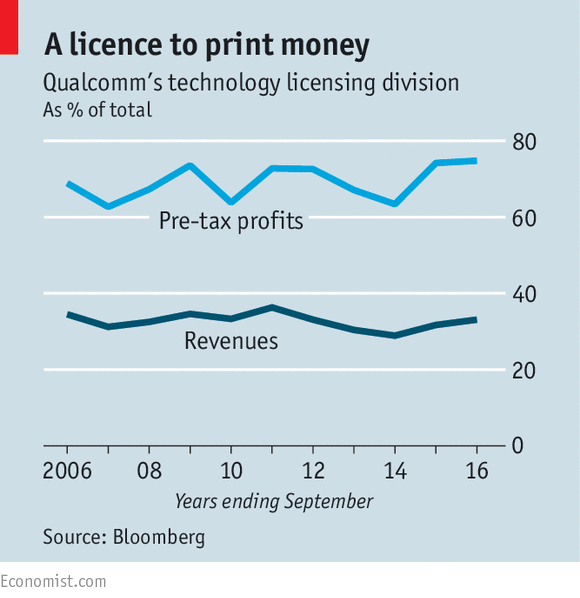
“SHOULD five per cent appear too small, be thankful I don’t take it all.” The Beatles wrote “Taxman” in 1966 to protest at Harold Wilson’s exorbitant “supertax” rates. Critics of Qualcomm, the world’s biggest chip-design firm, would say the lyric is a clue to the company’s business practices. Its methods have attracted a barrage of legal complaints. The latest came on January 25th, when Apple, a smartphone maker, sued it in China for abusing its clout in mobile processors and demanded 1bn yuan ($145m) in damages. Just days earlier Apple had filed a similar lawsuit in California asking for $1bn.
America’s Federal Trade Commission (FTC) issued a separate complaint against the firm this month. In late December, the equivalent body in South Korea fined it a whopping $853m, which hurt its quarterly results, announced this week. These cases follow two similar ones in 2015: Chinese regulators imposed an even higher fine, of $975m; and the European Commission found Qualcomm guilty of having sold chips below cost to hurt rivals.
Qualcomm is no household name, but most people with mobile phones use its technology….Continue reading
Political dating sites are hot
 Looking for a bit of Trumpy pumpy
AFTER Donald Trump was elected president, Maple Match, an online dating app which connects Canadians and Americans, was inundated with people signing up. The app promised to make it easy for Americans to find a Canadian partner to save them from the “unfathomable horror” of a Trump presidency. Joe Goldman, the app’s Texas-based founder, says it has taken on the perceived ethos of Canada: welcoming, open and tolerant. “We’re building bridges when people are talking about building walls and our users like that.”
TrumpSingles.com is forging connections, too. Its founder, David Goss, wants to make it easier for Trump supporters to find each other. The site’s earliest users were in Los Angeles, New York and Philadelphia, which are Democratic strongholds. Now its users are in every state. They are also signing up from abroad, including in Britain and in Russia. Mr Goss and his team personally approve each of the site’s 26,000 users to weed out trolls. The site was able to increase its monthly fee from $4.95 to $19.95 in December following Mr Trump’s election victory. It enjoyed a…Continue reading