
Tag: Business and finance
The definition of “maximum employment” needs updating
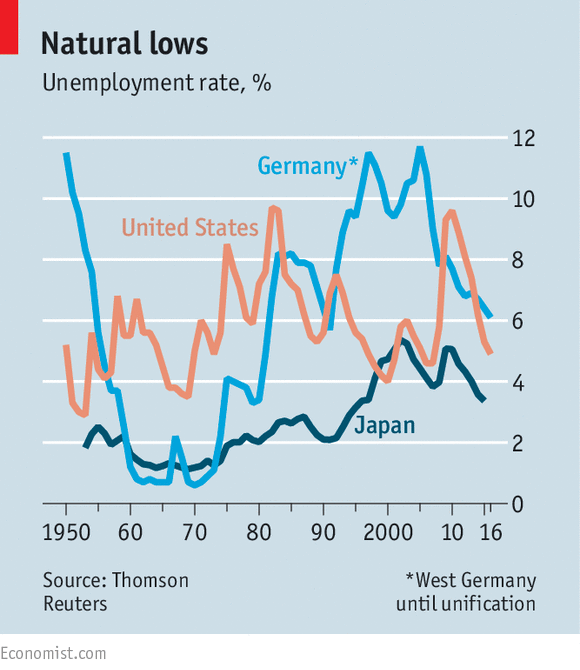
“IT IS fair to say the economy is near maximum employment,” said Janet Yellen, chairman of the Federal Reserve, in recent comments preparing markets for rate rises to come. But “maximum employment”, like pornography, is in the eye of the beholder. American adults, of whom only about 69% have a job, seem less than maximally employed. In previous eras, governments of countries scarred by economic hardship set themselves the goal of “full” employment. Today, the target is termed “maximum”. But it is the same concept. It needs a bit of updating.
Ms Yellen has a particular definition of maximum employment in mind, built on the economic experience of the past half-century. In the 1960s and 1970s a consensus (or, at least, what passes for one in macroeconomics) emerged that government efforts to boost demand could push unemployment only so low. Below that “natural rate”, it would soon start climbing again and inflation would accelerate. So now central bankers take a guess at the natural rate and at how quickly unemployment that is “too low” will spark inflation. Maximum employment, in their view, is the sweet spot: the…Continue reading
McDonald’s is going for healthier fare and greater digitisation

IN A newly released film, “The Founder”, the character of Ray Kroc promises that the startup he had taken over from the McDonald brothers “can be the new American church”. Portrayed by Michael Keaton as a turbo-charged egomaniac whose scruples diminish as his success increases, Kroc understood the power of branding, the advantages of franchising and the attraction of speed in food retailing. McDonald’s is now one of the country’s biggest food chains, with more than 14,200 outlets.
The domestic market is still its most important one, despite the firm’s massive global presence. When it reported this week that global sales had dropped by only 5% in the fourth quarter, the number beat expectations. News of a drop in sales in America of just 1.3% was received more gloomily. Hopes had risen because of the previous six consecutive quarters of domestic growth. At the end of 2015 and in early 2016 the chain had reaped the rewards of introducing the popular all-day breakfast in America. A year or so later, Egg McMuffins and sausage biscuits have shed some of their allure.
Still, Steve Easterbrook, the firm’s British boss, who took over…Continue reading
President Trump’s infrastructure plans probably involve more tolls

FOR business travellers trying to work out what the Donald Trump era will mean for them, one of president’s central campaign promises seemed to bode well: investing up to $1trn in American infrastructure. But anyone hoping for smoother roads, faster rides and more efficient airports might be in for a rude awakening, in the form of long waits and extra expenses at the toll booth.
American infrastructure needs an upgrade. The American Society of Civil Engineers is already complaining that a 13-figure investment might fall short of the $3.6trn required to bring roads, airports, pipelines and the like up to par. But the crux of the issue is not the amount Mr Trump will spend; it is how that money will be allocated. The answer appears to be that it will be spent by private companies on projects where they can turn a profit.
On Tuesday, the Congressional Budget Office
American Airlines does away with seat-back entertainment

IT IS becoming a dilemma for any airline ordering a new batch of planes: should it ask for entertainment screens to be fitted into the back of every seat? Most aviation watchers expect that the technology will become obsolete at some point in the coming years, as more people fly with their own devices. But it is not passé yet. Anyone flying long-haul still expects to find a tiny, fuzzy monitor a few inches from their nose.
Nonetheless, over the lifetime of a new plane, entertainment built into headrests will come to look quaint. So American Airlines has decided to get ahead of the times. Its new order of 100 Boeing 737s, which should start to enter service by the end of the year, will not have seat-back entertainment. Instead passengers will be able to stream films on their phones, tablets and laptops using the plane’s Wi-Fi.
This seems like a sensible move. Ninety per cent of its passengers, reckons the airline, already carry a smart device onboard. In-flight entertainment systems cost around $3m to install on every jetliner. Shunning them not only saves on that initial outlay, but also on fuel costs. All that underfloor wiring and modified seating adds bulk to…Continue reading
An Expert’s Guide to Trumponomics
A leading economist has issued stark warnings about the Trump era and its impact on the American and global economy. We ask if the new President’s monetary policy is likely to succeed or fail. And with Trump being an economic populist, what will be his attitude to The Fed?
The markets have second thoughts on Donald Trump

MARKETS are always full of surprises. In the run-up to the Presidential election, many investors were nervous about the possibility of a Trump victory. But on the night of the results, there was a dramatic turnaround. Within a few weeks, the market capitalisation of global equities had risen by $3trn and that of government bonds had fallen by the same amount. Markets were betting on “Trump lite”—that his tax cuts and infrastructure spending would be pushed through boosting growth and possibly inflation. By contrast, they downplayed the other “Donnie Darko” element of his policies—his threats to tear up trade agreements and heighten geopolitical risk in the middle east and Asia.
So far, however, we have seen more of Donnie Darko than Trump lite. First there was his “I have a nightmare” inauguration speech with its references to “American carnage” and protection. Then there were his early actions…Continue reading
Britain starts to accept passport photos taken on mobile phones

DESPITE what doting parents claim, babies are mostly generic-looking. It sometimes takes Gulliver an embarrassing length of time to pick out his own child in old baby-group photos. He certainly wouldn’t recognise her from her passport picture aged four months.
Now she is five, with recognisable facial features, she will shortly have to renew her passport. Snapping the new likeness should be easier than the first time around, when it involved a schlep to a photography shop, and several attempts to get her facing the right way, head up, with Mrs Gulliver’s supporting hands nowhere in shot. In fact she won’t even have to leave the house. The passport office has confirmed that it will now accept photos taken on mobile phones when Brits renew their passports online. (Those applying for their first passports still have to have physical photos countersigned by a professional acquaintance to vouch for their likeness.)
The change should be welcomed. The whole process of renewing a British passport has become easier since the introduction of online applications last year. Two main objections have been raised, though. The…Continue reading
Davos in the spotlight
China’s President has addressed the World Economic Forum, the first Chinese head of state to do so. We assess his message to Donald Trump. Plus the author of the “Second Machine Age” Erik Brynjolfsson on why governments are failing to address the downsides of automation. And Harvard’s Ken Rogoff examines the The Curse of Cash and why reducing our dependency on it might be a good thing.
Korea Air admits to tasering unruly passengers

CABIN crew on Korea Air flights have used electric stun guns to pacify flyers on five occasions, according to an investigation by the BBC. The report says that South Korea’s national carrier is the only big airline known to fly with such tasers on board. They were first introduced on its planes in 2002.
According to the Beeb, the airline is now “ramping up training for staff using the guns after criticism for the way it handled a recent in-flight disturbance”. In that instance, an all-female cabin crew apparently took four hours to subdue a drunk passenger, with other paying flyers forced to help them do so.
Allowing flight attendants to use weapons on planes is troubling. If it takes demure crew several hours to pacify a drunkard, it will not take much for a ne’er-do-well to take the weapon from them for his own means. And no matter how well trained the crew are at handling a taser, they were presumably not selected by the airline for their dead-eye abilities. The danger of something going wrong is too great.
If someone must be responsible for electrocuting flyers, it should be a…Continue reading
Korean Air admits to tasering unruly passengers
CABIN crew on Korean Air flights have used electric stun guns to pacify flyers on five occasions, according to an investigation by the BBC. The report says that South Korea’s national carrier is the only big airline known to fly with such tasers on board. They were first introduced on its planes in 2002.
According to the Beeb, the airline is now “ramping up training for staff using the guns after criticism for the way it handled a recent in-flight disturbance”. In that instance, an all-female cabin crew apparently took four hours to subdue a drunk passenger, with other paying flyers forced to help them do so.
Allowing flight attendants to use weapons on planes is troubling. If it takes demure crew several hours to pacify a drunkard, it will not take much for a ne’er-do-well to take the weapon from them for his own means. And no matter how well trained the crew are at handling a taser, they were presumably not selected by the airline for their dead-eye abilities. The danger of something going wrong is too great.
If someone must be responsible for electrocuting flyers, it should be a…Continue reading