
Tag: Business and finance
Autumn blues
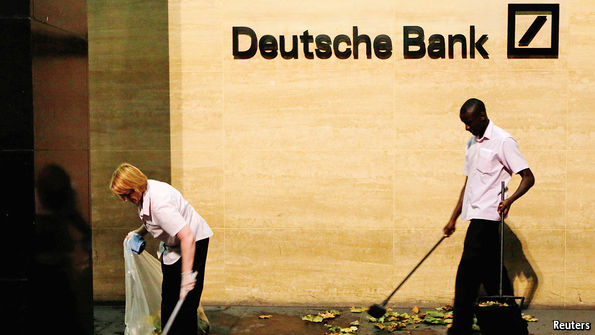
QUEASY calm is unpleasant, but it beats sickening panic. Late on September 29th Deutsche Bank’s share price lurched downwards again, to a 34-year low, after Bloomberg reported that “about ten” hedge funds had switched some business away from the troubled German lender. That capped a stomach-churning fortnight, after America’s Department of Justice (DoJ) requested $14 billion to settle claims that Deutsche mis-sold residential mortgage-backed securities (RMBSs) before the financial crisis. Hopes that it might settle with the DOJ for $5 billion-odd, though so far unfulfilled, have since brought uneasy respite. On October 5th Deutsche’s shares were some 20% above their nadir.
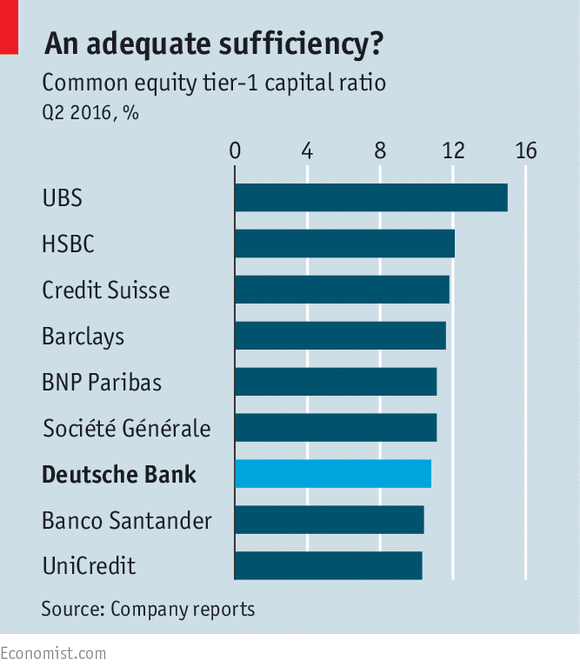
A swift, affordable agreement would end uncertainty about the bill and quieten chatter, pooh-poohed by government and bank, that the German state might have to prop up the country’s biggest lender. It would also buy breathing space….Continue reading
An emerging threat

WHEN the returns on cash and government bonds in the developed world are zero, or even negative, it is hardly surprising that investors are casting their nets more widely. In the process the “search for yield”, as it has been called, has inevitably turned its attention to emerging markets.
One or two decades ago, emerging-market sovereign debt might have been the only beneficiary of these flows. But government bonds do not offer such a juicy return these days; the yields on ten-year bonds issued by Malaysia and the Philippines, for example, are around 3.6%.
As a result, investors are taking a big extra risk and piling into emerging-market corporate debt. So far this year bond funds in that sector have received inflows of $11.5 billion, according to HSBC. Their enthusiasm has been rewarded. Bloomberg’s emerging-market corporate-bond index has returned 13.4% since January 1st, compared with a return of just 4.4% from American Treasury bonds (see chart). This rally has occurred despite early-year wobbles about the strength of the Chinese economy and the impact of higher American interest rates.
The improved…Continue reading
How the other tenth lives

WHAT is the most important number in global economics? Judging by the volume of commentary it excites, America’s monthly payrolls report (released on October 7th) might qualify. Other contenders include the oil price or the dollar’s exchange rate against the euro, yen or yuan. These numbers all reflect, and affect, the pace of economic activity, with immediate consequences for bond yields, share prices and global prosperity—which is what economics is ultimately all about.
But if global prosperity is the ruling concern of economics, then perhaps a more significant number was released on October 2nd by the World Bank. It reported that 767m people live in extreme poverty, subsisting on less than $1.90 a day, calculated at purchasing-power parity and 2011 prices. The figure is not up-to-the-minute: such is the difficulty in gathering the data that it is already over two years out of date. Nor did the announcement move any markets. But the number nonetheless matters. It represents the best attempt to measure gains in prosperity among the people most in need of them.
The latest figures should arouse mixed feelings. They are…Continue reading
Career breaks
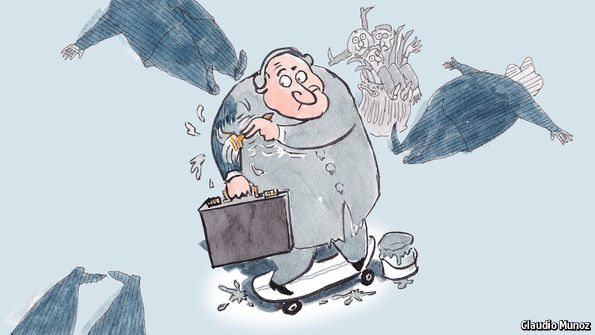
FRANK LLOYD WRIGHT quipped that “the modern city is a place for banking and prostitution and very little else.” Little did the early 20th-century architect know how banks would flourish, hoovering up much of the world’s talent by the early 2000s. But this golden age is ending: bankers’ jobs are at risk from the digital revolution on the one hand, and falling profits on the other.
Nowhere have bankers fallen from grace with such a bump as in Europe. This week ING, the Netherlands’ largest bank, announced that up to 7,000 jobs would be cut in the next five years. Commerzbank, Germany’s second-largest bank, had already reported it would cut its workforce by 9,600, nearly a fifth.
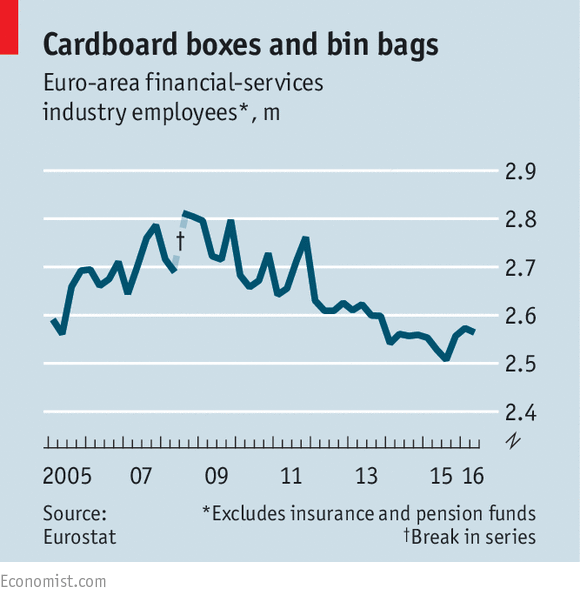
Across Europe, bankers are packing up. In Britain more than 10% of bank jobs were cut between 2011 and 2015; in Germany the workforce has shrunk by around 20% since 2001. Since the start of the year Credit Suisse has got rid of…Continue reading
Peacocks of the sea

THE Monaco Yacht Show, which ran from September 28th to October 1st, is arguably the world’s most extravagant game of one-upmanship. This year more visitors than ever—34,500—came to gawp at 125 superyachts with a collective value of $2.7 billion, tied up in the principality’s Port Hercules. But the yachts were only the beginning. Monaco is essentially a bazaar for the 0.1%: everywhere you look there are hawkers in pop-up tents trying to sell things that you never knew you needed. There were submersibles that can take six people to the bottom of the ocean; armour-plated Land Rovers; jet-skis and 3D goggles; military-style helicopters and flying boats. Among the variety of servants for hire were armed guards and on-board DJs.
In this world, size counts for a lot. The bit of the yacht industry that has recovered most strongly since the financial crisis is the “monster yacht” segment. The Superyacht Intelligence Agency says 62 yachts of 70 metres plus were delivered in 2011-16. Another 59 are under construction, despite the fact that some of the usual big spenders have pulled in their horns a bit. The decline in the oil price has hit both…Continue reading
Your name will also go on the list

FIRMS must list foreign workers, blares the headline of London’s Times newspaper today after a speech from the Conservative government’s new home secretary, Amber Rudd. The idea, it seems, is not to list each and every individual but for companies to list the total number of their foreign employees so that they can be “named and shamed”.
Conservative Home Secretaries have a tradition of throwing red meat to delegates so it may be that this policy never goes any further. On the BBC’s Today programme this morning, Ms Rudd was emphasising that the policy was only “for consultation”, and if she consults business, she’ll probably get a pretty rude answer. Which business would want to be named and shamed at the top of the list, with all the potential for adverse publicity, demonstrations etc? It’s all a bit reminiscent of the first world war, when shops with German-sounding names had their windows broken and the Royal family changed its name from Saxe-Coburg-Gotha to Windsor.
But this was not the only bad idea to come out of the current Conservative conference. First, there was the idea of
Fat help

BACK in Syria food was cheap, remembers Maya, as she sits cross-legged in the small flat she shares with her husband, their five children and another couple in Amman, Jordan’s capital. When she first arrived here, she had to cut back. But now, with her husband working and 20 dinars ($28) a month from the World Food Programme (WFP), a UN agency, she can buy the children a treat like fish or chicken.
Scattered across Turkey, Lebanon and Jordan are 4.4m registered Syrian refugees, 90% of whom, like Maya, live outside formal refugee camps. This makes it a logistical nightmare to get the traditional food aid to them—sacks of rice and pulses. The WFP, the world’s largest food-aid provider, has adapted: a decade ago, it doled out aid only in kind. Now just over a quarter of its aid globally is cash-based. Every month Maya gets a text message alerting her that her special debit card, which she can use only to buy food, has been topped up. The WFP reaches around 1.1m refugees like this in Jordan, Lebanon and Turkey.
This week saw the launch in neighbouring Turkey of the largest-ever humanitarian-aid project financed by the EU: a whopping €348m…Continue reading