
Tag: Business and finance
Hard bargains

ECONOMICS can seem a rather bloodless science. In its simplest models, prices elegantly balance supply and demand, magically directing individuals’ pursuit of their own self-interest towards the greater good. In the real world, humans often undermine the greater good by grabbing whatever goodies their position allows them. The best economic theorising grapples with this reality, and brings us closer to understanding the role of power relationships in human interactions. This year’s Nobel prize for economic sciences—awarded to Oliver Hart and Bengt Holmström—celebrates their study of economic power, and the tricky business of harnessing it to useful economic ends.
Behind the dull-sounding “contract theory” for which the two were recognised lies an important truth: that when people want to work together, individual self-interest must be kept under control. For a chef and a restaurant-owner to work together productively, for example, the owner must promise not to use the power he has to change the locks in order to deny the chef his share of future profit. Mr Hart, a British economist working at Harvard University, tackled power dynamics while…Continue reading
Hide and seek

IT WAS one of the most spectacular robberies of modern times. In February thieves tried to steal nearly $1 billion from accounts held by Bangladesh Bank, the central bank, at the Federal Reserve Bank of New York. They were thwarted, but only after spiriting away $101m. Since then Bangladesh’s government has twice suppressed the publication of a report into the heist, most recently last month, on the ground that making it public would jeopardise efforts to retrieve from the Philippines $81m that is still missing. Interviews with officials and others in Dhaka lead to an obvious conclusion: the report will almost certainly never be made public.
The investigating panel’s remit was to establish why the central bank kept the theft secret for a month, whether bank officials were involved in it and how to avert a similar heist in future. Mohammed Farashuddin, a former central-bank governor, who led the probe and once advocated its publication, will not comment on its findings. The word in Dhaka is that the report is being buried because it exposed lapses at the central bank and implicated its officials or consultants. The government has consistently…Continue reading
Brexit means…higher prices

THE economic arguments for and against Brexit in the course of the referendum campaign were quite esoteric and confusing to the average voter. Similarly, sterling’s decline in the currency markets might seem like the kind of thing that only concerns City traders.
So the row that has broken out between Tesco, Britain’s biggest supermarket chain, and Unilever, the Anglo-Dutch multinational, has made the story concrete in ways that were not apparent before. Unilever wants to raise prices across a range of goods to reflect the fall in the pound, which has dropped from around $1.50 on the day of the referendum to less than $1.22 at the time of writing. Similar falls have been seen against the euro; indeed travellers who change their money at the airport are getting less than a euro per pound.
The row has centered on Marmite, a salty yeast-based spread that is loved by some, but not all, Britons including this blogger. (I have yet to meet an American who can stand it.) But Marmite isn’t the best example as it is made in this country. PG Tips, one of Britain’s favourite tea brands (pictured), is a better example; that is…Continue reading
The business of outrage

ONE of the gentler quips uttered by the writer and thinker H.L. Mencken was that nobody ever went broke underestimating the intelligence of the American public. By the same token, nobody ever went broke overestimating the anger of the American people. The country is in an unusually flammable mood. This being America, there are plenty of businesspeople around to monetise the fury—to foment it, manipulate it and spin it into profits. These are the entrepreneurs of outrage and barons of bigotry who have paved the way for Donald Trump’s rise.
The very first of them was Rush Limbaugh who, back in the 1980s, transformed himself from a disc jockey into a radio commentator. Mr Limbaugh shook up the ossified talk-show format by dispensing with the tedious call-ins and adding anarchic humour. Soon an army of “ditto-head” followers hung on his every word. He has 13m regular listeners and hundreds of imitators, ranging from national stars such as Sean Hannity to local ranters.
The second entrepreneur of outrage was Roger Ailes, a Republican operative who teamed up with Rupert Murdoch to build Fox News. Mr Ailes took talk radio and added TV…Continue reading
There is more than one kind of economic mess to be in

HERE is a funny little story about the history of economics. John Maynard Keynes called his landmark economics text «The General Theory of Employment, Interest and Money». The «general theory» in the title was doing double duty. It modestly suggested a comparability between Keynes and Albert Einstein, a genius whose work revolutionised his field. It was also meant to convey that this was the big—one might say macro—idea shaping how employment, interest, and so on all work. Keynes’s peers, while impressed by the book, weren’t quite sure about its generality. John Hicks helped to turn Keynes’s great work into the models that would form the basis of macroeconomics textbooks, and shape policy thinking, for decades to come. Yet he also needled Keynes, writing that the great man’s economics provided a novel way of thinking about depressions but not much else:
[I]t is not the General Theory. We may call it, if we like, Mr. Keynes’ special theory. The General Theory…Continue reading
Flash Crash Bang Wallop
Philip Coggan joins host Simon Long to explain what’s next for the pound in the light of the latest flash crash in its value. Also: Ryan Avent delves into the work that won the latest Economics Nobel prize and Patrick Foulis lays out why Elon Musk’s finances might be as combustible as his rockets
Brexit is making Britons poorer, and meaner

THESE are exciting times for Britain’s currency, and not in a good way. On the eve of the vote on whether to leave the European Union, back in June, a pound bought you $1.48. Sterling has since declined by more than 16% against the dollar, to $1.22. Nearly half of the drop has occurred in the last week or so, as the Conservative government has outlined plans for a “hard” Brexit: one which shoves Britain right out of the single market in exchange for the ability to do more harm to itself by reducing migration.
In a piece for the Wall Street Journal, Greg Ip (a friend and former colleague of this blogger) does a nice job explaining the links between Brexit and a tumbling pound. Markets anticipate that it will become more costly for British firms to sell goods and services to Europe. Europeans will consequently buy fewer of them, and therefore fewer pounds, leading to a weaker currency. That is, cheap sterling is part of the adjustment to a loss in British competitiveness: the mechanism by which Britons come to spend less on foreign goodies (now…Continue reading
Airlines are to cough up for cross-border flight pollution
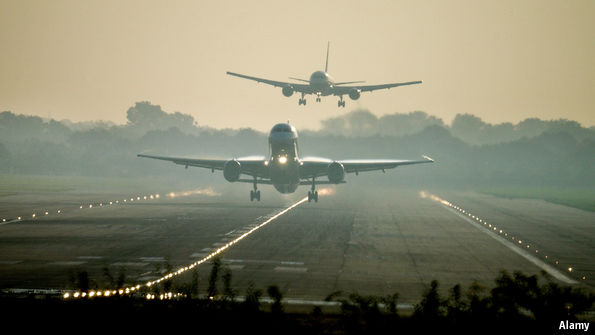
CIVIL aviation accounts for perhaps only 2% of manmade carbon emissions. Add in other pollutants, such as contrails and nitrous oxide, and the industry’s overall contribution to climate change might be twice that figure. That may not seem much. But the sector is growing rapidly. Since the 1970s, global air traffic has doubled in size about every 15 years. Rising prosperity in developing countries and massive backlogs of aircraft orders means that the growth will continue for decades. Without regulation, the world’s airlines could quickly choke the skies.
Last week, the International Civil Aviation Organisation (ICAO), a United Nations agency, announced a framework for mandatory carbon-offsetting on all international flights. The agreement was backed by 65 countries, which between them account for 86.5% of international flight operations.
International flights, unlike domestic ones, were exempt from last year’s Paris Agreement on climate change. This new tentative accord seeks…Continue reading
Oliver Hart and Bengt Holmstrom win the Nobel prize for economic sciences

SUPPOSE that you and I are interested in opening a lemonade stand together. We agree that I will bring the materials we need (cups, stand and so forth) while you will make the lemonade. I’ll do the pouring while you mind the cashbox and at the end we will split the proceeds fairly. A doubt niggles, though. I am worried you might, at the end, try to hog the contents of the cashbox. We therefore decide to draw up a contract (common practice in the lemonade-stand industry) dictating that the returns to our operation must be split evenly. But then you start to worry: much of the success of our stand will depend on the quality of the lemonade, over which I have no control. What if I decide to slack off and piggyback on your lemonade-brewing genius, knowing that after you pour your sweat into the lemonade (not literally), the split is still an even 50-50? We therefore set to haggling over language in the contract setting out precisely how each of us should do our respective jobs.
Contracts play a critical role in the operation of the modern economy. They set out who is allowed to do what with the land they own, the people they employ and the songs they store on their smartphones….Continue reading
Sterling takes a pounding

THE foreign exchange markets are about the most liquid trading arena in the world, certainly for the major currencies. So sterling’s 6% fall in two minutes this morning—from $1.26 to $1.18 (see chart below), with a similar-sized move against the euro—was a very unusual event.
Traders’ minds went back to the Swiss franc’s sudden jump in early 2015, when the currency rose by 30% in an instant. But that was down to a change in policy; the abandonment of the Swiss National Bank’s cap on the franc’s strength. There was no such news to affect the pound.
The best explanation seems to lie in the world of algorithmic trading—the computer programmes that automatically generate transactions. Such programmes have been blamed for “flash crashes” in the equity markets, particularly the May 2010 event which saw the Dow plunge nearly 1000 points in minutes before recovering. The problem seems to be that programmes feed off each other. Each may have a trigger point which requires the programme to sell an…Continue reading