
Tag: Business and finance
Feel the force flow

YOU would expect strong job growth to be accompanied by falling unemployment, but America is proving that one does not always entail the other. Over the past year, employment is up by fully 3m but the unemployment rate has stayed around 5%. In fact, a few more workers are unemployed than a year ago (see chart). The reason is that more Americans are seeking jobs. Over the past 12 months the labour-force participation rate of so-called “prime-age” workers—those between 25 and 54—is up by just under one percentage point, the fastest growth recorded since January 1989. Economists trying to spot inflation on the horizon want to know how long this trend can continue.
The recent surge in prime-age participation follows a long decline from its peak, 84.6%, scaled in January 1999. Between then and September 2015, it tumbled by an average of about a fifth of a percentage point a year. Among men, it had been falling since the mid-1960s. The long slide accelerated after the financial crisis, as laid-off workers quit the labour force in droves.
Hence the refrain of some that low unemployment is a mirage: stronger economic growth,…Continue reading
Gold posts
 He’s got the moves
HAVING just received the latest PlayStation console from Sony, Dele Alli, an English footballer, posts a photo of it to his Instagram account. He dutifully thanks his benefactor and concludes the message: “#ad”.
It is the latest frontier of a rapidly growing industry. Since January, more than 200,000 posts per month on Instagram, a picture-sharing app owned by Facebook, have been tagged with “#ad,” “#sp” or “#sponsored”, according to Captiv8, a firm that connects brands to people like Mr Alli. Most are reaching Instagram users via such celebrities. Hiring “influencers”, as they are known, connects brands to a vast network of potential customers. Kim Kardashian West, a reality-TV star, for example, reaches 160m people across Facebook, Instagram and Twitter.
Consumers love the unprecedentedly deep access to the lives of the rich and/or famous that platforms offer. DJ Khaled, a music producer and prolific poster on Snapchat (another picture-messaging app), delighted millions of his followers with live video updates of himself lost at sea at night on a jet ski. He is also an…Continue reading
Made men
AT A bar called “University” in San Giovanni a Teduccio, a rundown suburb of Naples, two blown-up photos adorn the walls: Albert Einstein and Steve Jobs, founder of Apple. Nelson Ciarravolo, the owner, put them up when the bar opened two years ago, long before the news came that Apple would open its first European iOS (its mobile operating system) developer academy in the district. Locals joke that Mr Jobs’s photo may have gone up more recently. Either way, it signals that Naples has embraced the American tech giant. On October 6th Apple held the opening event for the new academy, which it will run in collaboration with Federico II University, after which the bar is named.
“We go to places nobody thought were possible”, explained Lisa Jackson, vice president of environment, policy and social initiatives at Apple, at the inaugural event. Naples lags far behind northern Italy for transport and digital infrastructure, and criminality is rife. The Camorra, a mafia gang, runs one of the biggest drug-trafficking enterprises in the world from the city. The neighbourhood in which Apple has opened the academy (it is located inside a new campus of Federico II University) used to be more dangerous. “We used to see our friends die on the ground,” recalls Davide Varlese, a cousin of Mr Ciarravolo. But things have improved over the past decade as authorities have…Continue reading
Insanely virtual
 Better reality
AT THE heart of an emerging technology cluster in London’s Shoreditch lies the Stage, a big mixed-use building complex that is being developed by Vanke, a Chinese real-estate company, among a few others. A potential Chinese buyer of one of the flats in its 37-storey residential tower recently had a look around. She went from room to room, observing the furnishings and fittings. She marvelled at the city views from the balcony and peeped inside the refrigerator. There was no need for a flight to London. She toured the property using virtual reality (VR) goggles at Vanke’s global marketing centre in Shanghai.
The use of VR kit is quickly becoming widespread in China’s property industry. Few real-estate firms in other countries are as advanced. China is fast emerging as the world’s most important VR market, thanks to rapid adoption by property firms and by companies in other industries. The prompt take-up is not because Chinese firms make the best VR headsets, which they do not. In fact, the pioneers in cutting-edge hardware are America’s Oculus, which is owned by Facebook, Japan’s Sony, South Korea’s…Continue reading
Cream of the crop

TO CELEBRATE its 40th birthday, Vinamilk, a big Vietnamese dairy firm, filmed a children’s choir crooning adorably from the helipad of one of the country’s tallest towers. In truth the company hardly needs to sing its own praises. Vinamilk is probably Vietnam’s most familiar consumer brand, and it is widely considered to be the country’s best-run firm. Over a decade its profits have grown by close to one-third each year.
Hence the interest among foreigners in a 9% share to be sold by the government this year—the first tranche in a disposal which should eventually see Vietnam’s communist government give up its entire 45% stake in the firm. It is one of several big companies which the ruling party now promises to part with; two others are the Hanoi and Saigon beer companies, known as Habeco and Sabeco. After years of divesting mainly small slivers of unappealing enterprises, Vietnam is at last offering foreigners a slice of its best assets.
Vinamilk meets much of Vietnam’s daily demand for dairy products, including four-fifths of its condensed milk (most often found lurking sweetly at the bottom of the country’s famous…Continue reading
Charred chaebol

WHEN Samsung Electronics announced on October 11th that it would discontinue its flagship smartphone, the Galaxy Note 7, one crucial event in the history of the world’s second-biggest technology company by revenues (after Apple) sprang to mind. In 1995 Lee Kun-hee, then its boss, ordered 150,000 mobile phones burned and bulldozed in front of 2,000 weeping employees. Business partners who had received the devices as gifts from him had reported back that they did not work properly.
The South Korean auto-da-fé is said to have helped create a culture of permanent crisis at the firm, which drives employees to work incredibly hard. Now the question is how the ignominious end of the Galaxy Note 7 handset, which some hardware aficionados had called the best “phablet” (or large smartphone) ever made, will change Samsung, which is going through a leadership transition. In the midst of the crisis, the firm announced that Lee Jae-yong, the son of Mr Lee, would join the board of Samsung Electronics later this year, taking another step towards succeeding his father, who two years ago suffered a debilitating heart…Continue reading
Retailers and issuers are still battling over payment –card fees
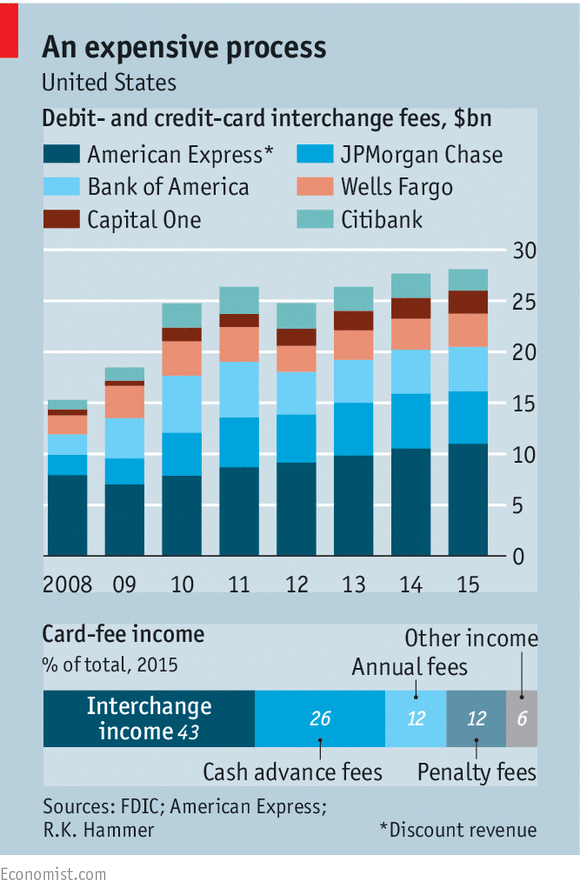
IN 1966 a medical journal identified a condition it dubbed “credit-carditis”: lower-back ache, with pain radiating down the leg—caused by a back-pocket wallet stuffed with plastic. Payment cards still inflict pain of a different sort. American merchants paid more than $40 billion to process debit- and credit-card transactions in 2015. Despite a reform by the Federal Reserve in 2011 aimed at reducing these costs, revenue from these so-called “interchange fees” has more than doubled since the financial crisis. Retailers are still in revolt; banks are still resisting. That is not surprising, since they rely on the fees for a large and growing share of their income.
American consumers favour debit and credit cards over cash by more than two to one. But this convenience comes at a cost. The seller is charged a fee for every card purchase: in America, typically 0.5% to 3% of its value. These fees are set by payment-card networks, such as Visa and MasterCard and collected by card issuers, such as Wells Fargo and JPMorgan Chase. Some portion of these fees is borne by consumers, including those who pay by cash, in the form of higher…Continue reading
Adventure tourism

VISITORS to Lisbon, Portugal’s hilly capital, usually seek its nightlife, its sweet custard tarts (pasteis de nata) or its gothic architecture. But no guidebook could help two visitors on October 10th. The pair of analysts, from Dominion Bond Rating Service (DBRS), a Canadian credit-ratings agency, went to assess the creditworthiness of the Portuguese government.
Markets are waiting anxiously for October 21st, when DBRS will update its rating of Portuguese sovereign debt. Hints from DBRS have been playing havoc with the ten-year bond yield: in August a gloomy comment from Fergus McCormick, DBRS’s chief economist, saw it climb 14 basis points (hundredths of a percentage point). This week, word that DBRS was “totally comfortable” with the government’s fiscal position saw it dip by ten basis points.
This unusual attention to a little-known ratings agency is due to the eligibility rules for the European Central Bank’s (ECB) quantitative-easing scheme. The ECB will buy only sovereign debt that is rated as investment grade by at least one of four approved ratings agencies: Fitch, Moody’s,…Continue reading
When a bubble is not a bubble

ESTATE agents in China, as elsewhere in the world, are normally a smooth-talking, self-assured bunch. But Liu Zhendong, a salesman at a large development in the northern reaches of Shanghai, is afflicted by doubts. He had expected business to be solid and steady this year. Instead, it has been manic, with clients jostling to see show apartments. Some had hoped to wait for the market to cool, but capitulated and bought as prices climbed higher week after week. Flats in the area, the once-rural village of Malu, still dotted with fields and scruffy wholesale food markets, now cost 90% more than a year ago. “It feels a bit like a bubble,” he says.
Mr Liu is in good company. Even the head of the central bank’s research bureau, usually cautious in his choice of language, has said a property bubble must be stopped before it gets too big. House prices have climbed by 16% nationwide over the past year, and double or even triple that in big cities. So in the past two weeks more than 20 municipalities have tried to calm the market down—for example, by requiring higher down-payments or limiting purchases by residents of other cities.
As the past…Continue reading
Why sterling suffered a “flash crash”

IF A country’s exchange rate represents international investors’ confidence in its government’s policies, the markets have given Britain the thumbs-down. So far this year, only the Nigerian naira among major currencies has put in a worse performance.
The decline seems to be accelerating. On October 7th the pound fell from $1.26 to $1.18 against the dollar within a few minutes, with one trade reported below $1.14. The shift occurred during Asian trading, when liquidity in sterling is likely to be thinnest. The most likely explanation for the plunge lies in the action of algorithmic trades—computer programs that automatically buy and sell assets, from currencies to commodities. Such programs may be designed to sell when an asset’s price falls below a certain level. These sales can be contagious, with one program’s trades setting off the sell signals of other algorithms.
The most famous “flash crash” occurred on Wall Street in May 2010, when the Dow Jones Industrial Average fell by almost 1,000 points in the middle of a trading day. On that occasion, the market righted itself before drifting lower in subsequent…Continue reading