
Tag: Business and finance
A plane’s aisle seat is for cynics
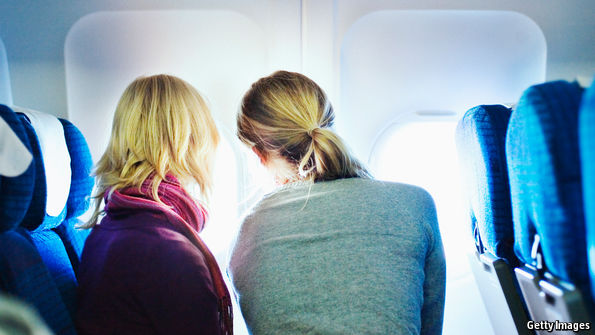
GULLIVER was just reading about Ryanair’s decision to shorten the window of time in which customers can check in before a flight, from a week to four days. The idea is to give those who are prepared to pay to reserve a particular seat more chance of success. (Pony up, and four days’ check-in time becomes a week again.)
That got him to thinking why anyone would pay to reserve a specific seat on Ryanair, given that the best ones—exit seats and the like—are sold separately. It must be people who are desperate to ensure they sit either in the aisle or by the window. This realisation then demanded its own debate on which is preferable.
It goes without saying that no one wants to be stuck in the middle seat. When travelling alone it means you have two strangers’ elbows and knees to combat. Flying en famille is just as bad. Gulliver’s young daughter insists on the window, so sitting in the middle row means hours of reading her books rather than his own. Worse, it means virtually no chance of plugging himself into some Alice Coltrane, closing his eyes and drifting…Continue reading
The pound is one of the world’s worst-performing currencies in the past year
RARELY do people compare the British pound to the Nigerian naira, Azerbaijani manat or Malawian kwacha. But these are special times. Following the Brexit vote, investors dumped sterling. Some are worried about the possibility of a «hard» Brexit. Others are simply baffled by the government’s xenophobic and divisive rhetoric.

One question which people have not really explored is, what assets precisely are investors selling? After all, British stockmarkets are on the up (in pound terms, at least). And Britain’s government-bond prices are still very high (though in recent days they have fallen a little). Both of those phenomena suggest that money is flowing into British assets, not out of them.
We cannot be sure, but one likely explanation is that foreigners are selling cash holdings (instead of assets). The rise in the stockmarket, meanwhile, may be mainly due to the actions of domestic investors. The FTSE pays lots of dollar-denominated dividends so is increasingly attractive to British investors as the pound falls.
Anyway, so the pound is falling. How bad is the drop? To the right is a chart of a year-to-date change against the…Continue reading
What Walmart's pay-rise experiment says about the future of low-wage work

IT HAS been a long time since the economy really worked well for most American workers. Those without a college degree have found themselves losing relative economic ground since the early 1980s, and nearly all workers have had a rough time of things—facing stagnant pay, for example—since the beginning of this century. It would be really great if workers, and those with less education especially, could find ways to earn more. In an intriguing piece published over the weekend, Neil Irwin, of the New York Times, suggests that Walmart, the massive discount retailer, may have found an answer: pay workers more and you get better workers. It sounds fantastic, a win-win for everyone, and why has it taken firms so long to discover this possibility? Yet the solution might not be as simple as all that.
Mr Irwin notes that Walmart has long been one of the most aggressive and influential cost-cutters in the American economy: credited, in some studies, with single-handedly depressing pay…Continue reading
More airlines are banning Samsung’s smartphone

RESTRICTIONS on smartphones aboard aeroplanes have long been a bugbear of business travellers. Rules proscribing their use are slowly falling away; they might not after all, it has been decided, interfere with an aircraft’s systems. (This was discovered, coincidentally, around the same time that carriers found that they could charge for onboard Wi-Fi.) But now airlines are banning them them once again. Or at least one particular type: the Samsung Galaxy Note 7
These phones, it seems, might pose a real danger to an airliner in flight. It was the Note 7’s propensity to catch fire that persuaded American authorities to ban them on American flights last week. (Back in September, some carriers had already told passengers not to re-charge them while aboard.) However, in the past few days, many other airlines around the world have followed suit. Over the weekend Japan’s transport ministry said it was prohibiting passengers from flying with the phones. Those caught trying to smuggle the devices onto carriers such as ANA would have them confiscated, it said. Emirates and Etihad are also taking a hard line, the latter insisting that «Guests must not carry Samsung Galaxy Note 7…Continue reading
Why did the Obama administration change its mind on the American Airlines-US Airways merger?
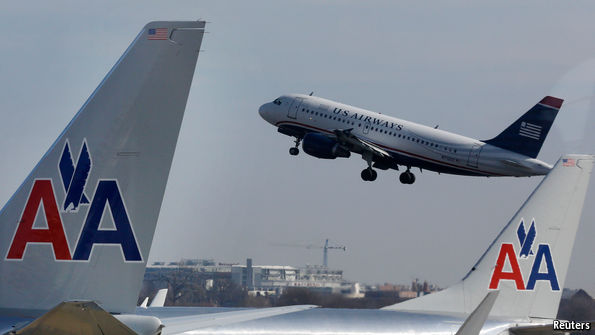
FLYERS in the United States are often frustrated by the dearth of options on certain routes, and the high price of tickets that are the result of limited competition. After several high-profile mergers in recent years, more than 80% of the domestic air market is controlled by four companies. That has led some travellers to ask how the government could possibly have allowed this to happen.
The answer is the same one that explains so many beguiling aspects of American governance: the combination of money, lobbying, influence, and the political revolving door that often makes it so easy for powerful companies to get their way.
A new investigation by ProPublica delves deeply into the complex web of meetings, donations, and hirings that surrounded the tie-up between American Airlines and US Airways. Three years ago, the administration of Barack Obama filed a lawsuit against the merger, alleging that it would raise prices and fees, cut service, and worsen amenities. Three months later, it reversed course, settling with the airlines and allowing the merger to move…Continue reading
Will the Fed greet the next president with a recession?

IT WAS just a few months into the presidency of Barack Obama that America crept out of the Great Recession and into the current expansion. With just three months to go in his second term, Mr Obama seems likely to pass that expansion on to his successor. But what are they odds that she will make it through a four-year term without a brush with economic contraction? The Wall Street Journal polled 59 economists to get their view. They reckon there is a 60% chance of recession striking within the next four years. Is that a reasonable estimate? Let’s consider a few facts about expansions and recessions.
1) This expansion is getting up there in years, by American standards… The recovery began in June of 2009, which means that we are currently in its 88 month. According to NBER, which maintains a list of historical recessions going back to the mid-19th century, the current expansion is the fourth longest on record. The third longest, at 92 months, was the…Continue reading
Overdoing it

LATE of an evening, Japan’s black-suited salarymen let their hair down in the streets of Shimbashi, a district of Tokyo. Shirts untucked, ties off, liquor flowing, they stagger around before heading home, or directly back to the office via a konbini (convenience store) to buy a clean shirt.
This is the harmless outlet for their stress: karoshi, or death by overwork, is the darker, and until recently, more overlooked one. This month the first ever government report into the scale of karoshi found that employees put in over 80 hours of overtime a month at almost a quarter of companies surveyed. At 12% of those firms the figure rose to a whopping 100 hours. These numbers may underestimate the problem; under a fifth of 10,000 companies contacted responded, which is a normal response rate, but firms with still worse overtime figures may have kept out of the study.
Little wonder that 93 people committed or attempted to commit suicide in the year to the end of March 2015 because of overwork. These are the cases where the government has officially recognised that families are owed compensation;…Continue reading
Worth it?

While many MBA programmes are feeling the pinch, life is rosy for the very best business schools. Chicago retains its place at the top of our ranking of full-time MBAs. It is the sixth time in seven years that it has taken first place. Like most of Chicago’s peers, nearly all of its MBA class can expect to find a job immediately after graduation, with a basic salary well in excess of $100,000. Such degrees do not come cheap. The average cost of tuition at the top 15 schools is $112,000. America, the spiritual home of the MBA, dominates our list, accounting for 11 of the top 15 schools. The ranking is based on a mix of hard data and subjective marks given by students. It weights data according to what students tell us is important. The four categories covered are: opening new career opportunities (35% weighting), personal development and educational experience (35%), increasing salary (20%) and the potential to network (10%).
Stumpfed
 Retired hurt
WHEN you consider the hundreds of billions of dollars of losses and fines that the banking industry has made or incurred over the past decade, the affair that has just ended the career of John Stumpf, the boss of Wells Fargo, may at first seem innocuous. In September Wells admitted that its retail-banking sales people had been too pushy, and agreed to pay regulators a $185m fine, a tiny sum by recent standards (Deutsche Bank is presently in negotiations to pay a fine of perhaps $5 billion to American regulators). Mr Stumpf probably thought that he had a couple more happy years to go as the head of the world’s most valuable bank.
But on October 12th, he stepped down after being roasted alive for weeks in an inferno of criticism. Wells’s transgressions have caught the public mood far more than esoteric abuses in the mortgage-backed-security market ever did. The bank admitted that its staff created up to 2m bogus accounts, without customers’ permission, in order to meet aggressive sales targets. To many Americans fed up with banks’ red tape and lousy service that seemed reckless, unforgivable and possibly…Continue reading
Campus vs beach

THE CONVICTION that the secrets of commerce can be taught in a classroom, whether real or virtual, shows little sign of fading. In America, more master’s degrees are awarded in business than in any other discipline—over 189,000 in the 2013-14 academic year, the latest for which figures are available. Business is the most sought-after master’s qualification in the world. The majority are masters of business administration (MBA), covering a broad range of business skills, a qualification that is close to a mandatory requirement for a budding tycoon. At any one time, around two-fifths of chief executives at Fortune 500 companies are likely to hold an MBA.
Yet a fresh case study on the MBA may be in the making. Interest in the full-time variety has waned markedly in recent years. Applications to most programmes are either falling or static, according to the Graduate Management Admission Council (GMAC), an association of business schools. Data from The Economist’s own latest ranking of full-time MBA programmes tell the same story. Five years ago, a business…Continue reading