
Tag: Business and finance
The infrastructure dilemma; castles in the air or bridges to nowhere?
IF THERE is a consensus right now in American politics, it must be that infrastructure spending is a good thing. It employs workers, improves economic efficiency and, at the moment, can be financed at rock-bottom bond yields. So why don’t governments get on with it?
The problem is multi-faceted. Although people tend to be enthusiastic about infrastructure in general, they are more critical of specific projects. If they are in the country, then they ruin the currency; if they are in the town, then they ruin neighbourhoods or impinge on private-property rights. When it comes to public infrastructure projects, the benefits are long term but the costs are short term. The politician that authorises the project is rarely the same one that opens it. So an elected leader gets all the flak from those who oppose this white elephant/blot on the landscape but none of the praise for the reduced traffic jams or cheaper power that ensue. Occasionally a leader might be tempted into authorising a big scheme (like Britain’s high-speed rail) but, as the
Are big infrastructure projects castles in the air or bridges to nowhere?
IF THERE is a consensus right now in American politics, it must be that infrastructure spending is a good thing. It employs workers, improves economic efficiency and, at the moment, can be financed at rock-bottom bond yields. So why don’t governments get on with it?
The problem is multi-faceted. Although people tend to be enthusiastic about infrastructure in general, they are more critical of specific projects. If they are in the country, then they ruin the currency; if they are in the town, then they ruin neighbourhoods or impinge on private-property rights. When it comes to public infrastructure projects, the benefits are long term but the costs are short term. The politician that authorises the project is rarely the same one that opens it. So an elected leader gets all the flak from those who oppose this white elephant/blot on the landscape but none of the praise for the reduced traffic jams or cheaper power that ensue. Occasionally a leader might be tempted into authorising a big scheme (like Britain’s high-speed rail) but, as the
American regulators accuse Fiat Chrysler of emissions cheating

FOR each of the past three years, Fiat Chrysler Automobile’s (FCA) 3 litre V6 turbodiesel has made it to a list of the industry’s top ten engines compiled by Ward’s, a distinguished American car-industry trade publication. Its place on the shortlist for 2017 must now be in doubt. On January 12th America’s Environmental Protection Agency (EPA) accused FCA (whose chairman, John Elkann, sits on the board of The Economist’s parent company) of using illegal software in conjunction with the engines. This, it says, allowed 104,000 vehicles—mostly Dodge pickups and some Jeeps, fitted with the 3 litre V6 turbodiesel—to exceed legal limits of toxic emissions.
The news sent the firm’s shares plummeting by 17%, before recovering somewhat. Nervous investors feared a repeat of the huge penalty imposed on Germany’s Volkswagen (VW) for cheating American emissions laws. A day earlier VW had agreed to pay a criminal fine of $4.3bn for selling around 500,000 cars fitted with so-called “defeat devices” that are designed to reduce emissions of nitrogen oxide (NOx) under test conditions. With the latest sum included, its final bill…Continue reading
Thousands of flyers have been caught trying to smuggle loaded guns onto American planes

ON JANUARY 6th, a gunman ran amok at Fort Lauderdale-Hollywood International Airport, killing five people. Earlier this week, Esteban Ruiz Santiago, a 26-year-old Iraq war veteran, appeared in court charged in relation to the horrific crime. If convicted, the judge told him, he could face the death penalty.
Mr Santiago allegedly pulled a gun out of his luggage in the baggage reclaim area. Although he appears to have a history of questionable mental behaviour, including entering an FBI building with a magazine of ammunition, he had probably checked his weapon into the hold of his flight legally. According to Transport Security Administration (TSA) rules, “You may transport unloaded firearms in a locked hard-sided container as checked baggage only. Declare the firearm and/or ammunition to the airline when checking your bag at the ticket counter. The container must completely secure the firearm from being accessed.”
Yet despite such an easy-going attitude to allowing passengers legitimately to fly with guns, an increasing number try to do so illegally, by sneaking firearms…Continue reading
Tokyo’s showy tuna auctions do not augur economic growth

KIYOSHI KIMURA does not like to lose. For the past six years he has outbid all comers for the first bluefin tuna of the year sold by Tokyo’s famed Tsukiji fish market. Last week Mr Kimura, who owns a chain of sushi shops, paid ¥74.2m ($642,000) to win the first fish. That nets out to some $3,000 per kilogram.
Folk wisdom has it that high tuna-auction prices signal future economic buoyancy. Mr Kimura has said that he pays the exorbitant prices to “encourage Japan”. But that rationale seems fishy.
After a rival Hong Kong bidder baited him, Mr Kimura paid three times as much for the Tsukiji tuna in 2013 as in the previous year—a record-high ¥155.4m. GDP growth did not replicate that rise, however, sinking from 1.7% to 1.4%. In fact, Japan’s economic fortunes and Tokyo’s season-opening tuna prices seem to float rather erratically (see chart). A deep dive by The Economist suggests that tuna prices explain only 6% of the fluctuation in GDP. The correlation is a red herring.
Environmentalists, meanwhile, are gutted. Bluefin tuna are endangered; stocks have plunged by 97% from their peak, according to one estimate. The…Continue reading
Our Big Mac index of global currencies reflects the dollar’s strength
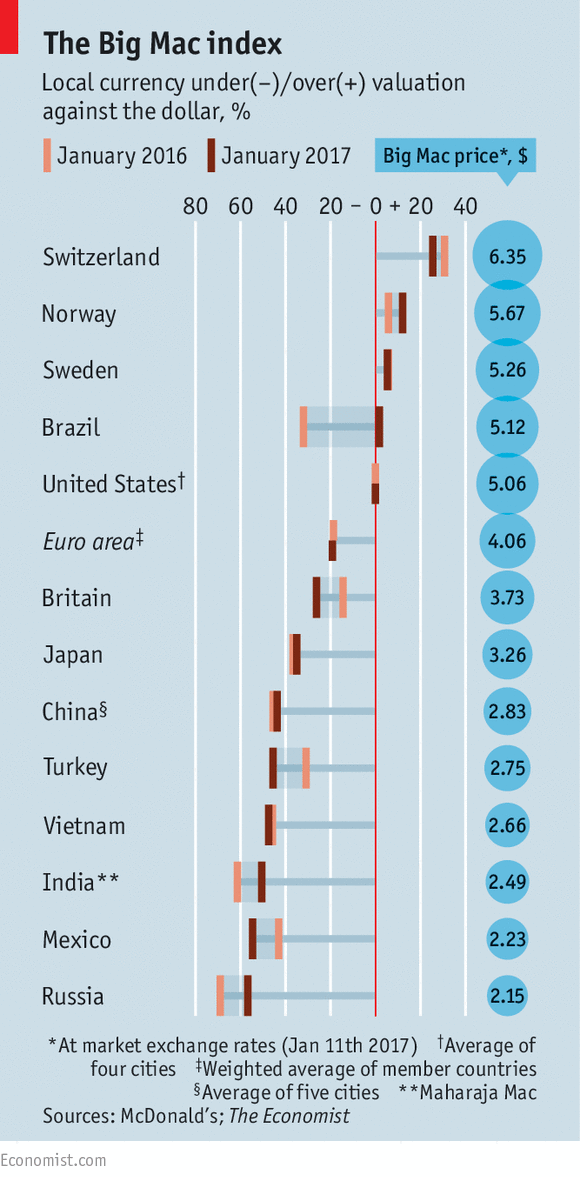
IT IS perhaps not surprising that the worst-performing major currency in the world this year is the Turkish lira. Many emerging-market currencies have taken a battering since the election in November of Donald Trump raised expectations of faster monetary tightening in America and sent the dollar soaring. But the lira has many other troubles to contend with, too: terrorist bombings, an economic slowdown, alarm over plans by the president, Recep Tayyip Erdogan, to strengthen his powers, and a central bank reluctant to raise interest rates to defend the currency. It has plunged to record lows. According to the Big Mac index, our patty-powered currency guide, it is now undervalued by 45.7% against the dollar.
The Big Mac index is built on the idea of purchasing-power parity, the theory that in the long run currencies will converge until the same amount of money buys the same amount of goods and services in every country. A Big Mac currently costs $5.06 in America but just 10.75 lira ($2.75) in Turkey, implying that the lira is undervalued.
However, other currencies are even cheaper. In Big Mac terms, the Mexican peso is…Continue reading
A controversial transaction sits at the heart of Liberty Media’s takeover of Formula One

ON JANUARY 17th shareholders of Liberty Media Corporation, an American firm controlled by John Malone, a billionaire, are expected to approve a transaction that many hail as the sports deal of the decade. In September 2016 Liberty agreed to buy the Formula One (F1) motor-racing franchise from CVC, a private-equity group, for $8bn. F1, which generates annual revenue of $1.8bn, is now central to Liberty’s global plans: in a sign of the importance he attaches to the deal, Mr Malone has installed Chase Carey, a former president of Rupert Murdoch’s 21st Century Fox, as F1 chairman. The main Liberty subsidiary is to be renamed Formula One Group.
The deal has lots of attractions. For F1 it offers a potential solution to the problem of who will take over from Bernie Ecclestone, its 86-year-old impresario. There was no credible succession plan for the man whose wheeling and dealing has long held together the sport and its fractious collection of racing teams. With Mr Carey leading the search, there could be.
As for Liberty, F1 offers the sort of live, exclusive content it needs to lock in audiences that are peeling off to on-demand streaming…Continue reading
China’s reputation for low-cost manufacturing under attack

WHEN China was gripped by political turmoil in the 1960s and 1970s, Cao Dewang cut his teeth as an entrepreneur. Mao’s chaotic rule forced him out of school and he took to the street, a scrappy teenager selling fruit and cigarettes. Looking back, Mr Cao has said that it was actually a good time to do business: the government was too busy waging ideological campaigns to enforce its regulations. Mr Cao went on to become a billionaire, as China’s biggest manufacturer of automotive glass. Last month he sparked controversy by complaining that life was tough for businesses in China. There are, he said, far too many regulations—especially taxes and fees. These days the government is much more effective in enforcing them.
Mr Cao hit a nerve with his claim that it was more costly to run a business in China than in America. He should know. His company, Fuyao Glass, bought an old General Motors factory in Ohio in 2014 and announced plans to invest $200m there. Mr Cao claimed that the overall tax on manufacturers is 35% higher in China than in America. Once China’s higher land and energy costs are factored in, the advantages of its lower labour costs…Continue reading
A rush to patent the blockchain is a sign of the technology’s promise
FOR fans of bitcoin, a digital currency, the year got off to a volatile start. On January 5th one bitcoin changed hands for nearly $1,150—almost as much as the record set three years ago. It has since dropped by 33%. Elsewhere in the land of monetary bits, things move more slowly but trouble is brewing: a potential patent war looms over the blockchain, a distributed ledger that authenticates and records every bitcoin transaction.
Heated fights over intellectual property are nothing new in promising technology markets. But given that the blockchain is expected to shake up everything from the way precious diamonds are safeguarded to the way shares are traded, the legal fights could be especially fierce.
On the face of it, the blockchain does not lend itself easily to staking out intellectual-property claims. Bitcoin’s creator, known only by his pseudonym, Satoshi Nakamoto, published a paper about his invention, coded the first implementation and then disappeared—meaning that the core of the technology is now part of the public domain and only important additions and variations could be patented. And the blockchain’s components are widely known. In America court decisions as well as a new law on the granting of patents make it difficult to claim ownership for such financial innovations.
This hasn’t stopped firms from trying to get patent…Continue reading
Singapore tries to become a fintech hub

IN AN era when architectural masterpieces curve and bloom (Zaha Hadid), or shimmy and fold (Frank Gehry), designers of central-bank buildings remain reassuringly fond of right angles. The Monetary Authority of Singapore (MAS), the city-state’s central bank and financial regulator, is housed in a boxy tower just south of the central business district. But tucked into one corner is a room called “LookingGlass@MAS” that desperately wants to be Silicon Valley: witness the scruffily dressed young men, whiteboards on wheels covered in buzzwords and the kitchen along one wall.
This is the MAS’s fintech lab, where Singapore is trying to put its own twist on the technologies disrupting the financial sector. A report from Citigroup published in 2016 warned that as fintech lets customers do more online and cuts into banks’ lending and payments activities, European and American banks could lose almost 2m jobs in the next ten years. Similar fears stalk Singapore, home to more than 200 banks, and dependent on finance for 12.6% of GDP.
In London, Berlin and San Francisco, many fintech innovators are betting against the big banks. Singapore,…Continue reading