
Tag: Business and finance
Adidas’s high-tech factory brings production back to Germany
 Impossible is nothing
BEHIND closed doors in the Bavarian town of Ansbach a new factory is taking shape. That it will use robots and novel production techniques such as additive manufacturing (known as 3D printing) is not surprising for Germany, which has maintained its manufacturing base through innovative engineering. What is unique about this factory is that it will not be making cars, aircraft or electronics but trainers and other sports shoes—an $80bn-a-year industry that has been offshored largely to China, Indonesia and Vietnam. By bringing production home, this factory is out to reinvent an industry.
The Speedfactory, as the Ansbach plant is called, belongs to Adidas, a giant German sports-goods firm, and is being built with Oechsler Motion, a local firm that makes manufacturing equipment. Production is due to begin in mid-2017, slowly at first and then ramping up to 500,000 pairs of trainers a year. Adidas is constructing a second Speedfactory near Atlanta for the American market. If all goes well, they will spring up elsewhere, too.
The numbers are tiny for a company that makes some 300m pairs of sports shoes each year. Yet…Continue reading
The curious case of missing global productivity growth

WORK smarter, not harder. It is one of the more irritating things that a boss can tell you. But at the macroeconomic level, it is important. Growth can come from having more labour (recruiting more workers, or making existing employees work for longer hours), more capital, or from using that labour and capital more effectively—something known as total factor productivity (TFP). This can come from the kind of brilliant innovations devised by Thomas Edison (pictured) or the less-heralded but equally important improvements such as the adoption of the moving conveyor belt to speed up assembly work. Since there are limits to the amount of additional capital and labour, productivity is key to long-run growth.
Measuring productivity is far from easy; it tends to be the residual left over when all other factors have been accounted for. The OECD says it «can often be a measure of our ignorance». Still, the attached table is very striking. It comes from the American Chamber of Commerce (here’s the link, with thanks to…Continue reading
China’s currency upsets forecasts by beginning the new year stronger

THE omens for the Chinese yuan seemed bad heading into 2017. The capital account looked as porous as ever, making a mockery of the government’s attempts to fix the leaks. The new year, when residents received fresh allowances for buying foreign currency, was due to bring even more pressure. The mighty dollar would be a magnet for Chinese investors as it strengthened still further in the run-up to Donald Trump’s inauguration. Analysts braced for a stampede for the exits from China. The yuan had fallen sharply at the beginning of 2016, catching them by surprise. This time, they were ready.
Instead, the yuan began the year as one of the world’s star performers. This was particularly so in the offshore market, where foreigners trade it most freely. It gained 2.5% against the dollar over two days in the first week of 2017, its biggest two-day increase since 2010, when trading began in Hong Kong, its main offshore hub. Within China itself, price increases were more subdued, but the yuan still climbed to a one-month high.
British Airways crew walk out over “poverty” pay
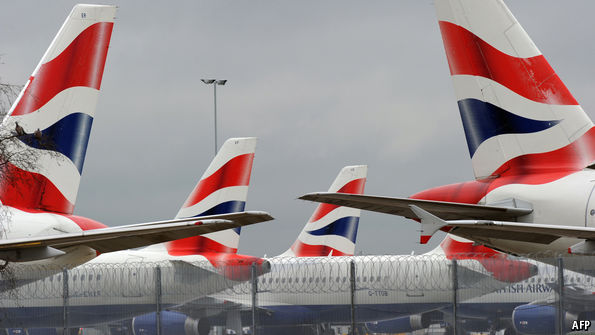
BARRING a last-minute breakthrough, about 2,500 cabin crew members employed by British Airways (BA) will strike this week over alleged “poverty pay” at the airline. Workers originally planned walkouts for the Christmas period, but suspended the action to consider a revised pay offer. Having rejected that offer by a 7-1 margin, the strikes will now occur on 10th and 11th January. BA says the impact will be minimal, with 85% of cabin crew reporting for duty and just 12 return flights being cancelled each day. Passengers due to travel on those affected flights, which all leave from London Heathrow Airport, will be rebooked onto alternative services. Still, the slightest whiff of disruption will prompt howls of discontent in a week in which strikes on both London Underground and some national rail services into the capital are adding to the misery.
This is not the first time BA cabin crew have called industrial action. In 2010, a series of strikes caused 22 days of travel chaos. Then, cabin crew were angry about staffing cutbacks and the introduction of new contracts, dubbed “mixed-fleet” contracts, which offered inferior terms for new…Continue reading
MasterCard could estimate passengers’ weight for airlines based on what they buy

FIRMS must tread lightly around the subject of their customers’ weight. It is a sensitive subject for many. Still, a lot of organisations would like to be able to size up those who use their services.
MasterCard, a credit-card company, has filed a patent application for what it describes as “a system, method, and computer-readable storage medium configured to analyse the physical size of payment accountholders based on payment transactions, and allowing a transportation provider to apply the physical size of payment accountholders to seating”. In plain English, the firm plans to estimate its customers’ size and weight based on their clothing and shoe purchases. It could then transmit this information to airlines (and other transportation providers, such as rail and bus companies) which might use it to assign seats.
Exactly how airlines would deploy this information is not known. In its application, MasterCard takes a charitable interpretation, writing that “for the comfort of their passengers, transportation providers should avoid seating physically large strangers next to each…Continue reading
Wage growth surges, just in time for the Trump presidency

THE news that average wages grew by 2.9% in December, the final full month of the Obama presidency, provides more evidence that America’s labour market is heating up. For some time, America has been creating plentiful jobs—2016 was the fifth consecutive year with more than 2m job gains. But wage growth has been weak enough to cast doubt on the labour market’s strength. A commonly cited reason for paltry pay rises was the number of 25- to 54-year-olds—dubbed “prime age” workers—who had stopped looking for work after the recession, and hence were no longer counted as unemployed. Wages, the argument went, would not pick up until they were encouraged back to work.

With the average pay-cheque now growing faster than at any time since 2009—when layoffs of low-paid workers were artificially boosting average wagesContinue reading
Plastic planes will allow airlines to increase cabin pressure

A FELLOW Gulliver, cheery chap that he is, kicked off the new year explaining why 2017 might be even worse for business travellers than the year we have just put behind us. The reasons are largely geopolitical: the fallout from Brexit, the uncertainty surrounding soon-to-be-President Donald Trump, the likely rise in oil prices, the Chinese economic slowdown and the threat of terror. But there’s one trend that could have a pleasant effect on travel, making flying more comfortable despite efforts by airlines to pack passengers in tighter and charge for the most basic amenities. No doubt you’ve beaten me to it: carbon-reinforced plastic composites.
Much of the discomfort of flying—whether reclining in a private first-class suite or jammed into coach—comes from two factors: air pressure and humidity. At 35,000 feet, the air pressure outside an aeroplane is extremely low, so the cabin is pressurised to bring it to a level closer to what we experience on the ground. The trouble is that lowering it all the way to sea-level pressure would put tremendous strain on the body of the plane, which would…Continue reading
The Greenspan legacy

MORE than ten years have elapsed since Alan Greenspan stepped down from the Federal Reserve; a decade that has not been kind to his reputation. Having just read Sebastian Mallaby’s comprehensive biography*, «The Man Who Knew», it struck me that his career was a classic example of cognitive dissonance.
The main post-crisis criticism of Mr Greenspan was that he was a naive believer in market efficiency, failing to pop bubbles in the late 1990s or mid-2000s and failing to regulate the financial sector properly. He was, for a while, a disciple of the libertarian novelist, Ayn Rand. But Mr Mallaby shows that things were rather more complex than that characterisation suggests.
In a paper written back in 1959, for example, Mr Greenspan clearly seemed to understand the detrimental effect that bubbles could have. He wrote that
The higher the stock market gets at its peak and hence the greater decline required to return to «normal», the deeper the decline in economic activity
In 2002, after the Enron scandal, Greenspan also spoke in favour of greater regulation of corporate accounting standards. smacking the table, he told a meeting…Continue reading
The high economic costs of India’s demonetisation

MOST economists might hazard a guess that voiding the bulk of a country’s currency overnight would dent its immediate growth prospects. On November 8th India took this abstruse thought experiment into the real world, scrapping two banknotes which made up 86% of all rupees in circulation. Predictably, the economy appears indeed to have been hobbled by the sudden “demonetisation”. Evidence of the measure’s costs is mounting, while the benefits look ever more uncertain.
At least the new year has brought a semblance of monetary normality. For seven weeks queues had snaked around banks, the main way for Indians to exchange their old notes for new ones or deposit them in their accounts. That is over, largely because the window to exchange money closed on December 30th. The number of fresh notes that can be withdrawn from ATMs or bank counters is still curtailed, but the acute cash shortage is abating, at least in big cities.
As data trickle through, so is evidence of the economic price paid for demonetisation. Consumers, companies and investors all wobbled in late 2016. Fast-moving consumer goods, usually a reliable growth sector, retrenched…Continue reading