
Tag: Business and finance
Why low returns are inevitable

WHEN the stockmarket is close to a record high, the chances are that recent returns will have been very strong. The terrible tendency among investors is to assume that those returns will continue. But the higher you go, the harder it is to keep rising at the same pace.
When I visited America for a story on pensions last autumn, I was struck by how few people failed to grasp this point. Public pensions have return targets of 7-8% for their portfolios. When challenged they tend to cite their 30-year record of achieving those numbers. But that record makes it less likely, not more that they will hit their targets.
The easiest way to think of this is via the bond market. In 1987, the yield on the ten-year Treasury bond was just under 9%. Since then it has fallen to its current level of just under 3%. So not only did bond investors get a high yield in their early years,…Continue reading
Latvia’s top banking official has been accused of taking a bribe

ILMARS RIMSEVICS, governor of Latvia’s central bank for the past 17 years, had been due to retire next year. Instead, he is facing calls to resign. On February 17th he was detained by Latvia’s anti-corruption authority on suspicion of taking a bribe of at least €100,000 ($123,000). The prime minister, Maris Kucinskis, says the allegations are so serious that Mr Rimsevics cannot possibly return to work. Mr Rimsevics, for his part, is staying put. Released on bail on February 19th, he denies the allegations, saying he was set up and is facing death threats.
Just a few days earlier, in an unrelated case, the US Treasury had proposed sanctions on ABLV, one of Latvia’s largest banks. It claimed ABLV had “institutionalised money laundering” and facilitated transactions with North Korea, which is under sanctions. In the days that followed €600m was withdrawn by the bank’s customers. On February 19th, seeking to stabilise the institution, the ECB froze payments by ABLV….Continue reading
Latvia’s top banking official is accused of demanding bribes
ILMARS RIMSEVICS, for 17 years the governor of Latvia’s central bank, had been due to retire next year. Instead, he is facing calls to resign. On February 17th Latvia’s anti-corruption authority detained him on suspicion of demanding bribes of at least €100,000 ($123,000). That sparked international concern. Mr Rimsevics is a member of the governing council of the European Central Bank (ECB) and privy to the most sensitive monetary-policy decisions.
The prime minister, Maris Kucinskis, says the allegations are so serious that Mr Rimsevics must stand down. But he is staying put. Released on bail on February 19th, the central bank chief says the allegations are a set-up to punish him for cracking down on lax practices. He also says he has received death threats.
Latvia’s outsized and ill-regulated offshore banking industry has been a headache since the country regained independence in 1991. During the global financial crisis ten years ago, Parex Bank, the largest…Continue reading
Indian teaching startups make work for idle thumbs

TO ANY outsider it looks as if the children have been hypnotised by yet another smartphone game. As the spying elders in a TV ad try to break the spell, the sprogs flash a grin at their screens. “It’s maths, dad,” giggles a fifth-grader to her father. The company behind the ad, Byju’s, sells an educational smartphone app which has been downloaded 14m times since its launch in 2015.
Byju’s is one of many education technology (or “edtech”) startups that have emerged in India in the past few years. Their target is vast—some 260m pupils in schools and over 30m graduates who train in order to pass entrance tests for a seat in medical, engineering and elite management institutes. KPMG, a consultancy, reckons the industry will grow eightfold to be worth around $2bn by 2021.
Much of the expected growth is due to India’s woeful record in primary-school education, where teachers are scarce, infrastructure crumbling and the culture one of rote learning. Almost half of…Continue reading
Japanese businesses are struggling to keep up standards

KUMIKO HIRANO has noticed a disquieting change when she goes to her neighbourhood konbini, one of Japan’s ubiquitous convenience stores. “No one is around and I have to use a loud voice to get someone to serve me,” says the 48-year-old worker in Tokyo. “It irritates me.”
This might not seem a big problem, but Japan prides itself on the standard of customer service, which approaches the level of bespoke attention elsewhere. Taxi drivers, who often wear white gloves, sometimes get out to bow when they drop off a passenger. Staff in shops and restaurants are unfailingly polite. Shoppers can order on Amazon and take delivery reliably the same day. Now Japanese are having slowly to adapt to levels of service long suffered by the rest of the world.
The human touch is becoming rarer. Lawson, another konbini chain, is automating payment during the small hours at selected stores. Some restaurants and supermarkets are following suit….Continue reading
The world’s largest-ever tech deal now depends on Qualcomm
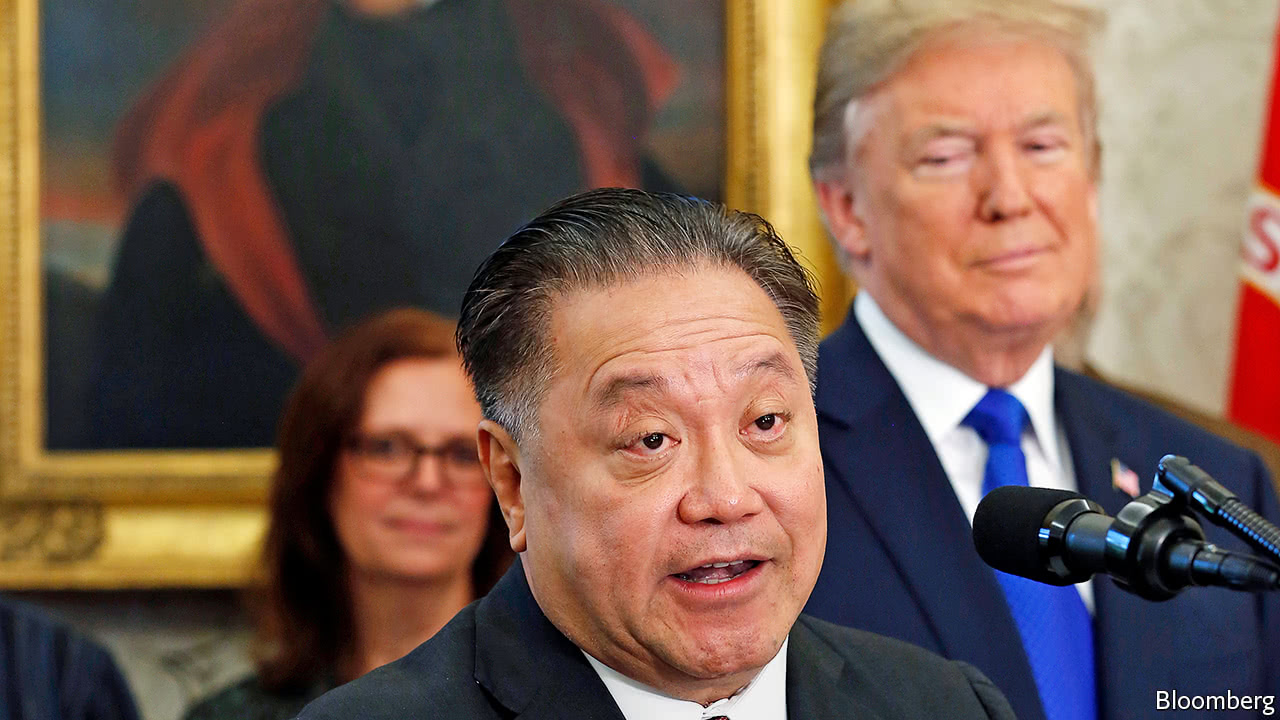
VALENTINE’S DAY might seem like a good time to discuss a proposal. But whether it brought luck to Broadcom’s attempt to woo its rival chipmaker, Qualcomm, is still unclear. As The Economist went to press, a meeting between the boards of both firms to discuss Broadcom’s bid of $146bn (including debt) proved inconclusive. Having rejected an initial approach in November, Qualcomm’s board will soon meet to discuss next steps.
Should the board reject Broadcom’s offer, the fate of the largest-ever tech acquisition would then lie with Qualcomm’s shareholders. The deal could still proceed if they elect a majority of Broadcom’s nominees to the board at Qualcomm’s annual investor meeting on March 6th. But it would have a complicated course to run.
Neither firm may be a household name like Intel or Samsung, but a merger would create the world’s third-largest chipmaker. Scale is critical in an…Continue reading
Will Comcast try to outbid Disney for Fox?

WHEN Disney struck a deal just before Christmas to buy much of 21st Century Fox for $66bn, it was a career-defining moment for the two firms’ bosses, Bob Iger and Rupert Murdoch. A third media mogul, Brian Roberts of Comcast, was left out in the cold. Having tried and failed last autumn to get Mr Murdoch to take a higher offer, Mr Roberts may now be preparing a still richer bid to upend the deal.
It is not hard to understand his motivation. Comcast is in an awkward position at a time when the media landscape is shifting. With millions of consumers dropping pay-TV for the likes of Netflix, media companies have suddenly become either buyers, to achieve scale, or sellers, to exit. Mr Roberts has always been a buyer, building the cable business his father started into a diversified empire through acquisitions, including AT&T’s broadband business in 2002 and NBC Universal in 2011. Comcast now has heft in a number of businesses—broadband and cable, television networks, a film studio…Continue reading
Ten years on from Norway's quota for women on corporate boards

THE centrepiece of the opening-bell ritual at the London Stock Exchange on February 2nd was a roll call to honour 27 global investors. They were lauded for pledging allegiance to the “30% Club”, a group which campaigns for precisely that proportion of women on corporate boards globally. Membership is a hot ticket, judging by the club’s expansion. Behemoths including BlackRock, J.P. Morgan Asset Management and Standard Life have joined, and are voting against boards that fail to appoint more women.
In much of western Europe, such efforts follow a decade-long push by governments. In 2008 Norway obliged listed companies to reserve at least 40% of their director seats for women on pain of dissolution. In the following five years more than a dozen countries set similar quotas at 30% to 40%. In Belgium, France and Italy, too, firms that fail to comply can be fined, dissolved or banned from paying existing directors. Germany, Spain and the Netherlands prefer soft-law quotas, with no sanctions….Continue reading
Opportunities are opening for electrified commercial vehicles

ELECTRIC commercial vehicles were once a common sight in Britain’s towns and cities. A fleet of 25,000 battery-powered milk floats roved the early-morning streets delivering a crucial part of the nation’s breakfast. Short ranges and low top speed were unimportant for a milk round but near-silent running meant customers could sleep. Their demise came as supermarkets expanded, but electrification of business vehicles is gathering pace anew.
Just as better battery technology is bringing down the cost and boosting the range of passenger electric vehicles (EVs), those advances are making electrification of commercial vehicles more appealing. The purchase price is still far higher than a comparable vehicle with an internal combustion engine (ICE). But businesses are more focused than ordinary motorists on the total costs of ownership, and on other reasons to shift to electric power.
Much attention has been paid to…Continue reading
Recent tax reforms in America will hurt charities

DESPITE its oft-professed pro-market orthodoxy, America has always had an unusually large non-profit sector. Americans gave $390bn to charity in 2016, with the bulk of contributions coming from individual donors. Historically, revenues at non-profits tend to track GDP growth. The recent tax reforms imply that despite strong economic growth, charitable contributions in America are poised to fall for the first time since the financial crisis.
The most significant threat to charities comes from changes to income tax. American taxpayers can choose either to “itemise” specific expenses, such as charitable gifts or mortgage payments, or take a “standard deduction”. In an effort both to simplify the tax code and to lower overall tax rates, the Republican-led Congress almost doubled the standard deduction to $12,000 for individuals and $24,000 for married couples. This will make filing taxes a lot easier for many. But it also means that far fewer Americans will have a financial incentive…Continue reading